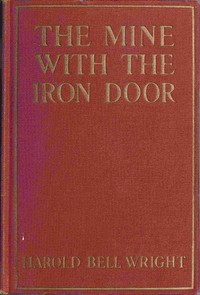
And yet--those who look for it still find “color” in the Cañada del Oro. Romance and adventure still live in the Cañon of Gold. The treasures of life are not all hidden in a lost mine behind an iron door.
From every street and corner in Tucson we see the mountains. From our places of business, from our railway depots and hotels, from our University campus and halls, and from the windows and porches of our homes we look up to the mighty hills.
But of all the peaks and ranges that keep their sentinel posts around this old pueblo there are none so bold in the outlines of their granite heights and rugged cañons, so exquisitely beautiful in their soft colors of red and blue and purple, or so luring in the call of their remote and hidden fastnesses, as the Santa Catalinas.
Every morning they are there--looking down upon our little city in the desert with a brooding, Godlike tolerance--remote yet very near. All day long they watch with world-old patience our fretful activities, our puny strivings and our foolish pretenses. And when evening is come and the dusk of our desert basin deepens, their castle crags and turret peaks signal, with the red fire of the sunset, “good-night” to us who dwell in the gloom below. Even in the darkness we see their shadowy might against the sky, and feel the still and solemn mystery of their enduring strength under the desert stars.
This is a story of some people who lived in the Catalinas.
If you would find more exactly the scenes of this romance you must take the new Bankhead Highway that, in its course from Tucson to Florence and Phœnix, runs for miles in the shadow of these mountains. From the old Mexican quarter of the city--picturesque still with the colorful life of the West that is vanishing--you go straight north on Main Street, where the dust of your passing is the dust of the crumbled adobe buildings and fortifications of the ancient pueblo that had its beginning somewhere in the forgotten centuries. Leaving the outskirts of the town your way leads over rolling lands of greasewood and cacti, down the long grade past the cemetery, past the Government hospital in the valley, to the bridge that spans the Rillito. From the little river you climb quickly up to the desert slopes that form the western base of the main range and that lie under their wide skies unmarked by human hands since the beginning of deserts and mountains. Beyond the famous Steam Pump Ranch, some sixteen miles from Tucson, the road to Oracle branches off from the Bankhead Highway and climbs higher and higher until from a wide mesa you can see the place of my story--the mighty Cañada del Oro--the Cañon of Gold.
But if you know the way you may turn aside from the main road before you come to this new Oracle branch and take instead the old road that winds closer to the mountains and for several miles follows the bed of the lower cañon. It was along this ancient trail that the eventful and romantic life of this southern Arizona country, through its many ages, moved.
This way, centuries ago, came the Spaniards--lured by tales of a strange people who used silver and gold as we use tin and iron, and who set turquoise in the gates of their houses. This way came the Franciscan Fathers to find in the Cañada del Oro gold for their mission at San Xavier. This way, from the San Pedro and the Aravaipa, came savage Apache to raid the peaceful farming Papagos and later to war against the pale-face settlers in the valley of the Santa Cruz. Prehistoric races, explorers, Indians, priests, pioneers, prospectors, cattlemen, soldiers and adventurers of every sort from every land--all, all have come this way--along this old road through the Cañon of Gold.
And because there was water here, and because there was gold here, this wild and adventurous life, through the passing centuries, made this place a camping ground and a battle field--a place of labor and crime, of victory and defeat; of splendid heroism, noble sacrifice, and dreadful fear. Set amid the grandeur and the beauty of these vast deserts, lonely skies and wild and rugged mountains, the Cañada del Oro has been, most of all, as indeed it is to-day, a place of dreams that never came true; of hopes that were never fulfilled; of labor that was vain.
Of all the stirring tales of this picturesque region of the Santa Catalinas, of all the romantic legends and traditions that have come down to us from its shadowy past, none is more filled with the essence of human life and love and hopes and dreams than is the tale of the Mine with the Iron Door.
But this is not a story of those old Spaniards and padres and Indians and pioneers. It is a story of to-day.
The old, old tale of the Mine with the Iron Door is as true for us as it ever was for those who lived and loved so many years ago. We too, in these days, have our dreams that must remain always, merely dreams and nothing more. We too, in these modern times, are called upon to bury in the secret places of our modern hearts hopes that are dead. In every life there are the ashes of fires that have burned out or, by some cold fate, have been extinguished. For every living one of us, I believe, there is a Cañada del Oro--a Cañon of Gold--there is a lost mine that will never be found--there are iron doors that may never be opened.
And yet--those who look for it still find “color” in the Cañada del Oro. Romance and adventure still live in the Cañon of Gold. The treasures of life are not all hidden in a lost mine behind an iron door.
As the old prospector, Thad Grove, said to his pardner one time when their last pinch of dust was gone and their most promising lead had pinched out: “After all, it’s a dead immortal cinch that if we had a-happened to strike it rich like we was hopin’, we couldn’t never bin as rich as we was hopin’ to be. There jest naterally ain’t that much gold, nohow.”
“Sure,” returned Bob Hill, the other old-timer, “and ain’t you never took notice how much richer a feller with one poor, little, old nugget in his pan is than the hombre what only thinks he’s got a bonanza somewheres on the insides of a mountain? An’ look at this, will you: If everybody was to certain sure find the mine he’s huntin’ there’d be so blame much gold in the world that it’d take a hundred-mule train to pack enough to buy a mess of frijoles. It’s a good thing, I say, that somebody, er something has fixed it somehow so’s all our fool dreams can’t come true.”
“Speakin’ of love,” said Thad on another occasion, when the two were discussing the happiness that had so strangely come to them with their partnership daughter, “love ain’t no big deposit that a feller is allus hopin’ to find but mostly never does. Love is jest a medium high-grade ore that you got to dig for.”
“Yep,” agreed Bob, “an’ when you’ve got your ore you’ve sure got to run it through the mill an’ treat it scientific if you expect to recover much of the values.”
The affairs of the old Pardners and their daughter Marta were matters of great and never-failing interest to the loungers who gathered in front of the general store and post-office in Oracle.
Bill Janson, known as the Lizard, invariably opened and led the discussions. The Janson family, it should be said, had drifted into the Cañada del Oro from Arkansas. They were, in the picturesque vernacular of the cattlemen, “nesters.” The Lizard, an only son, was one of those rat-faced, shifty-eyed, loose-mouthed, male creatures who know everything about everybody and spend the major part of their days telling it.
It was on one of those social occasions when the Lizard was entertaining a group of idlers on the platform in front of the store that I first heard of the two old prospectors and their partnership girl.
“Yes, sir,” said the Lizard, “I’m a-tellin’ ye that them thar Pardners an’ their gal--Marta her name is--are th’ beatenest outfit ye er ary other man ever seed. Ain’t nobody kin figger ’em out, nohow. They’ve been here nigh about five year, too. Me an’ paw an’ maw, we been here eight year ourselves--comin’ this fall. Yes, sir, they’re sure a queer actin’ lot.”
The Lizard had so evidently made his introductory remarks for my benefit that some sort of acknowledgment was unquestionably due.
“What are they, miners?”
“Uh-huh, they’re a-workin’ a claim--makin’ enough t’ live on, I reckon--leastways they’re a-livin’. But that ain’t hit--hit’s that thar gal of theirn.” He shook his head and heaved a troubled sigh. “Law, law!”
And no one could have failed to mark the eager viciousness of the Lizard’s expression as the loose-mouthed creature ruminated on the delectable gossip he was about to offer.
“Ye see hit’s like this: Them two old-timers had this here gal with ’em when they first come into th’ cañon down yonder. She was a kid--’long ’bout fourteen, then. An’ there ain’t nobody kin tell fer sure who she is, ner whar she come from. They say as how old Bob an’ Thad found her when they was a-prospectin’ onct down on th’ border somewhares--tuck her away from some Mexican outfit er other. Mebby hit’s so an’ mebby hit ain’t. But everybody ’lows as how she ain’t come from no good sort nohow, ’cause if she had why wouldn’t the Pardners tell hit? An’ take an’ look at this dad-beatin’ father arrangement--take their names fer instance: one is Bob Hill, t’other is Thad Grove, an’ what’s the gal’s name but Marta Hillgrove--Hill-Grove--d’ye ketch hit? An’ one week old Bob he’ll be her pappy, an’ th’ next week old Thad he’s her paw, an’ the gal she jist naterally ’lows they both her daddies. My Gawd! Hit’s enough t’ drive a decent man plumb loony a-tryin’ t’ figger hit out.”
The Lizard’s friends laughed.
“Oh, ye kin laugh, but I’m a-tellin’ ye thar’s somethin’ wrong somewhars an’ I ain’t th’ only one what says so neither. Won’t nobody over here in Oracle have nothin’ t’ do with her. Will they?” He turned to the loungers for confirmation.
“She’s a plumb beauty, too, an’ a mighty cute little piece--reg’lar spitfire, if ye git her started--an’ smart--say, she bosses them pore old Pardners till they’re scared mighty nigh t’ death of her--an’ proud--huh--she’s too all-fired proud to suit some of us.”
The crowd grinned.
“The Lizard, he sure ought to know,” said one.
“How about it, Lizard?” came from another. “You been a-tryin’ t’ make up t’ her ever since she moved into your neighborhood, ain’t you?”
“Ye all don’t need to mind about me,” retorted the Lizard, with a vicious leer. “My day’ll happen along yet. Ye notice I ain’t drawed what Chuck Billings got.”
“Chuck Billings,” he continued for the benefit of any one who might not be well versed in Cañada del Oro history, “he was one of George Wheeler’s punchers, an’ he tuck up with her one evenin’ when she was a-comin’ home from Saint Jimmy’s, an’ I’ll be dad-burned if her old prospectin’ daddies didn’t work on Chuck ’til George jist naterally had t’ send him int’ th’ hospital at Tucson. Chuck he ain’t never showed up in this neighborhood since neither. I heard as how George told him if he did get well an’ dast t’ come back he’d take a try at him hisself.”