The opening · free to read
In 1903 I explained the origin of The Mediaeval Stage out of preliminary investigations for a little book on Shakespeare. That little book is still unwritten, and perhaps it was only a mirage, since working days have their term, and all that I can now offer, after an interval of twenty years, is another instalment of prolegomena. It has been in hand, more or less, throughout that period, which now ends felicitously with the tercentenary of the First Folio. But it has often been laid aside for other literary diversions, and still more often through the preoccupations of a life mainly concerned with activities remote from letters. As a result, I have constantly had to take account of new material furnished by the research or the speculations of others; and I only hope that in the process of revision I have succeeded in achieving a reasonable completeness of statement and a reasonable consistency in the conclusions of chapters drafted at very different dates.
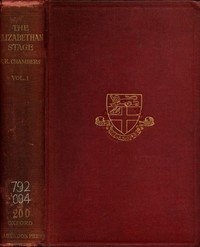
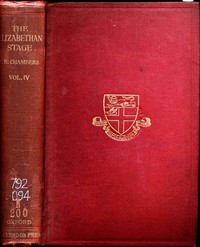
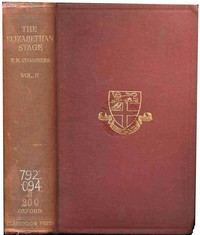
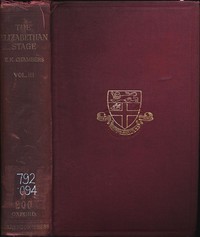
Much in these volumes is of course mere archaeology, but the historian may find some interest in the development of the stage as an institution, and in the social and economic conditions which made such a development possible. My First Book is devoted to a description, perhaps disproportionate, of the Elizabethan Court, and of the ramifications in pageant and progress, tilt and mask, of that instinct for spectacular mimesis, which the Renaissance inherited from the Middle Ages, and of which the drama is itself the most important manifestation. The Second Book gives an account of the settlement of the players in London, of their conflict, backed by the Court, with the tendencies of Puritanism, and of the place which they ultimately found in the monarchical polity. To the Third and Fourth belong the more pedestrian task of following in detail the fortunes of the individual playing companies and the individual theatres, with such fullness as the available records permit. The Fifth deals with the surviving plays, not in their literary aspect, which lies outside my plan, but as documents helping to throw light upon the history of the institution which produced them. I have not for the most part carried my investigations beyond the death of Shakespeare, and although I have sometimes regretted that I did not push on to the closing of the theatres, the decision not to do so has long been irretrievable.
Obviously I am treading a region far more carefully charted by predecessors than that of The Mediaeval Stage; but the progress of Elizabethan scholarship during recent years has been so great as to render a fresh attempt at a synthesis justifiable. I am conscious of a deeper debt than I can express to many fellow-workers, notably to my friends Dr. W. W. Greg and Mr. A. W. Pollard and Professor Feuillerat of Rennes, and to a growing band of American students, of whom I may name Professor C. W. Wallace and Mr. J. T. Murray as examples.
E. K. C.
January, 1923.
The book keeps going
Keep reading, and see it illustrated
Reading is free forever. Sign up and watch scenes appear while you read.
Scenes Storieta drew for other classics.