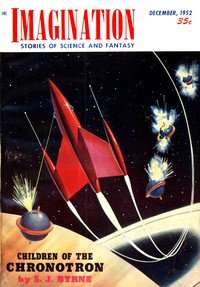
[Transcriber's Note: This etext was produced from Imagination Stories of Science and Fantasy December 1952 Extensive research did not uncover any evidence that the U.S. copyright on this publication was renewed.]
When their sun began to wane, the Xlarnans at first retreated underground to hoard the heat and life-supporting energies which their nuclear generators could supply. But as their world grew colder, century after century, they devised a means of creating a substitute for the ionosphere--a protective layer of radioactive gases in the upper reaches of the sky which could warm them by means of its slow, controlled reaction, give them eternal light, and yet absorb its own harder radiations.
Thus--a planetary cell of life, isolated from the universe, independent of solar heat. And the Xlarnans at last emerged from their subterranean cities to take up life anew in a tropical Paradise that knew neither nightfall nor seasons. They missed the starlit night skies of old, the sunrises and sunsets, and most of all the stupendous celestial rainbow, the Great Ring, which some of them believed to be formed of the particles of a large satellite that had encircled their world back in the dim Beginning.
But the time arrived when they knew they were losing control of their reaction sphere in the sky. The hard radiations increased inexorably in spite of all the coolants they could generate and send aloft. They had to admit that the day would come when they would be destroyed by the very instrument that had given them an extra hundred millenniums of life.
At the end of time--the Xlarnans, pressed against a wall, the reaction sphere, from which came hard radiations, burning them. The ethnic urge to survive in the face of swiftly approaching death. Necessity mothering invention. And then--
The Chronotron....
Electronic envelopes speeding faster than light. Three dimensional nature rejecting the envelope. Only in Time can anything be in two places--along the duration line.
The Chronotron--planting new Cause in the beginning of Effect. And there is alternate time.
Large numbers of Xlarnans, through the Chronotron, back to the beginning of the reaction sphere era, an already advanced race with the course of another hundred thousand years to run before facing the threat from the sky once more.
The first cycle ends, and at the last extremity of alternate time veritable super beings achieve immortality. With immortality, less procreation. And at last, sterility.
Still the deadly threat above them. The daily promise of sudden and complete devastation. Now there are rockets at last, but certain techniques and necessary discoveries in the fields of chemistry and metallurgy elude them. Attempted space flights end in collisions with meteors or death due to radiations in the outer void--but escape velocity never achieved.
Then came--THE THEORY....
Very vague and unidentifiable fossils discovered in astoundingly deep strata. Nothing definite, but a bothersome hint of high development. Hypothesis evolved into theory; Xlarn had known a complete geological cycle before the Beginning, perhaps when the Great Ring around the planet had been a moon! Granted this previous cycle, one might assume a complete evolutionary development. If such a world had existed on Xlarn previously then perhaps some highly intelligent race had evolved. They might have been threatened by some cataclysm in their own time and found a means of getting away from the planet--perhaps even to another solar system!
Sheer desperation. Sterile immortals of Xlarn supercharging a greatly improved Chronotron. A single emissary, shot through Time's great darkness beyond Beginning....
A long wait at the end of time. The remaining immortals wondered at the futility of it all. Theirs was the only life in the universe, in all space and time. Or was it? Would their emissary actually substantiate the theory of a world beyond Beginning?
"Extrapolation!" exclaimed the nuclear physicist, with an air of strained indulgence. His keen, blue eyes also told young Henry that the scientist was vastly amused. And he resented it. "Sonny, if you'd keep out of unabridged dictionaries until you were of age your mind might have a better chance of catching up to itself and the world around you!"
Henry closed his science fiction magazine with as much of an indignant "bang" as was possible with a well-worn pulp and turned his back on the intruder. He tried not to listen to him as he went on arguing with Uncle Andy. He tried to concentrate on the wisps of clouds straggling low over the gray Atlantic Ocean ten thousand feet below. He watched the giant nacelles of the right wing engines as the double-decked strato-cruiser droned monotonously onward toward New York. But he could not shut off his ears....
"Really, Dearden, you ought to watch that," the physicist was saying to the kindly man who had adopted Henry. "A bright, adolescent mind driving itself into the pit of self-delusion! Get him interested in something more realistic than science fiction. Lord knows the world needs some practical minds these days!"
"Just now I could quote Henry in a lot of appropriate ways," Uncle Andy replied. "He's very serious about this business of extrapolation. He thinks it is a new perspective, a seventh sense, as it were, that Man ought to develop. Furthermore, as long as you're interested...."
Good old Uncle Andy, thought Henry. A brilliant man, a leading technological specialist, yet as old-fashioned and unassuming as--as--Well, who was like Uncle Andy nowadays?
In his mind's eye he could see him, while he listened to his quiet conversation. Going on forty-five and looking the part, without pretense--graying at the temples, balding, and with a front upper plate in his mouth that was inoffensive but also no secret. He was a little heavy, and as out of condition, physically, as was considered to be average. But he had a good-looking, strong, kind face, clear gray eyes and a restful, reassuring manner. The strongest impression one gathered, outside of the fact that his pipe tobacco was abominable, was that he was the turtle that outran the hare. The reliable type, sans heroism, fanaticism or hysteria. A swell guy.
But what was that nosey Doctor Edwards putting in his two cents for? I am none of his business!--Henry decided abruptly.
"Doctor Edwards!" he interrupted, suddenly getting back into the argument, "did it ever occur to you that orthodox scientists are not the top of the intellectual pyramid?--that they are, in fact, the robotic servants of those who dare to think originally?"
"Get this kid!" one of them grunted. He was the slick, heavy-bearded fellow in the powder blue suit, the one with the mean looking scowl caused by a bright scar on one side of his mouth. But he was not being critical. He was genuinely interested.
"Yeah. Smart alec!" a second man muttered.
"There's about eighty people on board," said the third. "Gotta be at least one genius amongst 'em!" That was the big construction stiff from the base where Uncle Andy had worked--in French Morocco.
Henry squared his mental shoulders, stuck out his sixteen-year-old chin and thought--This is it!
"All right!" he said aloud, "how about a good hypothesis on novae, arrived at by extrapolation?"
Dr. Edwards slapped his knee in mock enthusiasm. "Just the information the world has been waiting for!" he exclaimed. "Go ahead!"
"I shall attempt to demonstrate that lightwaves produced by any given nova were produced long before their appearance, regardless of astronomical proximity to the observer, and that those waves actually were propagated through Time, along the Fourth Coordinate," Henry began, emphatically.
But there was an interruption.
"Well really!" exclaimed the Englishwoman, turning around to stare back at Henry, as if the emotional and physical expenditure required to deliver those two words were sufficient to handle the situation. She turned abruptly to a resumption of her magazine reading, while the plump, middle-aged governess beside her snored softly.
Henry's rather lean face lengthened as he contemplated the back of her persnickety-looking hat, which he thought was a ridiculous assembly of straw, lace and painted berries. He was blushing slightly as he looked back at Uncle Andy and Dr. Edwards, who wondered if he was going to ignore the lady's protest. When Henry looked at the three men behind him and noticed the all too knowing smirks on their faces, he gave up.
"Aw, skip it!" he said, and he got up, making his way to the aisle.
"Wait, Henry--!" Dr. Edwards started to say.
"Let him go," interrupted Uncle Andy. Those were the last words Henry caught as he hurried away down the aisle toward the stairway leading to the lower deck and the observation lounge and commissary.
It was all on account of Martia, he thought sullenly. She was the daughter of that stuck up English woman. He didn't like people like that, with her airs and the big pretense she put up trying to appear to be still the great lady, with her hatboxes and her governess. Lady Dewitt his foot! Everybody knew that such anachronisms were on their last legs now, with war economies eating away the foundations of landed wealth in England. If Martia weren't merely fifteen years old or so, Henry would have accused Lady Dewitt, in his mind, of coming to New York to catch her daughter a wealthy American husband. Actually, she was just another English evacuee. They were coming to Canada and the States by the tens of thousands, on the eve of war, inasmuch as World War Three's version of the V-2 was expected to be atomic--and England was becoming a glorified foxhole.
Martia had seemed to reflect her mother's snobbishness, in a way, but she was strikingly pretty and had the biggest, bluest--However, it wasn't the color of her eyes that had made Henry fall all over himself at the airport in London. He could not define it, but it was a powerful thing that had made him seem not to care what anyone thought. Martia, with her smug chin, pug nose, brunette bangs and patrician attitude, had some indefinable something about her that he knew he could never find again--in his entire life. And which was vitally important to him, alone.
So from that moment on, many of the passengers had been aware that he was "that way" about the English girl, in spite of the Lady Dewitt's determination to place all possible barriers in his path. She had lost no time in investigating Uncle Andy and discovering that he was, according to the passenger list, a mere construction engineer, and that Henry was an adopted orphan whose genealogy had been lost in one of the many obscurities resulting from World War II.
Heck!--thought Henry. I don't want to marry the little snob! I just wanted to--"Oh, excuse me!" he exclaimed, bumping into someone at the head of the staircase.