The opening · free to read
Published for the Author,
BY G. P. PUTNAM & COMPANY, 10 PARK PLACE.
1853.
PREFACE.
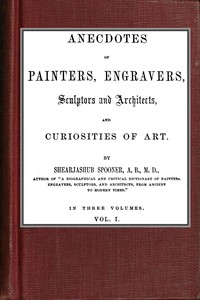
This work is not a mere compilation, or republication of anecdote. It will be found to contain much original matter, and much of the most interesting and instructive portions of the history of art. For a list of authorities, the reader is referred to the author’s Dictionary of Painters, etc., and for a convenient reference, to the Index at the end of vol. iii. The author has studied his subject con amore, for many years, and has gathered abundant materials for three more volumes, should these be favorably received. But he fears lest in these romance-loving days, the recital of the trials, misfortunes, achievements and exaltations of those men of genius and fine sensibilities, to whom the world is indebted for the creation and development of the most beautiful arts, will fail to arrest the attention or move the heart.
Although it does not become a man to prate of himself, yet the author trusts he will be pardoned when he speaks of his labors and their object. For a long period, his labors have been directed to the great object of the restoration and publication of Napoleon’s magnificent works, the Musée Français and the Musée Royal, a notice of which may be found in vol. iii., page 302, of this work. He trusts he may soon be able to present the first numbers to the public. These, and his other achieved undertakings, have made his life one of the most untiring industry. In order to find time for these enterprises, and still attend to the calls of his profession, he has been obliged to deprive himself of repose and relaxation; and during the five years he was engaged in publishing Boydell’s Illustrations of Shakspeare, and in preparing his Dictionary for the press, he spent but one evening out of his study, except those of the Sabbath, relinquishing his toil only at midnight, to be resumed at dawn.
These self-imposed labors have not been assumed through any mercenary or selfish motives. His experience has taught him the precarious results of literary and publishing enterprises of the nature undertaken by him, in the present state of the Fine Arts in our country. The amount of capital and labor he has invested has been enormous, and the risks proportionate; his books admonish him that he has already embarked many thousands of dollars which he can never hope to regain. Still, what he has accomplished is to him a theme of pride and exultation; it has also been a labor of love. His reward is the consciousness of having done something toward awakening a love for, and an interest in art and artists, and that he will leave to his countrymen, for their delight and instruction, so many world-renowned and world-approved specimens of the highest art. Posterity must be his judge; but he cannot forbear to add, that can he now succeed in restoring the great works before mentioned, and leave them as a rich legacy to his country, for the promotion of the Fine Arts in coming time, he will have accomplished his every earthly aspiration.
CONTENTS.
Infelicities of Artists--an Extract from the American Edition of Boydell’s Illustrations of Shakspeare, containing anecdotes of Torregiano, Banks, Barry, Blake, Proctor, &c., 1
Advantages of the Cultivation of the Fine Arts to a Country, 6
The book keeps going
Keep reading, and see it illustrated
Reading is free forever. Sign up and watch scenes appear while you read.
Scenes Storieta drew for other classics.