
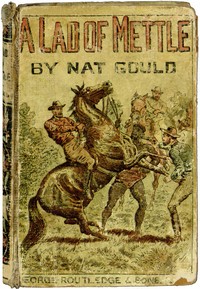
Public-domain ebook
A Lad of Mettle
by Nat Gould
Language: en494 downloads on Project Gutenberg
Subjects
In: Children & Young Adult Reading·Adventure·Novels
Public-domain ebook sourced from Project Gutenberg #66030.
Public-domain ebook
by Nat Gould
Language: en494 downloads on Project Gutenberg
Subjects
In: Children & Young Adult Reading·Adventure·Novels
Public-domain ebook sourced from Project Gutenberg #66030.
The opening · free to read
Lessons were over for the day, and the boys at Redbank School came running with shouts and whoops of joy into the playing-fields. They were like young colts freed from restraint for a few hours, and eager to make the most of their liberty.
Redbank was the home of brilliant cricketers and all-round athletes. Many a noted cricketer had received his first lessons in the great game on Redbank cricket ground. The lads were proud of the men who played in the All England eleven, and who were never slow to acknowledge that to Redbank they owed what prowess they possessed.
The Redbank lads were born runners, so many an old hand training them for races vowed. Something in the atmosphere of Redbank seemed to make the lads athletic. Perhaps the traditions attached to the school had much to do with this, for lads are very proud, and justly so, of the feats of scholars who have preceded them.
But Redbank was not merely a training ground for famous athletes. Redbank scholars had taken high honours at the Universities, and afterwards distinguished themselves in various walks of life. The Bishop of Flaxham was proud of the fact that he was ‘grounded’ at Redbank. He was an eloquent and distinguished man, an ornament to the Church, and a brilliant writer of readable books.
When the Bishop of Flaxham came to Redbank, and preached in the chapel, the lads with difficulty restrained themselves from giving him a hearty cheer at the end of his address. The Bishop knew how to talk to boys, and never forgot that at one period of his life he had been bored with wearisome sermons about the world, the flesh, and the devil, which he did not in the least understand. So he took warning, and told the lads to run the race set before them much in the same manner as they would a hundred yards sprint, each striving to win the prize and do the distance in even time. The Bishop believed that well-trained muscles and a healthy body were conducive to an active and moral state of mind. The Redbank lads gloried in the fact that the Bishop of Flaxham had been one of themselves.
Field-Marshal Lord Kingcraft was a Redbank boy, and his warlike deeds and bravery were celebrated in song on the fly-leaves of school-books, and occasionally on the panels of doors and the insides of desks.
‘Lord Kingcraft’s won the great V.C., May Redbank do the same for me.’
was discovered carved, evidently with much labour and pains, on the lid of a desk at which the celebrated Field-Marshal formerly worried his brains over Euclid and algebra.
This inscription was pointed out to the brave leader of men when he visited his old school, and he never forgot it. He hoped, from the bottom of his heart, the lad who carved it would one day win his V.C.
Redbank was represented in the navy and in the diplomatic world, and one day it was hoped a Redbank lad would become Prime Minister.
So, with all these successful public men constantly before them as an example, the lads of Redbank felt bound to endeavour to do great deeds, and win renown for themselves and their school.
The head-master of Redbank was the Rev. Henry Hook, and it was universally acknowledged that no more suitable man could have been selected. He ruled his lads with a firm hand, but he was no tyrant or hard task-master. The boys knew he meant what he said, and that his word to them could be implicitly relied upon. He had confidence in his boys, and they returned it.
When Edgar Foster came to Redbank School he was sixteen, small for his age, but muscular and active. At this time there were between two and three hundred scholars at Redbank, and naturally out of such a number there were several lads whose absence would not have been regretted.
Young Edgar Foster soon became popular. For one thing, his father was a well-known man, who had worthily upheld the honour of Redbank in the cricket field, and had captained the All England eleven. This was quite sufficient to give Edgar a standing in the school.
Bullies exist in almost every walk of life, and a few of this undesirable species were to be found at Redbank. The leader of these bullies was a lad named Raymond Rakes--‘Bully Rakes’ as he was generally called. He was a big, hulking fellow, powerful and strong, but deficient in courage, as bullies generally are.
There was nothing manly about Bully Rakes, and the boys knew it. So far he had held his own, for he was the biggest boy in the school. Any new scholar he at once endeavoured to inspire with awe, and generally succeeded.
Our story commences about a week after Edgar Foster’s arrival at Redbank. The boys were bounding out of school and soon spread over the fields in groups; the bulk of them, however, went towards the cricketing nets.
Edgar Foster had not had any opportunity of showing what he could do with the bat. He was a lad who did not push himself forward, but quietly bided his time, knowing full well that when that time came he would not be found wanting. The boy is father to the man, and it will be gathered from this story of a lad of mettle that Edgar Foster acted in this wise during many trying periods of his after-life.
Edgar watched the practice with keen and critical eyes. His father had taught him how to handle a bat as only a skilful player can.
‘Here, Foster, take a turn,’ said the lad who had just finished batting. ‘We’ve not had the chance of seeing how you shape yet.’
‘I’m ready,’ said Edgar, pulling off his coat and eagerly holding out a hand for the bat.
‘It’s my turn,’ said Bully Rakes. ‘Just you drop that bat, or I’ll make you.’
Edgar Foster looked up at the big fellow standing before him, but he did not flinch, nor did he drop the bat.
The boys crowded round, anticipating a row, and anxious to see how the new-comer would shape with Rakes.
‘If it is your turn,’ said Edgar quietly, ‘I will give you the bat. If it is not your turn, under no circumstances will I drop the bat.’
The tones were firm, there was no flinching, and the lad looked determined.
Bully Rakes was not accustomed to be addressed in this manner. He eyed Edgar scornfully, and said:
‘I shall have to teach you manners. I am the best judge of whose turn it is. Will you drop that bat?’
Edgar turned to the lad who had handed him the bat, and said:
‘Do you bat in turns? Has Rakes any right to bat before me?’
Courage is infectious. Will Brown had never defied Rakes before, but he felt he must back up his plucky schoolmate.
‘Rakes has no right to bat here at all,’ he replied. ‘He’s been batting at the other net, and has just finished his turn.’
Edgar Foster made no further remark, but walked coolly to the wicket.
This defiance of his demands gave Bully Rakes a shock. He knew if he allowed Foster to bat his hold over the boys would be gone. He strode up to Edgar and said savagely:
‘Give me the bat, or I’ll thrash you!’
‘Had you asked me politely at first, I should probably have handed you the bat,’ said Edgar. ‘I shall not do so now. As for thrashing me--well, that has to be decided.’
‘Bravo, Foster!’ shouted several lads.
‘Punch his head, Rakes,’ said one of the bully’s toadies.
‘Give me that bat, or fight me!’ shouted Rakes in a passion.
‘Shame!’ shouted the lads.
The book keeps going
Reading is free forever. Sign up and watch scenes appear while you read.



Scenes Storieta drew for other classics.
New illustrated classics
Once or twice a month: the latest books to get full character casts, scene art, and free comic editions. No account needed.