Public-domain ebook
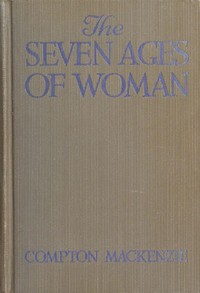
The Seven Ages of Woman
Language: en491 downloads on Project Gutenberg
Subjects
Public-domain ebook sourced from Project Gutenberg #66071.
Public-domain ebook
Language: en491 downloads on Project Gutenberg
Subjects
Public-domain ebook sourced from Project Gutenberg #66071.
The opening · free to read
On a June morning in the year 1859 Sir Richard Flower of Barton Flowers in the county of Southampton decided that the weather was propitious for his annual progress on horseback round the confines of his demesne. The order was given to saddle his gray gelding; Lady Flower was informed that her husband would dine two hours later than usual, and upon her expressing alarm at the prospect of so long a fast for him, she was reassured by a farther announcement that he would fortify himself against the strain of waiting until six o'clock for his dinner with light refreshment at one of the outlying farms. Lady Flower sent back word to say how much she regretted not having known of Sir Richard's expedition earlier in order that she might have made an effort to overcome her headache and bid him farewell in person. To this the baronet replied with a solemn admonition to her ladyship's maid that her ladyship must on no account do anything to make her headache worse. The exchange of courtesies being thus complete, Sir Richard mounted his gray gelding and set out, pausing for a moment at the top of the drive to look back at the Hall and respond with his crop to a handkerchief that fluttered from an upper window. In the manner of shaking his crop Sir Richard succeeded in conveying a reproof for the indiscretion of rising from bed, affection for his beloved wife, and gratification at the devotion displayed for himself. Then he turned his horse's head to the left and cantered down a grassy avenue between ancient oak trees.
Sir Richard was accustomed to give much thought to his position as holder of one of the oldest baronetcies in England, to the responsibilities that such a position laid upon himself, to the beauty and fertility of his demesne, to the timbered glories of his Hall, and to the honorable record of his family; but on the day annually devoted to riding round his ten thousand acres he never allowed himself to think about anything else. He even went so far, when in the depths of the wood neither squirrel moved nor bird chattered and there was none but the gray gelding to overhear him, as to cry aloud in exultation the motto of his house Floreant Flores. On this day dedicated to himself, his family, and his land, Sir Richard indulged in so many whimsicalities of behavior that an observer might have supposed him the prey of madness or the victim of degraded superstition. Thus at one point he dismounted from his horse and, kneeling in the middle of the ride, placed an outspread palm upon the cushions of moss and incorporated the thousands of green and golden stars within his allegiance. He went farther; he laid bare the earth beneath and commanded a congregation of disturbed millipedes to acknowledge him as master. He made with his hands a cup to contain the black earth, and let it trickle through his fingers as a miser might play with his gold. "Mine," he said aloud, and stood for a moment in amazement at one who owned not merely all the green world within sight, but four thousand miles of unimaginable territory beneath his feet. "Mine," he repeated, "and after me John, and after John another Richard. Praise God that I appreciate the state of life to which He has called me;" with this apostrophe the baronet swept off his high silk hat to salute his patron.
Sir Richard kept such extravagance of speech and gesture for the solitude of the woodland. No sooner had he emerged into one of the deep, hazel-bordered lanes that intersecting his demesne reminded him, deserted though they were, of the world beyond his boundaries, than he became the least fantastic inhabitant of that decorous countryside of well-tilled farms and preserved coverts. Sir Richard was close on sixty; but his slim figure, upright carriage, and clear-cut features enhanced by iron-gray whiskers, bushy enough to show that he was not afraid of the fashion and yet not so full as to mark him down the slave of that fashion, made him appear younger at a period when twenty-five looked middle-aged. Every good horseman gives the impression of being part of his steed, and Sir Richard on his gray gelding, with his gray whiskers and gray riding breeches and gray frieze tail-coat was as natural a centaur as Chiron himself.
"Good morning, Sir Richard."
The baronet pulled up to exchange a word with the first of his tenant farmers he was to meet that day, a bull-necked, stubby man who was leaning over a gate against a background of bright green barley.
"Good morning to you, Wilberforce. Your barley's looking uncommonly well."
"Beautiful, Sir Richard, beautiful. Some grumbles, but not me, Sir Richard, not me. May was bad for fruit with all that hail we had. But the crops didn't suffer. Will you be passing by the farm, Sir Richard?"
"Not this morning, Wilberforce. I'm taking my annual ride round the estate. You know my old custom."
"None better, Sir Richard. And what a one you be for keeping up old customs, if you'll permit the liberty of the observation, Sir Richard. And glad I am for one to have such a landlord in these days when Jack thinks himself so good as his master. And how's Mr. John, Sir Richard?"
"Mr. John is well, very well. He hopes to be quartered at Aldershot presently, when we may expect to see something of him."
"It'll be a grand day for Barton Flowers when the village turns out to see the conquering hero come. Mr. John must have been proud when Her Majesty pinned on the Victoria Cross with her own hands at Buckingham Palace the other day. But, as I said to all of 'em, Her Majesty must have been proud of Mr. John when she were a-pinning of it on."
"Yes, I believe he deserved his honor," said the father, trying to look unconcerned. "Of course you saw the little account of it in the newspaper?"
Farmer Wilberforce gave his landlord the pleasure of supposing that he had not yet read the account, whereupon Sir Richard took a cutting from his waistcoat pocket and read aloud as follows:
Lieutenant (now Captain) John Flower, Royal Artillery.
Date of act of bravery, 5th November, 1854.
For having at the Battle of Inkerman personally attacked three Russians, and, with the gunners of his Division of the battery, prevented the Russians from doing mischief to the guns which they had surrounded.
Part of a regiment of English infantry had previously retired through the battery in front of this body of Russians.
"He had to wait a long time for his deed to be recognized," said the father, replacing the slip of paper in his pocket with a sigh of satisfaction. "Good morning to you, Wilberforce. I mustn't stay gossiping here any longer. I've a good many miles in front of me, you know."
Sir Richard rode on, his mind full of his elder son's valor. He should be thinking about marriage, though. It was time to see a grandson at the Hall. One was apt to forget how fast the years were going by. How old was John now? Thirty. So he was, by gad, thirty. Yes, he must be getting married. Not much difficulty about that, the proud father laughed to himself. Handsome, brave, the heir to Barton Flowers! It was right that he should take his profession seriously, but after the Crimea and the Mutiny he could claim to have served his country well, could afford to sell out and prepare himself to administer the property he would one day inherit. One day ... but not just yet. "No, not just yet," Sir Richard murmured, gripping the flanks of the gray horse tightly in pride of his own strength. And perhaps at this moment when the electric telegram was almost daily bringing news of French victories in Italy, and when that rascal Napoleon might be forming who knows what schemes to invade England, yes, perhaps at this moment, Captain John Flower should stick to his guns. Still, he would talk to his wife about the boy's marriage. He hoped that when he arrived home again he should find that headache sufficiently improved to let her discuss the subject with keenness and intelligence. The right plan was to invite some eligible young women to visit the Hall during John's next furlough, and if luck should station him at Aldershot to take care that whenever he drove over to Barton he should find an attraction at home. Luckily there were plenty of eligible young women in the neighborhood. Sir Richard was enumerating the possible wives for his heir when the disquieting thought occurred to him that John, like his father before him, might look beyond Hampshire for a wife. Not that for a single moment he had regretted his own choice; but what might be done once with success might end in disaster if fortune were tempted again. Anybody who had been made aware of Sir Richard's thoughts at this moment might have been pardoned for supposing that he had found a wife of beauty, merit, and ability in a lower stratum of society. As a matter of fact, the present Lady Flower was the daughter of one of Wellington's most gallant officers and a French lady of rank whose father had taken refuge from the Terror in England, where he had preferred to remain during the Napoleonic tyranny. It was the French blood that made Sir Richard feel he was committing a breach of tradition in marrying Miss Helen Baxter. To have introduced French blood into the Flowers, notwithstanding the pride of the family in their Norman origin, still seemed to him an astonishing piece of audacity; and even now he could shudder to think what his father would have said, had his father been alive when he married. Yet his wedded life had been one of unbroken happiness, and Helen had not betrayed the least sign of her mixed origin unless perhaps in an incurable propensity to succumb to violent headaches, which she dignified, or as her husband preferred to think, Frenchified by calling migraines. The old family doctor attributed them to nerves, and nerves, Sir Richard felt, were French, not English, so that if Doctor Wilkinson was right, the headaches must have been inherited from her French mother. There was nothing of the Frenchman in the elder son John. He never had a headache in his life, and he had won the Victoria Cross. English to the backbone was John. But Edward...?
Sir Richard, who had been trotting gaily along his boundaries, pulled up his horse to a walk, because the personality and character of his younger son perplexed him. Edward had headaches, was prone to day-dreaming, and at twenty-eight showed no sign of making any progress at the Bar, to which without apparently the slightest taste for a legal career he had recently been called. Headaches, day-dreams, instability, these were not English qualities. What had Edward been doing down at home all the summer? How could he expect to be a successful barrister if he left his chambers in Pump Court to take care of themselves? If John had been a barrister, he would have made his mark by now. Yet Edward had been endowed with more brains than John. John was diligent, determined; but Edward had the brains. It had been the ancient custom of the Flowers to send the eldest son to Winchester, the others to Eton. Sir Richard, who was a Wykhamist, had broken the tradition by sending John to Eton and Edward to Winchester, partly because he thought that Winchester would eradicate more sternly any French symptoms that appeared in Edward, partly because he believed that what was known as cleverness in a boy would receive more encouragement at the older foundation. But Edward had been a disappointment. His career at Winchester had been undistinguished, and he had gone down from New College without taking a degree. That was the moment when his father should have been firm with him, when he should have insisted upon his making his own way in the world without parental assistance. But Helen had intervened, and she intervened so rarely that when she did her husband was always defeated. Edward had expressed a half-hearted desire to read for the Bar, and he had allowed himself to be persuaded into making the necessary allowance. What was the result? Edward at twenty-eight as little able to provide for himself as he was at eight! It had been all very well for his mother to plead for his company over long months at Barton to console her for the absence of her elder son first in the Crimea and then in India. But John had been back a year now, and Edward spent more time than ever at home. Confound it, the problem of Edward's future was spoiling the day, and in a burst of irritation the baronet spurred his horse to a canter.
The book keeps going
Reading is free forever. Sign up and watch scenes appear while you read.



Scenes Storieta drew for other classics.
New illustrated classics
Once or twice a month: the latest books to get full character casts, scene art, and free comic editions. No account needed.