Public-domain ebook
The Music Master
English437 downloads on Project GutenbergDownload EPUB
Public-domain ebook sourced from Project Gutenberg #66154.
Public-domain ebook
English437 downloads on Project GutenbergDownload EPUB
Public-domain ebook sourced from Project Gutenberg #66154.
The opening · free to read
Robots could play an instrument, but they could not write music--and Danny wanted to do both--even if it meant facing the psych squad!
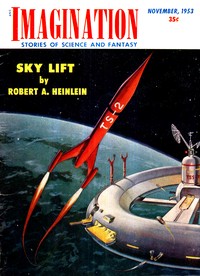
[Transcriber's Note: This etext was produced from Imagination Stories of Science and Fantasy December 1952 Extensive research did not uncover any evidence that the U.S. copyright on this publication was renewed.]
After the performers filed off stage the audience chattered politely and drifted toward the exits. Danny Tocar looked up at his mother, and, on impulse, detached his hand from hers and lingered behind. As long as she was busy culturizing he wouldn't be missed. When the auditorium was empty Danny made his way to the stage and stood among the instruments. He stroked a violin, dark and shining. It was very heavy, as if it were solid. It was solid. He touched the metallic ridges on it. Funny. When he had sat in the audience those ridges had looked like strings and had given out a pleasant sound. It made no sound for him though, even when he drew the bow across it as the musician had done.
It was the same with the drum when he pounded it. It too was silent. He frowned and tried the trumpet. He lifted the instrument to his lips and puffed his cheeks and blew. Nothing happened at all. He examined it intently and then sadly laid it down. It was fake. All the instruments were toys, imitations of something that had once been real.
The music had not been phony, though. He visualized the performance, a harmony of motions as well as sound: bowing, plucking, striking, blowing. Where had the music come from if not from the instruments? He still remembered the synthony.
There was one instrument much larger than the others. It was set on a raised platform and looked different. He wandered toward it, and discovered the enclosure. From the audience he hadn't noticed this; the enclosure was hardly visible though he was leaning against it.
He had experience with this sort of thing. A museum case; a guarantee that whatever was inside was real. With practiced fingers he felt for an invisible crevice in the transparent enclosure. A fingernail split, but something swung open, and Danny was inside.
He looked curiously at it. A large wooden instrument with white markings along the front of it. Danny remembered how these had been touched during the performance.
He was good at imitation; Danny brought his fingers down the way he had seen it done. The white things weren't markings: they were keys. The sound rolled out into the empty auditorium. Startled, Danny jerked his hands away. He didn't know it, but with those few notes he qualified as the musical genius of a hundred years. The only human who, in that time, had produced anything resembling music.
Entranced, he listened. When the last echo was lost he felt empty. He sat down on the stool and rubbed his cheek against the old instrument. His hands couldn't stay away from the keyboard.
Meanwhile his mother strolled determinedly through Culture City. "I just love the synthony don't you, Danny?" For the first time she realized he wasn't with her. She looked around bewilderedly.
"Don't worry," said her companion. "He can't be far. Probably in the twentieth century section watching the electric signs."
His mother laughed nervously. "Quaint, isn't it? Let's go. We have to find him." She angled to the left, thinking she saw him through the crowd. When she got there it was another little boy, not Danny at all.
However she had a bit of luck. The commercial artist on the street was temporarily vacant. She hesitated for a moment between her duty to find Danny at once and her desire to own a real work of art. The middle aged couple heading toward the booth decided her. Swiftly she inserted a coin.
"Yes?" said the deep gruff voice of the mechanism.
"I'd like two pictures," she said.
"Subject matter?"
"One for a child's room. Danny Tocar, age 11. You have access to personality records."
"I do. But if you can give me some indication--"
"Oh something by Roualt. That should be harmless."
The robot artist noted that. "Daylight or night?"
"Something that glows in the dark," she said.
"And the other picture?"
She considered. "Something different," she said. "Maybe a combined Miro and Goya."
"The two styles aren't compatible," warned the commercial artist.
"Then make them compatible," she answered. "It's time the two were reconciled."
The commercial artist could not sigh. "Subject matter of the Miro-Goya picture?"
"A peaceful scene. Perhaps rockets to the moon."
"Goya never heard of rockets," began the artist. "And while there was talk of them during Miro's life--"
"Project them," she insisted reasonably. "Project their perceptions to the time of the first rocket to the moon. It's merely a matter of analysis." She gave her name and address. She wasn't going to argue with a robot.
A relay in the artist clicked and sent a routine request for apartment dimensions, color layout, furnishing arrangement. Simultaneously the picture requirements were integrated. For the boy it was easy. The elements of the original artist Roualt were reshuffled and the basic night glowing pigments were selected.
The Miro-Goya picture was harder. Trial and error were necessary. The results would not be happy; a schizoid painting was bound to ensue. It was the task of the commercial artist to see that the pictorial insanity was not too evident.
The middle aged couple stepped into the booth as Danny's mother left. They ordered Grandma Moses and Norman Rockwell, sunny side up.
There was little reason for Danny's mother to be alarmed. An accident was improbable. Nevertheless she sent her companion in one direction while she took another route. Belatedly she thought of Music Hall.
It wasn't closed yet, though it would be soon. She stepped into the dim interior; a soft light illuminated the stage. And there was music, a kind she'd never heard. A child playing, as, a few hundred years before, countless children had played. A simple two fingered melody, but nevertheless a tune, distinct and recognizable.
"Danny," she called; but he didn't hear. She climbed to the stage though she had less luck with the door to the enclosure than her son had had.
"Danny." She pounded against it. Danny looked up, his smile of preoccupation fading. He came out.
"It's a piano," said Danny.
"I know it's a piano. And very valuable, the only one in the world. You might break it." She didn't know, but her statement wasn't true. There were seven others, carefully preserved and guarded.
"I've been careful," he said. "I don't want to break it."
The book keeps going
Reading is free forever. Sign up and watch scenes appear while you read.



Scenes Storieta drew for other classics.
New illustrated classics
Once or twice a month: the latest books to get full character casts, scene art, and free comic editions. No account needed.