Public-domain ebook
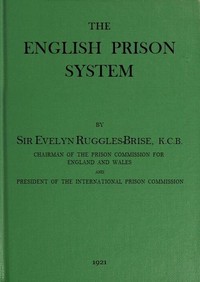
The English Prison System
Language: en820 downloads on Project Gutenberg
Subjects
In: History - British·Law & Criminology
Public-domain ebook sourced from Project Gutenberg #66174.
Public-domain ebook
Language: en820 downloads on Project Gutenberg
Subjects
In: History - British·Law & Criminology
Public-domain ebook sourced from Project Gutenberg #66174.
The opening · free to read
"Prison Reform"--a phrase of many meanings. The aim of the modern prison administration. The prison population. Influences operating for "reform" in prisons--religious services, visitation, education, lectures and addresses, summary of weekly news of the world, &c. No 'law of silence' strictly so-called: talking exercise in prisons, &c. Non-criminal persons committed under special legislation during the war--the prison system not intended for such. Officers of prisons and their power of influence for good. The special categories of the Borstal lad, and the 'habitual offender' at Camp Hill. The three directions along which 'prison reform' might proceed,--the organization and development of Probation: the extension of the principle of Preventive Detention to the Penal Servitude system: the co-ordination of preventive efforts.
CHAPTER. II.--THE PRISON COMMISSION: OFFENCES, AND PUNISHMENTS. 18
Constitution of Prison Board. Establishments under control of Prison Board. The criminal law and its a administration, punishments, &c. Probation Act, 1907. Court of Criminal Appeal.
CHAPTER III.--THE HISTORY OF PENAL SERVITUDE. 23
History of Transportation. Pentonville Prison. Public Works. Penal Servitude Act, 1857. Progressive Stage System. The Irish System. Royal Commission, 1863. The Penal Servitude Act, 1864. Mark System introduced. Habitual Criminals Act, 1869. Prevention of Crimes Act, 1871. The Royal Commission, 1878. The Star Class. Fall in convict population.
The Inquiry of 1894. Progressive Stage System recast. New classification of 1905. Weakminded convicts. Separate Confinement, history of. Changes in system under the Act of 1898. Corporal punishment. Penal Servitude for Women.
Definition of professional criminals. Proposed Habitual Offenders' Division. The Act of 1908. Camp Hill Prison. Rules for treatment of prisoners. Release on Licence. Statistics of Releases. The Advisory Committee. The Intention of the System.
Houses of Correction. Local Prisons and their administration. The phrase 'Hard Labour.' Howard and English Prisons. The Act of 1778 and separate confinement. Jeremy Bentham and the 'Panopticon.' Classification under the Act of 1823. Mr. Crawford's visit to U.S.A. Classification, the leading principle of reform. Inquiries of 1832 and 1836. Auburn and Philadelphian systems. The Act of 1839 and separate confinement. The model prison at Pentonville. Local Prisons and the control of Secretary of State. Surveyor-General appointed. Separate Confinement and Hard Labour, and the objects of imprisonment. Committee of 1850 and uniformity. Prison Act, 1865. Uniformity not secured. Centralization of Prisons under Act of 1877. Powers of Justices under. Classification and the objects and effect of Act of 1877.
CHAPTER VII.--THE INQUIRY OF 1894: THE PRISON ACT 1898: AND THE CRIMINAL JUSTICE ADMINISTRATION ACT, 1914. 75
Appointment of Committee and its report. Public opinion and the treatment of crime. Subsequent reforms in system. Retirement of Sir E. Du Cane and appointment of Sir E. Ruggles-Brise. Prison Rules and Administration. Triple Division and individualisation of prisoners. Part-payment of fines. Corporal punishment. Power to earn remission of sentence. Gratuity and remission of sentence.
Its Origin. Statistics of youths committed annually. The Committee of 1894. The Colony at Stretton, 1815. "The Philanthropic Institution." The Reformatory School Act, 1854. The Colony of Mettray. The Age of 16 and criminal majority. Visit to the American State Reformatory at Elmira. The London Prison Visitors' Association, and first experiments at Borstal: the features of the early System. Representation to Secretary of State. Statutory effect given to System in 1908. The Institution for males and females to-day. "Modified System" and Borstal Committee System in Convict Prisons. The Borstal System, and its extension under the Criminal Justice Administration Act, 1914.
CHAPTER IX.--THE HANDMAIDS OF THE PRISON SYSTEM. 101
(1) THE CHILDREN ACT, 1908.
(2) THE PROBATION ACT, 1907.
(1) The Children Act, and age of criminal responsibility. Juvenile Courts, statistics of. Physically and mentally defective children. The Elementary Education (Defective and Epileptic Children) Acts, 1899 and 1914. Juvenile Employment Bureaux and Labour Exchanges. The Elementary Education Act 1918. The Value of Voluntary personal service directed to the young.
(2) The Provisional Sentence abroad. The English law of Probation: Extent of its application: the Law prior to 1907. Difficulties of comparison of the various Systems. Probation in State of New York: Direct control and supervision by the State.
The fall in committals to prison. The heavy rate of Recidivism. Formation of the Lady Visitors' Association, its duties, &c. The Borstal System at Aylesbury, and the work of the Ladies' Committee of the Borstal Association. The "Modified" Borstal System; Instructions regulating the class; Extension of Borstal System under Criminal Justice Administration Act, 1914. Female recidivism, and the need for adoption of the principle of the reformatory sentence, and the formation of a State Reformatory. Superintendence and control of female prisoners by women.
CHAPTER XI.--EDUCATIVE, MORAL AND RELIGIOUS INFLUENCES IN PRISON. 124
Education in prisons before Education Act, 1870: comparative statistics of degree of education of prisoners: large number of illiterate prisoners: present system of education and teaching staff: prison libraries, lectures, debates, missions: the work of Chaplains.
CHAPTER XII.--LABOUR IN ENGLISH PRISONS. 131
Changes in system due to reduction of convicts. Less Public Works labour. Competition with free labour. Contract system unknown in English Prisons. Character of present work in Convict Prisons. Medical census of convicts' fitness for work. The last Public Works, Dover Harbour. Character of Convict Prison labour approximating more to that of Local Prisons. Inquiry of 1863, and labour in Local Prisons. 'Hard Labour' of two classes. The Prison Act, 1877. Abolition of unproductive labour, and inquiry of 1894. Revision of Labour Statistics. Improvement in output of manufacture since 1896. Unskilled labour. Reorganization of female labour, 1911. Work for Government Departments. Work during the War. The work of Juvenile-Adult prisoners.
CHAPTER XIII.--(1) VAGRANCY: (2) INEBRIETY. 142
(1) Early history of Vagrancy legislation. The Act of 1824. Categories of Vagrants. The casual pauper. Casual wards. Alleged attractiveness of prison to workhouse: Commissioners' observations on. Committee of 1906 and need for uniformity in casual wards, &c. Merxplas Colony. Labour Colonies and the Inquiry of 1903. Identification of habitual vagrants. Treatment of Vagrancy abroad. Great fall in number convicted of Vagrancy offences. The way ticket system. Casual Wards of Metropolis and Metropolitan Asylums Board. High number of convictions of vagrants. No plan yet adopted by State for dealing with professional vagrancy.
(2) Committee of 1872. Act of 1879. Inquiry of 1892. Principles of the Act of 1898. Establishment of State Inebriate Reformatories. Character of inmates. Control of State Reformatories. Commitments under the Act. The working of the Act. Committee appointed in 1908 to inquire into Inebriates and Probation. Causes operating against wider use of powers under Act. Inebriety as a factor of crime. Dr. Branthwaite's inquiry into a number of cases. Mental deficiency obvious in many. Condemnation of short sentences of imprisonment. Habitual inebriety and mental defectiveness. Report of Committee of 1908.
CHAPTER XIV.--"PATRONAGE" OR AID TO DISCHARGED PRISONERS: ITS EFFECT ON RECIDIVISM. 164
Former system of aid to discharged convicts. Gratuity system different from '_cantine_' or '_pécule_' system. Early history of aid to local discharged prisoners. Provisions made by Acts of 1862 and 1865. System under Act of 1877. Inquiry of Committee of 1894 and recommendations. Scheme of 1897. Formation of 'Central Association.' Discontinuance of Convict Gratuity System. New scheme for aid of Local prisoners, 1913. The Central Organization of Aid Societies; Aid to wives and families of prisoners. Proposed National Society for Prevention of Crime, and protection of the young offender. Aid on discharge from Borstal Institutions and Preventive Detention Prisons.
Personnel of the Medical Staff; duties. Sickness and low death rate in Prisons. Prisons described as the best sanatoria in England. Infectious disease. Venereal disease. Prison dietary. Insanity and mental defectiveness, estimated rates of; the Mental Deficiency Act, 1913. The 'Birmingham' experiment for mental investigation of remand prisoners. The Borstal System and physical development. The clinical laboratory; "Study-leave" for Medical Officers. The nursing of sick prisoners.
CHAPTER XVI.--A CRIMINOLOGICAL INQUIRY IN ENGLISH PRISONS. 198
The nature of the inquiry. Professor Lombroso and the postulate of the 'Positive' School. The Lombrosian doctrine founded upon observation alone. The science of statistics: 'Normal' and 'abnormal' man. The 'criminal diathesis:' The biometric method of Professor Karl Pearson. Anthropometry and the existence of a criminal type. Comparison of statistics of criminals and non-criminal public. Dr. Goring's conclusion that there is no physical criminal type. 'Selective' factors and the physique of criminals. No 'mental criminal type.' Statistics of mental defectiveness. Defective physique and defective intelligence in selection of criminals. Heredity and other environmental factors. The relation between education and crime. Alcoholism. Conclusions as to the causes of crime. The criminal a "defective" man. His inability to live up to required social standard. The need for individualization of punishment. The Mental Deficiency Act, 1913.
CHAPTER XVII.--(A) A SHORT SKETCH OF THE MOVEMENT OF CRIME SINCE 1872: (B) THE WAR 1914-18. 216
(A) Classification of offences proceeded against in Criminal Courts. Fall in serious crime since 1871. Decrease of non-indictable offences of a criminal nature. Statistics of non-criminal offences. Prison Population, statistics since 1881. Decrease in total number of sentences to Penal Servitude. Great decrease in prisoners under 21 years of age. Statistics of recidivism. Petty Recidivism and vagrants and mentally defective persons in prisons.
(B) Prison statistics during the War: the effect of the Criminal Justice Administration Act, 1914, and payment of fines. Statistics of the decrease in various offences. The effect of the Central Control Board (Liquor Traffic) and committals for Drunkenness. The great fall in Vagrancy. Criminal statistics in times of industrial prosperity and distress. Closing of penal institutions during the War. Statistics of charges tried and proceeded against. The maintenance in the future of the present low criminal population.
In October, 1910, I conveyed to the International Prison Congress at Washington the invitation of the British Government to hold the next Quinquennial Congress of 1915 in London. The invitation was accepted with enthusiasm. The London Congress of 1872 had prepared the way for the creation of the International Commission, which was founded a few years later; but, though supported and encouraged by the Government of the day, it owed its origin to American influence, notably that of the celebrated Dr. Wines. Great Britain did not formally adhere to the International Commission till 1895, when Mr. Asquith, then Home Secretary, nominated the present writer as British Representative to the Paris Congress of that year. Since that date, the Quinquennial Congresses had been held at Brussels, Buda-Pesth, and Washington in 1900, 1905, and 1910, at all of which the British Government was represented, the reports of the proceedings being duly submitted to Parliament.
The book keeps going
Reading is free forever. Sign up and watch scenes appear while you read.



Scenes Storieta drew for other classics.
New illustrated classics
Once or twice a month: the latest books to get full character casts, scene art, and free comic editions. No account needed.