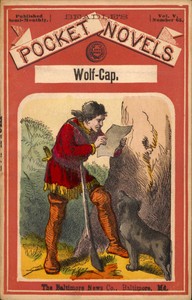
A substantial fire burns in an uncouth but serviceable fireplace, and a man reclines on the puncheons in the ruddy blaze.
His sole companion is a huge yellow dog of the mastiff species; and his master’s long black locks rest upon his shaggy coat.
It is nine o’clock at night, and the moon shines in an unclouded firmament.
Not a sound disturbs the stillness of the wood; but just at the edge of the meager clearing that lies before the cabin, a little river flows northward with a low noise, for it is almost bank full.
Man and dog are wide awake; the former gazes into the fire, the latter looks up into the hard, sunbrowned face.
The master is a great, strong man, whose looks, physique and voice, when he speaks, indicates a long frontier life. He is perhaps three and forty years of age. Some would say that he is fifty; but people must not judge age by certain crows-feet on the brow; troubles make young men old. His occupation is revealed by a quantity of animal traps lying in one corner of the room, and suspended from a rafter overhead hangs a bundle of skins, ready for the market at Fort Sandusky.
But he rises and looks at the dog, who bristles up and runs to the door, protected by a strong oaken plank.
“What is it, Yellow Dick?” asks the trapper, standing beside his companion, rifle in hand, and peering into the moonlight through a crevice between two logs. “I would hev sworn that I heard the voice of a man; but—”
He paused abruptly, for Yellow Dick had suddenly pricked his long ears anew, and the trapper began to unbarricade the door.
“’Tis old Johnny, Dick, as sure as death,” he said, glancing at the mastiff while he worked at his plank. “He hasn’t been this way for a three month. Mebbe he brings news from the seat of war.”
The dog seemed to understand the man, for his fierceness abated, and he stepped from the portal.
“There! I knew it was Johnny Appleseed,” the trapper said triumphantly, as he opened the cabin door, and let a flood of moonlight into the dingy room. “Here he comes, down the river. What’s that he’s saying, Dick?”
The speaker leaned forward and caught these words uttered in a melodious voice:
“The spirit of the Lord is upon me, and he hath anointed me to blow the trumpet in the wilderness and sound the alarm in the forest: for behold the tribes of the heathen are round about your door, and a devouring flame followeth after them.”
The herald of danger stood near the edge of the water, and looked like some wild being from spirit-land.
“Old Johnny means somethin’; somethin’s gone wrong somewhar,” cried the trapper, becoming excited, and then in a louder tone he spoke the singular cognomen of the man of the wilderness—“Johnny Appleseed!”
The latter turned and after some hesitation came forward.
“Do not detain the Lord’s anointed long,” said the little wiry man, exhibiting his old restless activity, “for the Philistines are this night sweeping down upon the scattered tents of Israel, who will be found without the cities of refuge.”
“But, Johnny, what has happened?” queried the settler, who could not repress a smile at the herald’s quaint phraseology.
“The Philistines hold revel in the great walled city on the northern water.”
“What! has Hull surrendered?”
“Even so, Israel is again in captivity, and the families on her borders must feel the fire now.”
The trapper was silent for a while.
“Then the red-coated and red-skinned devils are coming to devastate the frontiers,” he said, in a tone scarcely audible.
“Their forces no man can number,” said the strange herald. “They are like the sands of the sea-shore. But I must go. I am appointed to deliver my message before every door in the forest, that the Lord’s chosen may flee from the wrath to come.”
“Then go, Johnny. I should not have detained you a minute. Yours is an errand of mercy. I have a duty to perform this night. Go, Johnny; tell them all of the swoop of the red eagles; and tell them that Wolf Cap says, ‘Fly to the block-houses without delay!’”
The pioneer hero started forward, but paused after taking a step, and drew the portion of an old volume from his bosom.
“Here news right fresh from heaven,” he said, and he tore a leaf from the book and handed it to the trapper.
It was a leaf from Swedenborg’s writings, for Johnny Appleseed—Jonathan Chapman—is no myth, and he was a true disciple of the Swedish seer.
Having accomplished his duty, the strange man, clad in nothing save a garment fashioned from a coffee sack, and bearing a long distaff, started off to spread dismay throughout the fire-lands.
“So Hull has surrendered,” muttered Wolf-Cap through clenched lips, as he turned into the cabin again. “I know it was a cowardly affair, for Detroit was proof against ten thousand foes; but Hull was the wrong man in the right place. I know it; I told the soldiers so when I war there not long ago. These frontiers hev got to be desolated now, through the cowardice of one man,” the lone trapper continued, busying himself with preparations for a night journey. “Our block-houses are poor excuses for bulwarks; but we must get the women and children in them as quickly as possible.”
He donned his hunting accouterments and the wolf-skin cap which had given him the sobriquet that entitles our romance, and replenished the fire.
“I’ll leave you to keep house, Dick,” he said, addressing the dog. “I’ll be back about daybreak. Now old fellow do your duty, and don’t let a sneakin’ red-skin over this portal.”
He patted the dog’s shaggy back, barricaded the door, and made his exit from the cabin, by the roof.
“I’m pretty sure that Johnny missed ’em,” he said, pausing for a moment beside the cabin and communing with himself. “He came down the river, and they are too far to his left. Yes, I guess he missed ’em.”
The last word still quivered his lips when he started in a north-easterly direction, leaving the river to his left.
A well-defined trail stretched before him, and he walked rapidly through the moonlit forest, trailing his long-barreled rifle at his side.
It was a night in August, 1812, and, as not a breath of wind was stirring, the heat was oppressive. Once or twice the hunter started a deer from the weed-fringed margin of some forest stream, or frightened a coyote from his feast of freshly-slain bird.
Suddenly he paused and listened to a silver voice, soaring skyward far away.
“That’s Huldah’s voice,” he said, audibly. “No woman can sing like her in these parts. I don’t know, but some how or other I think an uncommon sight of that girl. She looks so much like Bessie did twenty years ago,” and here the rough deer-skin sleeve dashed a tear from the speaker’s eye.