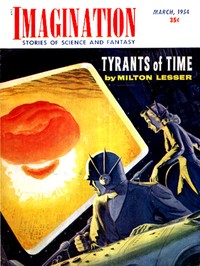
Public-domain ebook
The Sling and the Stone
English464 downloads on Project GutenbergDownload EPUB
Public-domain ebook sourced from Project Gutenberg #66292.
Public-domain ebook
English464 downloads on Project GutenbergDownload EPUB
Public-domain ebook sourced from Project Gutenberg #66292.
The opening · free to read
The room was very cold, Pyotr Diavilev struggled into his clothes, not sleepy at all, while the army man stood silently at the foot of the bed. Outside the door, stolid and heavy-footed in the darkness, there were other army men, creaking the floorboards and chuckling.
And so it comes, Diavilev thought. There was nothing at all to say or do. He hitched his belt tightly and breathed for what seemed like the first time, and then he nodded to the army man.
He was taken away.
He sat in the dark, in the plush rear seat of a huge car being driven at great speed through the city. He was surprised; he had expected them to be more brutal. But they were never, ever, what you expected. In the darkness he strove to compose himself.
The army man asked him for a cigarette. When he struck the match Diavilev realized that he had forgotten his glasses.
"My glasses," he said humbly, "please, I have forgotten my glasses."
The army man surprisingly, seemed concerned. Then he said:
"Never mind. We will get them."
He leaned forward and spoke into a radio. There was a brief reply which Diavilev could not hear and the army man sat back comfortably, satisfied.
"Your glasses will be there," he said.
Diavilev thanked him. Because of the unexpected courtesy the level of his fear began to go down. Perhaps it will not be so bad, he thought. Maybe after all it is only interrogation. But again he thought that you never knew what to expect, that in all the long years of yessing and bowing and applauding he had never understood them.
Well then, now was the time to understand.
I will say whatever they want me to say, I will not resist in the least. What does it matter? The world belongs to them, and if a man wishes to live he must be logical and agree. Let them do what they will, and I will applaud every step of the way.
He folded his hands in his lap.
After a long while the car stopped. The first army man gave him over to another army man whom he could not see in the darkness, and after many a salute he was conducted through a black iron gate. Within minutes he was aboard a plane with four more army men. No one would say anything. Pyotr Diavilev slept.
He saw the thing clearly in the late morning sun, rising in an enormous, shining tube from the hard-baked floor of the desert, but it was obviously impossible. He was taken on an elevator one hundred feet into the air and ushered through a door into the side of the thing, not believing any of it for an instant. He was told, rather kindly for once, that he was to be taken up in this thing and not to worry, because it had been tested. Many times. But he was so completely overwhelmed that he could not ask a question. There was nothing but army men now, one of whom conducted him to a foam rubber hammock and strapped him in. To his utter astonishment, the thing actually did take off.
There were some very bad minutes. For a while he weighed several tons and could not move, and then he weighed nothing at all and was sick. Someone else unstrapped him and gave him pills, and then thoughtfully tied him to a handring on the wall. And at long last his mind began to accept it.
The incredible Soviet had succeeded. His Russian contemporaries had put a manned vessel in outer space.
Diavilev sat quietly stupefied.
That the spouting, unshaven, preposterous baboons with whom he had worked could have built this thing seemed to him blankly impossible. Being one himself, Pyotr Diavilev had no great respect for what Russian scientists the great many purges had left. But of course there the thing was. Built by Germans perhaps, with secrets stolen from the Americans while they haggled about peace; nevertheless, there the thing was.
And if he was going up now there could be only one place to go and therefore he was not a prisoner at all. The wonder and relief of it was too much at once. He surrendered himself to awe. When the time came to board the satellite he was poised and ready.
In the midst of a curving room hung and inset with a thousand shining gadgets, Pyotr Diavilev floated in the air. A black-browed man took his arm carefully and pulled him to the floor, placed magnetic-soled shoes on his feet. Diavilev could not help grinning delightedly. The dark man, whose name was Krylov, stood thoughtfully and absently scratching his cheek.
"Now as to why you are here," he said, and Diavilev tensed and waited. There were three other men in the room, but no one moved.
"You understand of course what this station is, and that the building of it places us, our people, in control of the world."
Diavilev nodded.
"Atomic missiles launched from this base may be guided exactly to any point on the surface of the Earth that we select, yet the station itself represents so small and distinct a target as to be virtually invulnerable. Russia, my friend, need fear no country on Earth. Not," he added quickly, "that she ever did, of course."
Diavilev, with the inbred habit of years, gave his congratulations. Krylov stood looking at him closely, half-smiling, rubbing again at his cheek. There was something infinitely chilling in the moment, but Diavilev was able to smile back.
"This station has been in existence," said Krylov, "for slightly more than a week. There are not fifty people in the entire world who know of it. You have become one. You are therefore most important."
Diavilev was becoming nervous.
"But you are important," Krylov went on slowly, "for other reasons. To be exact, you are perhaps as important at this moment as any man who ever lived."
Diavilev, dazed, struggled to digest that while Krylov held him with his eyes and the three other men spoke lowly among themselves.
"I am saying all this to impress upon you the vastness of the work with which you have been entrusted. I want you to understand clearly that the accuracy of your work could mean the collapse of all our enemies, of the entire capitalistic empire. Therefore you will be accurate."
There was a fixity to Krylov's face which was unsettling. Diavilev waited, uneasy and bewildered. The dark man smiled.
"You are a Russian," he stated powerfully. "We know that you will do your best."
"Of course," Diavilev said.
Krylov turned and pulled open a drawer. Out of the drawer he drew a chart and handed it to Diavilev.
"Do you recognize that?"
Diavilev stared.
"That is the plotted orbit," Krylov said carefully, "of a moon. It is not of course the moon with which you are familiar. But it is a moon circling the Earth, a second moon.
"It is a moon of which no one knows, excepting ourselves and the Kremlin. We discovered it shortly after we arrived, when it passed quite near the station. It is small and dark, too small and non-reflecting to be seen from Earth. It is approximately five miles wide.
The book keeps going
Reading is free forever. Sign up and watch scenes appear while you read.



Scenes Storieta drew for other classics.
New illustrated classics
Once or twice a month: the latest books to get full character casts, scene art, and free comic editions. No account needed.