Public-domain ebook
The Natural History of the Gent
by Albert Smith
Language: en431 downloads on Project Gutenberg
Subjects
Public-domain ebook sourced from Project Gutenberg #66323.
Public-domain ebook
by Albert Smith
Language: en431 downloads on Project Gutenberg
Subjects
Public-domain ebook sourced from Project Gutenberg #66323.
The opening · free to read
WHAT THE GENT IS GENERALLY.
THE species of the human race, to the consideration of which we are about to draw the attention of the reader, is of all others the most unbearable, principally from an assumption of style about him—a futile aping of superiority that inspires us with feelings of mingled contempt and amusement, when we contemplate his ridiculous pretensions to be considered “the thing.”
The Gent is of comparatively late creation. He has sprung from the original rude untutored man by combinations of chance and cultivation, in the same manner as the later varieties of fancy pippins have been produced by the devices of artful market-gardeners, from the original stock wild crab of the hedges. The fashion which Gents have of occasionally addressing one another as “my pippin” favours this analogy: and when they use this figure of speech, they pronounce it as follows,—placing great stress on the first letter, and then waiting awhile for the rest,—“Ullo, my P—ippin!”
After much diligent investigation, we find no mention made of the Gent in the writings of authors who flourished antecedent to the last ten years.
In the older works we meet with “_bucks_” and “_gay blades_” and “_pretty fellows_;” and later with “_men upon town_,” “_swells_” and “_downy ones_,” or “_knowing coves_:” but the pure Gent comes not under any of these orders. He was not known in these times. He is scarcely understood now so universally as we could wish; but we trust that his real character will, before long, be properly appreciated. He is evidently the result of a variety of our present condition of society—that constant wearing struggle to appear something more than we in reality are, which now characterizes every body, both in their public and private phases.
Our attention was first called to the Gents in the following manner:—
We were in the habit of occasionally coming into contact with certain individuals, who when they spoke of their acquaintances were accustomed to say “I know a Gent,” or, “A Gent told me.” Never by any good luck did we hear them speak of Gentlemen. But it occurred that we chanced, on future occasions, to see one or two of the Gents above alluded to, and then we understood what they were.
The first Gent we ever saw, we encountered on the roof of an omnibus, with his hat a little on one side, and a staring shawl round his neck. He was also smoking a cigar, as he sat next to the driver, in order that he might reap the benefit of his anecdotes and remarks concerning the horses and vehicle, to which the Gent replied at intervals, “Ah,” and “Yes,” and “I should say not,” and “Just so,” with other similar phrases used to fill up unmeaning dialogue. We heard him speak of “a Party he knew,” and he was very much interested at hearing that the off-horse worked “in the fust bus as ever Shillibeer started, and was took from the Angel to be put on the Elephant.” He was also informed of the singular speculation in which “the guvner give a fippun note for that little mare, and was offered eight sovrins for her within a week, though she was a reg’lar bag o’ bones;” upon which the Gent observed that “very often those sort of horses were the best.” Having delivered himself of which opinion, he rolled his cigar about in his mouth, gave a whiff in our face, and then removed it between his middle and ring-finger, to offer it to another Gent on the roof, who begged the favour of a light.
The next Gent we met was in the street. He wore large check trowsers of the true light comedian pattern, which appeared to have been made expressly for Mr. Walter Lacy, or Mr. Wright: and he had on a short odd coat; such a one as that in which Mr. Buckstone might be expected to go to a ball. He carried a little stick of no earthly use, with a horse’s silver hoof on the top of it, which he kept to his lips always; and he also patronised the staring shawl and cigar; and he evidently imagined that he was “rather the Stilton than otherwise”—“_Stilton_” or “_cheese_” being terms by which Gents imply style or fashion. He was pursuing a pretty girl of modest deportment, who was possibly going home—for it was evening, when Gents and cheap umbrellas chiefly flourish—after her hard day’s toil at a bonnet-shop. The Gent had not the sense to see that his advances were repulsed with scorn and indignation. He imagined that by addressing his coarse annoying gallantry to an unprotected girl, he was acting as if he was “upon town,” “a fast man,” “up to a thing or two,” or some other such epithet, which it is the ambition of the Gent to get attached to his name.
We met the next Gent in the boxes at one of the theatres, whither he had come in the full-dress of a light blue stock, and cleaned white gloves re-dirtied. We knew they had been cleaned; they exhaled a faint camphine odour, as he put his hand on the brass rail and leant over us, and there was none of that sharpness of outline in their dirt which new gloves evince: it was denser, cloudier, more universal; and the knuckles and nails were remarkably so. This Gent also had a little stick. He lighted a cigar at the lobby-lamp on leaving the house, and pulled a staring shawl out of his hat as he whistled an air from one of the burlesques. He went over to the Albion, the room of which was quite full; and after standing in the centre for a few seconds—tapping his teeth with his stick, whilst his left hand was thrust into the hinder pocket of his coat, dragged round to his hip—apparently disgusted at not creating any sensation, he turned round on his heel, and crossing Covent Garden, ultimately dived into Evans’s.
Then we thought that the Gents must be a race by themselves, which social naturalists had overlooked, deserving some attention; and we determined to study their habits, and allot to them a certain position which at that time they did not appear to have.
------------------------------------------------------------------------
EXPERIENCE proves that pictures are the best media for conveying information at the outset of tuition. Hence, in the study of Natural History, for instance, tyros learn the animals with their letters: their hornbooks have zoological alphabets, coloured in tints more or less eccentric; and, although led away by the representations, they sometimes read “A for donkey, B for great cow, C for poor puss,” yet, on the whole, the way is a good one.
So, we will teach those not yet well up in the manner, by pictures, how they may know the Gents.
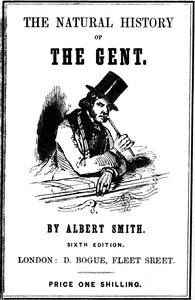
The finest specimens may be seen in the coloured “Fashions,” with which certain comically-disposed tailors adorn their windows. In these presumed representations of prevalent style, some favourite west-end locality is taken for the background; and, in front, are many Gents, in such attitudes as may display their figures and little boots to the best advantage. Some are supposed to be arrayed for an evening party, in green dress-coats and puce tights. Some, again, are represented as sportsmen, with pinched-in waists, that the shock of the first leap, or the kick of the first shot, would knock in half; and others are promenade Gents, in frock coats and corded trowsers, bowing to one another with much grace, or leading little Gents by the hand, who look like animated daguerreotypes of themselves. Well, then, these are Gents, pur sang. Observe, as the showman says, observe their fashionably-shaped hats, their Lilliputian boots, their tiny gloves. There is no deception. Observe that all their positions are evidently the result of much study; and that the greater part of them have one arm elevated, and the palm open, with the air of a conjurer when he says,—“You will perceive I have nothing in my hand.”
Of the same family as these Gents, are the fashionable loungers in pantomimes, who walk about with the distinguished females in the scanty visites of pink glazed calico, trimmed with ermine; and the lovers in the blue coats and white trowsers on the sixpenny valentines, who direct the attention of the adored one to the distant village church.
------------------------------------------------------------------------
ONE has only to look into the advertisements of cheap tailors, and the windows of ticketed shops, to form a very good notion of the other principal marks by which the Gent may be distinguished.
It should be borne in mind, that the main object of the Gent is to assume a position which he conceives to be superior to his own.
Now this, he fancies, is in a great measure accomplished by out-of-the-way clothes—a mark of superiority which has the advantage of requiring but a small outlay of intellect; and cunning manufacturers invent things on purpose to suit this taste, as the men of Manchester export gay-coloured, large-figured patterns for the negroes.
For him the cheap Tailor announces the “Gent’s Vest”—which is the Hebrew for “Snob’s Waistcoat”—as patronised by the nobility. To catch his eye alone, are the representations of men of ton put at the side of the advertisements; and, for his inspection, do the dummies stand at the doors of the shops, invested in the splendour of an entire suit, with an impossible waist, “made to measure for the same terms.”
And we may observe that the Gents usually speak of their get-up as _the ticket_—the term possibly being used in allusion to the badge which distinguished their various articles of dress when exposed for sale. And, in writing these, the leaning of the Gents towards distinguished associations is very evident. A great coat must be a “Chesterfield,” a “Taglioni,” or a “Codrington;” a little rag of coloured silk for the neck is called a “Byron Tie;” and so on. If the things are not dignified by these terms, the Gent does not think much of them.
To his taste does the ready-made Shoemaker appeal in the short fancy Alberts, ticketed “The Fashion.” If you are accustomed to derive a little gratuitous amusement from shop windows, as you go along the streets, you will see in them the funniest things, meant for the Gents, that it is possible to conceive. The most favourite style of chaussure is a species of cloth-boot, with a shiny-leather toe, and a close row of little mother-of-pearl shirt-buttons down the front; not for any purpose, for they are simply sewn on, the real method of fastening on the brodequin being by the humble lace and tag of domestic life, at the side.
But it is with the Haberdashers that the toilet of the Gents comes out strongest.
You will see “Gents’ Dress Kid” ticketed in the window. Be ye sure that they are large sized, awkwardly cut, yellow kid gloves, at one-and-sixpence. The tint is evidently a weakness with the Gents, who think them dashing, and say they come from Hoobegongs. But the merchants, lacking discrimination, believe that the predisposition is general. We will wager a dozen pairs of them that you never went into one of these establishments, and simply and decidedly demanded a pair of white kid gloves, but you were immediately asked “if you would not prefer straw-coloured?”
And then the stocks—what marvellous cravats they form! Blue always the favourite colour—blue, with gold sprigs! blue, with a crimson floss-silk flower! blue Joinvilles, with rainbow ends! And, if they are black and long, they are fashioned into quaint conceits: Frills of black satin down the front, or bands of the same fabric looking like an imitation of crimped skate; or studs of jet made like buttons, as if the Gent wore a cheap, black satin shirt, and that was where it fastened. And the white stocks are more fanciful still. They are not very popular in their simple form; for the Gents feel that they cannot help looking like waiters in them; and so a little illegitimate finery is necessary. Hence they have lace ends, like the stamped papers from the top of bon-bon and French plum boxes. And the effect in society is very fine.
The book keeps going
Reading is free forever. Sign up and watch scenes appear while you read.



Scenes Storieta drew for other classics.
New illustrated classics
Once or twice a month: the latest books to get full character casts, scene art, and free comic editions. No account needed.