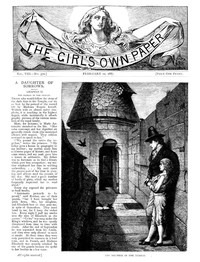
THE ORPHAN OF THE TEMPLE.
Those who would follow the story of the dark days in the Temple, can do so best by the perusal of the record left by Madame Royale herself. Written with an almost naive simplicity, it is touching in the highest degree, while incidentally it affords graphic pictures of the various members of the royal family.
Here, for instance, is Marie Antoinette sketched to the life. “Her calm contempt and her dignified air generally struck them (the municipal officers) with respect. They seldom ventured to speak to her.”
“We passed the entire day together,” writes the princess. “My father gave a lesson in geography to my brother; my mother made him read some pages of history, and learn some verses, and my aunt gave him a lesson in arithmetic. My father was so fortunate as to find a library which gave him occupation; my mother employed her time in working embroidery.... My aunt spent the greater part of her time in praying, and always read the prayers of the day. She read a great number of books of piety, which my mother frequently requested her to read aloud.”
Every day exposed the prisoners to fresh insults.
“Antoinette pretends to be proud,” said Rocher, one of their guards, “but I have brought her pride down. She, her daughter, and Elizabeth bow as they pass me, in spite of themselves. They must bend to me, for I keep the wicket low. Every night I puff my smoke into the eyes of Elizabeth as she passes.” “Ca ira” was sung under the King’s windows, and he was openly threatened from time to time with death. After the end of September he was separated from his family, and they were only allowed to meet at meals. At these times they were only permitted to converse in a loud tone, and in French, and Madame Elizabeth was severely rebuked by one of the guards because she spoke to her brother in a low voice.
In December and January came the King’s trial and condemnation. The agony of these days of suspense to the Queen, her sister, and her children, cannot be described. When the fatal sentence was pronounced, they were allowed one parting interview. The story of that farewell has often been told. It lasted for nearly two hours and a half. When the moment of separation came, Madame Royale swooned at her father’s feet, and had to be borne away by the faithful Cléry, from whom she was snatched by one of the municipal officers, who carried her roughly to her room. All the night she fell from one swoon to another, and her aunt only left her to prostrate herself before the crucifix in an agony of prayer.
“The Queen had scarcely strength sufficient left to undress my brother and put him to bed. She herself lay down in her clothes, and all night long we could hear her shivering with cold and anguish.” The King had promised to see them again in the morning, but he deemed it better not to expose them to the further ordeal. The beat of the drums and the shouts of the people told them that all was over.
“Nothing succeeded in calming the anguish of my mother,” writes Madame Royale; “life or death had become indifferent to her. She sometimes gazed at us with a piteously forlorn air that made us shudder. Happily my own illness was increased by sorrow, and this gave my poor mother some occupation.”
Marie Antoinette was unwilling to walk in the garden of the Temple after her husband’s death, for in so doing she was obliged to pass the door of the room where he had been confined. Afraid, however, that the want of air would tell on her children’s health, she obtained leave to walk with them on the top of the Tower. The platform was, however, surrounded with lattice work, and the air-holes were carefully stopped. The Queen asked to have a door opened between her room and that of Madame Elizabeth, but this request, after being referred to the Council General, was refused. At all hours—sometimes in the dead of night—their rooms were invaded by the municipals, or by commissaries of the convention, often intoxicated, who rudely searched every corner, and took away whatever little trifles they could find. “They searched even beneath our mattresses,” says Madame Royale, on one occasion; “my poor brother was sleeping. They tore him roughly from his bed that they might search it, and my mother held him in her arms, quite benumbed with cold.”
In the beginning of July the Convention ordered that the Dauphin should be separated from his mother, and committed to the guardianship of Simon, the shoemaker, in another part of the Tower. A terrible scene ensued when this decree was communicated to the hapless prisoners. The poor boy—he was only eight years old—threw himself with cries of terror into his mother’s arms for protection, and Marie Antoinette for more than an hour defended the bed on which she laid him against the municipal officers, protesting that they should kill her before they should take away her child. “At length they grew enraged, and threatened so positively to kill both him and me, that her love for us once more compelled her to yield. My aunt and I took my brother out of bed, as my mother herself had no strength left; and, as soon as he was dressed, she took him in her arms, and, after bathing him in her tears, which were the more bitter as she foresaw that it was the last time she should ever see him, she placed him herself in the hands of the municipal officers.”
The mother’s cup of sorrows was nearly full. Madame Royale thus pictures the days that followed:—
“We ascended to the top of the Tower very frequently, because my brother also walked there at his side of the building, and the only pleasure my mother now had was to get an occasional distant glimpse of him through a small slit in the division wall. She used to remain there for entire hours, watching the moment when she could see her child. This was her only desire, her only solace, and her only occupation.”
A month later Marie Antoinette’s own turn came, and she was removed to the Conciergerie. She rose up, and submitted herself in silence.
“My mother, having first tenderly embraced me and exhorted me to take courage, to pay every attention to my aunt, and to obey her as a second mother, repeated to me the religious instructions I had before received from my father, and then, throwing herself into the arms of my aunt, she recommended her children to her care. I could not utter a word in reply, so overwhelmed was I at the thought that it might be the last time I should see her. My aunt said a few words to her in a low voice of anguish and despair. My mother then hastened from the room without casting another look towards us, fearful, no doubt, lest her firmness should desert her. She was stopped for some time at the bottom of the stairs while the municipal officers drew up a procès verbal for the keeper of the prison as a discharge for her person. In passing through the prison gate she struck her head against the wicket, her thoughts being so occupied that she forgot to stoop. She was asked if she had hurt herself. ‘Oh, no,’ said she; ‘nothing now can hurt me.’”
Madame Royale and her aunt were now left alone. Inconsolable at the loss of the Queen, they made constant and urgent inquiries concerning her, and begged earnestly to be reunited to her. They were only told, however, in the vaguest terms that no harm would come to her. In September the rigour of their imprisonment was increased. They were confined to one room, and no longer allowed a servant to do the coarse work. “We made our beds ourselves, and were obliged to sweep the room, which took us a long time to do at first, until we got accustomed to it.” They were not allowed to walk on the Tower, for fear they should attempt to escape, although the windows were all barred. Anything that could tend in any way to their comfort or convenience was taken away. Madame Elizabeth asked for something instead of meat on fast days. She was told that under the new rules of equality there was no difference between the days. When she asked another time, she was told, “No one but fools believe now in all that nonsense.” In spite of these refusals, however, she managed to keep Lent strictly when it came. She took no breakfast, and reserved the coffee then provided for her dinner, while at night she only took bread. She wisely, however, forbade Madame Royale following her example, and urged her to eat whatever was brought, saying she had not yet come to an age which required her to abstain. In the winter evenings she taught her niece tric-trac, which they played together, “as a sort of distraction to our grief.” As the days began to get longer, however, they were not allowed any more candles, and had to go to bed as soon as it was dark.
The beautiful prayer composed by Madame Elizabeth, which the aunt and niece used daily, shows us the pure influence which was helping to mould Madame Royale’s character, and the spirit in which days of dreariness and grief were met and conquered:—
“What may befall me this day, O God! I know not; but I do know that nothing can happen to me which Thou hast not foreseen, ruled, willed, and ordained from all eternity; and that suffices me. I adore Thy eternal and inscrutable designs. I submit to them with all my heart, through love to Thee. I accept all; I make unto Thee a sacrifice of all; and to this poor sacrifice I add that of my Divine Saviour. In His name, and for the sake of His infinite merits, I ask of Thee that I may be endowed with patience under suffering, and with the perfect submission which is due to all which Thou willest or permittest.”
All this time they remained ignorant of the fate of the Queen. They had, indeed, heard the street hawkers crying the sentence of death under their windows; but, though their hearts misgave them at times, they refused to believe that the sentence could have been actually carried out, and so hoped against hope. Whether from callous indifference or because no one had the heart to tell them, the fatal news never reached their ears, and it was eighteen months before Madame Royale knew of her mother’s death.
Thus the days passed until the 9th of May, 1794. The day had been spent as usual, and the prisoners were just going to bed, when loud and continued knocking at the door and demands for immediate admission warned them of some new evil. The summons was for Madame Elizabeth. “Citizen, will you accompany us downstairs?” “And my niece?” “She shall be taken care of afterwards.” Madame Elizabeth embraced her niece, and told her, by way of reassuring her, that she would soon return. “No, citizen,” said the ruffians; “you will not return. Put on your bonnet and go downstairs.” “She bore it all with patience,” says Madame Royale, “put on her bonnet, embraced me once more, and told me to take courage and be firm, to place my hope in God, to live in the good principles of religion which my parents had taught me, and to keep constantly in my mind the last advice of my father and mother. She then departed.”
The young girl of fifteen was thus left, as she herself expresses it, “in an utter state of desolation.” She “passed a cruel night”; but, though filled with fears, she could not believe that serious harm could be intended to one who was so saintly and pure, and who could never be accused of taking any share in the Government or of any political offence. She was told the next day, in answer to her inquiries, that her aunt had been to take the air. She little thought that Madame Elizabeth had even then travelled her last journey and reached her long home.