Public-domain ebook
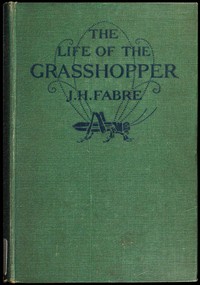
The Life of the Grasshopper
Language: en1,751 downloads on Project Gutenberg
Subjects
In: Science - Biology·Nature/Gardening/Animals
Public-domain ebook sourced from Project Gutenberg #66650.
Public-domain ebook
Language: en1,751 downloads on Project Gutenberg
Subjects
In: Science - Biology·Nature/Gardening/Animals
Public-domain ebook sourced from Project Gutenberg #66650.
The work is a scholarly essay on insects, assembled from previously published chapters that appeared in assorted miscellanies and translations. Its opening page explains that portions of the volume have already circulated under different titles, and that the present edition, titled Social Life in the Insect World, offers new photographs taken from life. From the very first chapter the author launches into a wide‑ranging meditation on the familiar fable of the cicada (or grasshopper) and the ant, using the story as a springboard to examine how folklore distorts natural history. The text proceeds to contrast the popular legend with observations of actual cicada behaviour, setting the stage for a detailed, almost forensic, exploration of insect habits and their cultural misrepresentations.
Written in the early twentieth‑century voice of Jean‑Henri Fabre, the prose combines erudite commentary with vivid, sometimes lyrical, description of field observations. Its style is deliberately didactic yet peppered with humor and occasional poetic interludes, reflecting the period’s blend of scientific rigor and literary flourish. Readers who relish meticulous natural‑history writing, enjoy the intersection of science and folklore, or appreciate a thoughtful, historically situated look at insects will find this book rewarding.
The opening · free to read
Fame is built up mainly of legend; in the animal world, as in the world of men, the story takes precedence of history. Insects in particular, whether they attract our attention in this way or in that, have their fair share in a folk-lore which pays but little regard to truth.
For instance, who does not know the Cicada, at least by name? Where, in the entomological world, can we find a renown that equals hers? Her reputation as an inveterate singer, who takes no thought for the future, has formed a subject for our earliest exercises in repetition. In verses that are very easily learnt, she is shown to us, when the bitter winds begin to blow, quite destitute and hurrying to her neighbour, the Ant, to announce her hunger. The would-be borrower meets with a poor welcome and with a reply which has remained proverbial and is the chief cause of the little creature’s fame. Those two short lines,
Vous chantiez! J’en suis bien en aise. Eh bien, dansez maintenant, [1]
with their petty malice, have done more for the Cicada’s celebrity than all her talent as a musician. They enter the child’s mind like a wedge and never leave it.
To most of us, the Cicada’s song is unknown, for she dwells in the land of the olive-trees; but we all, big and little, have heard of the snub which she received from the Ant. See how reputations are made! A story of very doubtful value, offending as much against morality as against natural history; a nursery-tale whose only merit lies in its brevity: there we have the origin of a renown which will tower over the ruins of the centuries like Hop-o’-my-Thumb’s boots and Little Red-Riding-Hood’s basket.
The child is essentially conservative. Custom and traditions become indestructible once they are confided to the archives of his memory. We owe to him the celebrity of the Cicada, whose woes he stammered in his first attempts at recitation. He preserves for us the glaring absurdities that are part and parcel of the fable: the Cicada will always be hungry when the cold comes, though there are no Cicadæ left in the winter; she will always beg for the alms of a few grains of wheat, a food quite out of keeping with her delicate sucker; the supplicant is supposed to hunt for Flies and grubs, she who never eats!
Whom are we to hold responsible for these curious blunders? La Fontaine, [2] who charms us in most of his fables with his exquisite delicacy of observation, is very ill-inspired in this case. He knows thoroughly his common subjects, the Fox, the Wolf, the Cat, the Goat, the Crow, the Rat, the Weasel and many others, whose sayings and doings he describes to us with delightful precision of detail. They are local characters, neighbours, housemates of his. Their public and private life is spent under his eyes; but, where Jack Rabbit gambols, the Cicada is an entire stranger: La Fontaine never heard of her, never saw her. To him the famous singer is undoubtedly a Grasshopper.
Grandville, [3] whose drawings have the same delicious spice of malice as the text itself, falls into the same error. In his illustration, we see the Ant arrayed like an industrious housewife. Standing on her threshold, beside great sacks of wheat, she turns a contemptuous back on the borrower, who is holding out her foot, I beg pardon, her hand. The second figure wears a great cartwheel hat, with a guitar under her arm and her skirt plastered to her legs by the wind, and is the perfect picture of a Grasshopper. Grandville no more than La Fontaine suspected the real appearance of the Cicada; he reproduced magnificently the general mistake.
For the rest, La Fontaine, in his poor little story, only echoes another fabulist. The legend of the Cicada’s sorry welcome by the Ant is as old as selfishness, that is to say, as old as the world. The children of Athens, going to school with their esparto-grass baskets crammed with figs and olives, were already mumbling it as a piece for recitation:
“In winter,” said they, “the Ants dry their wet provisions in the sun. Up comes a hungry Cicada begging. She asks for a few grains. The greedy hoarders reply, ‘You used to sing in summer; now dance in winter.’” [4]
This, although a little more baldly put, is precisely La Fontaine’s theme and is contrary to all sound knowledge.
Nevertheless the fable comes to us from Greece, which is preeminently the land of olive-trees and Cicadæ. Was Æsop really the author, as tradition pretends? It is doubtful. Nor does it matter, after all: the narrator is a Greek and a fellow-countryman of the Cicada, whom he must know well enough. My village does not contain a peasant so ignorant as to be unaware of the absolute lack of Cicadæ in winter; every tiller of the soil is familiar with the insect’s primary state, the larva, which he turns over with his spade as often as he has occasion to bank up the olive-trees at the approach of the cold weather; he knows, from seeing it a thousand times along the paths, how this grub leaves the ground through a round pit of its own making, how it fastens on to some twig, splits its back, divests itself of its skin, now drier than shrivelled parchment, and turns into the Cicada, pale grass-green at first, soon to be succeeded by brown.
The Attic peasant was no fool either: he had remarked that which cannot escape the least observant eye; he also knew what my rustic neighbours know so well. The poet, whoever he may have been, who invented the fable was writing under the best conditions for knowing all about these things. Then whence did the blunders in his story arise?
The Greek fabulist had less excuse than La Fontaine for portraying the Cicada of the books instead of going to the actual Cicada, whose cymbals were echoing at his side; heedless of the real, he followed tradition. He himself was but echoing a more ancient scribe; he was repeating some legend handed down from India, the venerable mother of civilizations. Without knowing exactly the story which the Hindu’s reed had put in writing to show the danger of a life led without foresight, we are entitled to believe that the little dialogue set down was nearer to the truth than the conversation between the Cicada and the Ant. India, the great lover of animals, was incapable of committing such a mistake. Everything seems to tell us that the leading figure in the original fable was not our Cicada but rather some other creature, an insect if you will, whose habits corresponded fittingly with the text adopted.
Imported into Greece, after serving for centuries to make the wise reflect and to amuse the children on the banks of the Indus, the ancient story, perhaps as old as the first piece of economical advice vouchsafed by Paterfamilias and handed down more or less faithfully from memory to memory, must have undergone an alteration in its details, as do all legends which the course of the ages adapts to circumstances of time and place.
The Greek, not possessing in his fields the insect of which the Hindu spoke, dragged in, as the nearest thing to it, the Cicada, even as in Paris, the modern Athens, the Cicada is replaced by the Grasshopper. The mischief was done. Henceforth ineradicable, since it has been confided to the memory of childhood, the mistake will prevail against an obvious truth.
Let us try to rehabilitate the singer slandered by the fable. He is, I hasten to admit, an importunate neighbour. Every summer he comes and settles in his hundreds outside my door, attracted by the greenery of two tall plane-trees; and here, from sunrise to sunset, the rasping of his harsh symphony goes through my head. Amid this deafening concert, thought is impossible; one’s ideas reel and whirl, are incapable of concentrating. When I have not profited by the early hours of the morning, my day is lost.
Oh, little demon, plague of my dwelling which I should like to have so peaceful, they say that the Athenians used to rear you in a cage to enjoy your singing at their ease! One we could do with, perhaps, during the drowsy hour of digestion; but hundreds at a time, all rattling and drumming in our ears when we are trying to collect our thoughts, that is sheer torture! You say that you were here first, do you? Before I came, you were in undisputed possession of the two plane-trees; and it is I who am the intruder there. I agree. Nevertheless, muffle your drums, moderate your arpeggios, for the sake of your biographer!
Truth will have none of the absurd rigmarole which we find in the fable. That there are sometimes relations between the Cicada and the Ant is most certain; only, these relations are the converse of what we are told. They are not made on the initiative of the Cicada, who is never dependent on the aid of others for his living; they come from the Ant, a greedy spoiler, who monopolizes every edible thing for her granaries. At no time does the Cicada go crying famine at the doors of the Ant-hills, promising honestly to repay principal and interest; on the contrary, it is the Ant who, driven by hunger, begs and entreats the singer. Entreats, do I say? Borrowing and repaying form no part of the pillager’s habits. She despoils the Cicada, brazenly robs him of his possessions. Let us describe this theft, a curious point in natural history and, as yet, unknown.
In July, during the stifling heat of the afternoon, when the insect populace, parched with thirst, vainly wanders around the limp and withered flowers in search of refreshment, the Cicada laughs at the general need. With that delicate gimlet, his rostrum, he broaches a cask in his inexhaustible cellar. Sitting, always singing, on the branch of a shrub, he bores through the firm, smooth bark swollen with sap ripened by the sun. Driving his sucker through the bung-hole, he drinks luxuriously, motionless and rapt in contemplation, absorbed in the charms of syrup and song.
Watch him for a little while. We shall perhaps witness unexpected tribulation. There are many thirsty ones prowling around, in fact; they discover the well betrayed by the sap that oozes from the margin. They hasten up, at first with some discretion, confining themselves to licking the fluid as it exudes. I see gathering around the mellifluous puncture Wasps, Flies, Earwigs, Sphex-wasps, [5] Pompili, [6] Rose-chafers [7] and, above all, Ants.
The smallest, in order to reach the well, slip under the abdomen of the Cicada, who good-naturedly raises himself on his legs and leaves a free passage for the intruders; the larger ones, unable to stand still for impatience, quickly snatch a sip, retreat, take a walk on the neighbouring branches and then return and show greater enterprise. The coveting becomes more eager; the discreet ones of a moment ago develop into turbulent aggressors, ready to chase away from the spring the well-sinker who caused it to gush forth.
In this brigandage, the worst offenders are the Ants. I have seen them nibbling at the ends of the Cicada’s legs; I have caught them tugging at the tips of his wings, climbing on his back, tickling his antennæ. One, greatly daring, went to the length, before my eyes, of catching hold of his sucker and trying to pull it out.
The book keeps going
Reading is free forever. Sign up and watch scenes appear while you read.



Scenes Storieta drew for other classics.
New illustrated classics
Once or twice a month: the latest books to get full character casts, scene art, and free comic editions. No account needed.