Public-domain ebook
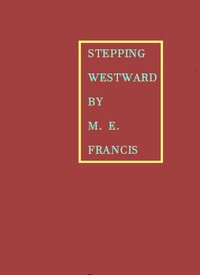
Stepping Westward
Language: en444 downloads on Project Gutenberg
Subjects
In: Romance·Novels·British Literature
Public-domain ebook sourced from Project Gutenberg #66833.
Public-domain ebook
Language: en444 downloads on Project Gutenberg
Subjects
In: Romance·Novels·British Literature
Public-domain ebook sourced from Project Gutenberg #66833.
The opening · free to read
THE wayside hedgerow, gay with its autumn tints, stretched its undulating length beside the rather stony lane that wound upwards from the high road, and lost itself amid a multiplicity of sheep-tracks on the down.
It was one of those mild days that here in the south country cheat the fancy with their likeness, not merely to spring, but to summer. The sky was blue and cloudless; the birds were singing; the banks were still starred with many flowers: crane’s-bill, mallow and scabious. Here and there the gorse was blooming afresh, and new blossoms of guelder-rose surmounted, incongruously enough, twigs with claret-coloured leaves that dropped at a touch. Here, indeed, the finger of autumn had left its trace, and all along the hedge were tokens of its magic. Such miracles of colour as the conjurer had wrought this year are rarely to be seen: such goldens and ambers, such scarlets and crimsons; stretching away beyond the hedge were fields still silvery with night-dews, and woods shining with the incomparable burnish of the season.
Sol Bowditch, the hedger, had no eyes for any of these beauties, however; under the strokes of that uncompromising bill-hook of his the glories of the hedge were shorn. Bending his vigorous young body backwards, he threw all his strength into the task, and with each rhythmical swing of his sturdy arm a fresh victim fell. Now a branch of maple that seemed to shower stars as it dropped; now a jagged wild-rose, heavily laden with ruby provender which later on might have made many a starving bird happy; now a hazel-twig with a few belated nuts still clinging to their shrivelled wrappings; now, with quick sharp strokes, making short work of hawthorn and privet; again tearing, rather than cutting with his hook, long-tufted tendrils of jewelled bryony or hoary traveller’s-joy.
Thus was beauty laid low and nature’s kindly forethought set at nought. Farmer House cared little for the poetical aspect of things, and still less for the wants of the singing-birds; being apt, indeed, to speak of all wild creatures in a lump as “dratted varmint.” It was Sol Bowditch’s duty to please Farmer House, and so between them the birds’ winter store was trampled under foot or scattered to the winds.
Sol Bowditch was a stranger, having recently tramped hither all the way from Bridport in search of work; but though he had travelled on foot and carried his worldly goods in a small bundle, he was unquestionably an honest and respectable young fellow. No one who looked at his brown face and clear eyes could doubt that fact, and as for the manner in which he wielded his bill-hook it was, as the farmer said, a treat to see him.
It wanted yet an hour or two of dinner-time when Sol, having paused a moment to finish tearing away an obstinate tangle of bryony, was startled by the approaching sound of wheels; and, looking up, saw the rim of the green hood of a carrier’s cart slowly rounding the corner of the lane from the point where it descended from the down. The horse was apparently very old, for it proceeded slowly; and the vehicle creaked and jolted as if it too were ancient. As it jogged nearer Sol saw that it contained but a single occupant, that of the girl-driver, and when it came nearer yet he observed that she was young and pretty; her face, with its clear, yet delicate colouring, framed in curling brown hair, standing out against the background of the old green “shed” like a picture, as he said to himself. The girl’s eyes rested on him for a moment as she jogged past, and he jerked his head at her sideways in a manner which implied as plainly as words: “Good day.” She nodded back at him brightly, yet modestly, and the vehicle, which was, as Sol observed, filled with packages of various sizes, went rattling on its downward way, the horse stumbling and sliding every now and then, and being admonished in a high, clear treble.
Dinner-time came, and rest, and then work again, and finally, with a suddenness proper to the time of year, dusk. Sol was just in the act of putting on his coat preparatory to leaving the scene of his labours, when he caught sight, in the far distance, of a wavering light, and presently heard the creaking and rattling of an ancient vehicle which he inwardly decided to be the carrier’s cart returning.
It was indeed the only cart of any kind which had passed his way that day. As he picked up his bill-hook and walked slowly to meet it, for his homeward path must perforce take him past it, he could see the outline of the girl’s figure, and observe that it was bent forward; her voice at the same time was uplifted as if in anxiety or distress.
“Dear, to be sure! Whatever must I do now? Come up, Di’mond, you’re shammin’. No, he bain’t, poor beast.”
Just as Sol was a pace or two away she threw the reins on the horse’s back and leaped to the ground, the animal immediately halting.
“What be the matter here?” enquired Sol, as she lifted the lantern from its place and ran round to the other side.
“Oh, I don’t know. He mid ha’ picked up a stone or summat, or he mid only be lazy—you never can tell wi’ he. Hold up, Diamond. That’s all right; hold up again.”
“There’s a stone,” cried Sol eagerly, “and wedged so tight as anything. ’Tis so big as a happle—I wonder it didn’t throw en.”
“Stand!” cried the girl, still in an exasperated tone, as she deposited the lantern on the ground, and hunted about for a larger stone wherewith to dislodge the pebble which was indeed jammed in Diamond’s hind hoof.
“Here, let me,” said Sol. “Keep your fingers out o’ the way else I’ll be a-hammerin’ o’ they.”
The rays of the lantern, striking upwards, revealed a flashing smile which belied the seeming gruffness of tone and words.
The girl straightened herself and stood back:—“Don’t be long about it, that’s all!” said she. “I’m late as it is—and tired just about!”
“Why, what be you a-doin’ travellin’ the roads so late?” enquired Sol, as he struck at the recalcitrant pebble.
“I do travel the road every day,” returned she. “I do get my livin’ by it. I’m a tranter.”
Sol was so much astonished by the announcement that he was obliged to look up, whereupon Diamond immediately jerked away his hoof.
“I never did hear of a maid bein’ a tranter afore!” remarked the hedger with a grin.
“An’ what ’ud ye say to a old ’ooman of seventy-five bein’ a tranter then?” returned she triumphantly. “My grammer have only just left off a-drivin’ o’ this ’ere cart, an’ now I do do it. E-es, we’ve done all the trantin’ in our place for nigh upon fifty year, I mid say.”
“There! well now,” commented Sol, as he recaptured the hoof, and resumed his labours.
“E-es, my granfer begun it, an’ then when he died my father kept it on, an’ when he died my grammer took it up, an’ now I do do it. Can’t ye shift that stone?”
“He be coming,” returned Sol. “’Tis queer work for a maid, an’ lwonesome too.”
“’Tis a bit lwonesome just about here,” she agreed. “I do generally have company part of the time, but nobody comes our ways much, an’ this ’ere bit o’ lane an’ the track over the down is lwonesome, once it do get so dark.”
“There he goes!” exclaimed Sol, as the stone, yielding to an especially vigorous tap, dropped into the road. “I’ll walk a bit alongside of ’ee in case the harse should go lame or anything.”
“Oh, no need to come so far out of your road,” returned she. “I’ll not trouble you.”
Sol, without heeding this protest, picked up the lantern, and restored it to its place, and then extended a hand to assist the girl to mount. She accepted his help, seated herself, and gathered up the reins once more.
“Good night, and thank ye,” said she.
“I’m comin’ part o’ the road wi’ ye,” said Sol, exactly as if he had made no such suggestion before.
She chirruped to the horse and it plodded on, Sol’s tall figure keeping pace with it. Presently he rested one hand upon the shaft, the lantern-light revealing how strong it was, and brown.
“My name’s Solomon Bowditch,” he remarked.
“Oh, an’ be it?” she returned faintly.
“E-es. What be yours?”
“Sally Roberts.”
“Tranter Sally,” remarked Sol with a laugh.
“They call me that sometimes,” she conceded. “Here we be at the top of the hill, Mr Bowditch. I be goin’ to make en trot now.”
“I can trot too,” said Sol, and indeed his long legs carried him along at a pace that shamed the shambling efforts of poor Diamond.
Sally protested, scolded, and finally laughed: Sol took no notice of any of these modes of procedure, his tall figure jogged along at the same steady pace, just a little in front of the hood, so that the light fell full on his honest good-humoured face, and broad-shouldered frame. The cart went bumping and jolting over the uneven down track, now threading its way between patches of firs, now rounding a copse of stunted trees. At last a few twinkling lights came in view, shining fitfully from a not far distant hollow.
The book keeps going
Reading is free forever. Sign up and watch scenes appear while you read.



Scenes Storieta drew for other classics.
New illustrated classics
Once or twice a month: the latest books to get full character casts, scene art, and free comic editions. No account needed.