Public-domain ebook
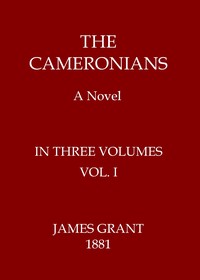
The Cameronians: A Novel, Volume 1 (of 3)
by James Grant
Language: en445 downloads on Project Gutenberg
Subjects
In: Historical Novels·Novels·British Literature
Public-domain ebook sourced from Project Gutenberg #66873.
Public-domain ebook
by James Grant
Language: en445 downloads on Project Gutenberg
Subjects
In: Historical Novels·Novels·British Literature
Public-domain ebook sourced from Project Gutenberg #66873.
The opening · free to read
EAGLESCRAIG.
'Twenty-sixth Regiment,' said the old general, raising his voice, as he rustled the morning paper importantly, after taking it from the ebony reading-easel (attached to the arm of his large and comfortable velvet easy-chair), whereon Mr. Tunley, the butler, always laid the journals, after he had duly aired and cut them. 'Twenty-sixth Regiment,' he added, coughing and clearing his voice, 'a detachment of this distinguished corps, says the Ayr Observer, has recently arrived at the castle of Dumbarton, under the command of Lieutenants Cecil Falconer and Leslie Fotheringhame.'
'Well, there is nothing remarkable in that, uncle,' said one of his young lady listeners, who seemed chiefly intent upon her breakfast, and not much interested by the intelligence.
'My old regiment--my old regiment still,' said the old man, musingly. 'Gad, I'll have the senior--what's his name? Cecil Falconer--over here, for a few days' cover-shooting.'
'And why not the other too?' asked the young lady who had just spoken, laughingly; 'we might have an admirer each, Annabelle.'
But Miss Erroll, to whom the name of Fotheringhame seemed not unknown, coloured and did not reply.
'Both could not leave their men at the same time,' said the general.
'Then I hope the senior is a pleasant fellow--he whom you propose to bring, Sir Piers,' said Mr. Hew Montgomerie, of whom more anon.
'All the Cameronians were pleasant fellows in my time,' said the general, tartly, 'and I have no doubt they are so still. And remember, girls, that the smartest officers are usually selected for detachment duty,' he added.
Those remarks passed in the cosy and elegant morning-room of Eaglescraig, the mansion of Sir Piers Montgomerie, Bart., who--a retired general officer--was G.C.B. and G.C.S.I. and Colonel of the Cameronian Regiment, and Governor of the Castle of Dumbarton: and the party at breakfast consisted only of Sir Piers, his remote kinsman and heir, Hew Montgomerie, of the Indian Civil Service, home on a year's leave; his grandniece and orphan ward Mary, also a Montgomerie; her friend Annabelle Erroll--both very handsome girls--and an old lady who presided over the silver tea-urn and Wedgewood breakfast equipage, Mrs. Garth, Mary's governess and friend, the widow of an old captain of the Cameronians--five personages, with whom we hope to make the reader fully acquainted in time.
Sir Piers was verging now on his seventieth year, but he was fresher and more hale and hearty than many a man of fifty. His features were still handsome and regular, though lined and wrinkled; his eyes were keen as those of a hawk, and his figure, still wonderfully erect, was clad in a rich maroon-coloured robe-de-chambre, with yellow silk facings, cord, and tassels, and he was seated near the blazing winter fire, with his feet on a velvet stool, and encased in slippers of Mary's handiwork.
Generous by nature, yet hot-tempered and proud---pride of birth had been a positive vice with him in early life--Sir Piers was a curious mixture of the testy old Indian general, accustomed to every luxury, including tyrannising over 'niggers,' with the country gentleman of the old school; and having a profound admiration for the service and everything pertaining thereto, like old Bismarck, he believed that every man should be a soldier and rejoice in being one.
In his latter years Sir Piers had not been with the Cameronians, but had seen a deal of service in India as a general officer, and, while slowly creeping up the list of his rank, had been appointed, in the usual courtesy of the army, full colonel of the old regiment in which he had been a subaltern and field-officer.
His hunting-days were well-nigh past now; yet, at a meet, all the field rejoiced to see the fine old man in his saddle, and with all his pride of bearing--for a wealthy parvenu, however honestly he had won his wealth, Sir Piers would have treated with chilling hauteur--he was never above conversing with some sturdy farmer of Kyle or Cunninghame, kindly and affably, on the price of stock, the fall of wheat, on breeding, fattening, or draining, and always winding up by some, often irrelevant, anecdote of his sporting experiences in India, or when he followed the drums of the Cameronians. Old as he was, he had never been known to shrink from a bullfinch, or be fished out of a brook; he was welcome in every homestead throughout the country-side, and the farmers' wives always assumed their brightest looks, brought forth their whitest tablecloths and the best contents of larder and pantry, in honour of the old Laird of Eaglescraig, when he came their way.
He was a Justice of the Peace and Commissioner of Supply for the County; he read the Field, of course, as what country gentleman does not? He studied the War Office Gazette regularly, as if he expected his own name to appear there, once weekly; he was simple in all his tastes and happy in all his surroundings, yet, for all that, there was a skeleton in his house and heart, known, perhaps, to himself alone.
He was a childless man now--childless by an act of his own--and the title and estates, which he inherited from a long line of ancestors, were eventually to pass from him to the heir of entail, whom he strove hard, but in vain, to like or admire.
The latter, Hew Caddish Montgomerie, was then about thirty years of age. He was not ungentlemanly either in manner or bearing; but his face, like his disposition, was very defective. His eyes were called grey, and seemed to be grey at times; yet, on closer inspection, it was but too apparent that those shifty and furtive orbs of his were of different colours, for one was a species of bilious green.
They were closely set on each side of a nose that strongly resembled a shoe-horn, and his mouth, which was both cruel and licentious in contour, was partly concealed, or altered in expression, by a luxuriant brown moustache. He had come home, we have said, on leave from the C.S., a sharp hand at cards and with a billiard-cue, deeply dipped in debt, and with the current reputation, among his set, of being 'a bad lot.' His mother, daughter of a Sudder judge, was one of the old English family of Caddish, a name which Hew was wont to affirm was a corruption of Cavendish; be that as it may, the corruption thereof, in some instances, suited his character amazingly well.
'This is rather unlike your usual proud exclusiveness, Sir Piers,' said he, after a pause.
'What? inviting this young officer to knock over a few birds?'
'Yes--without an introduction.'
'Introduction? None was needed in my time; the epaulettes were introduction enough everywhere. The service is certainly not what it was in my day, the special school of honour and politeness; but I'll do the right thing, for all that. Let me see, which is senior--Falconer or Fotheringhame. Tunley, hand me the "Army List." Thanks. It is Falconer. I have known what it is to be on detachment in such a dull hole as Dumbarton, killing time till the spring drills come on, so I'll invite the senior.'
'And how about the poor junior?' asked Miss Erroll, colouring slightly again.
'Well, even to gratify you, Annabelle, I cannot bring him,' said the general, laughing. 'I remember once, when we were in cantonments at Barrackpore----' Hew smiled as the general began thus; but they were spared the probably prosy reminiscence, for just then Sir Piers' faded features clouded suddenly, as he put down the 'Army List' and said, in a changed voice: 'Had my boy Piers lived, he might now have been at the head of the regiment--five-and-twenty years ago--five-and-twenty years! My God, how long--how time has rolled away!'
His eyes, as he thought this, rather than spoke it all aloud, were cast for a moment furtively--as if he was ashamed of exhibiting any sudden emotion--on the full-length portrait of a handsome young subaltern, in the uniform of the Cameronians, scarlet faced with yellow, massive gold epaulettes, and the silver sphinx on his belt-plate. It represented a spirited-looking young fellow with a proud and joyous expression of face, and a well-knit, well-set-up figure.
The shifty, parti-coloured eyes of Hew Montgomerie travelled for a moment in the same direction, and then he addressed himself to the grouse-pie, thinking the while that 'things were deucedly well ordered as they were, so far as he was concerned.' And then the meal proceeded somewhat silently, Mrs. Garth officiating over the cups, and Mr. Tunley, a paragon of old rubicund butlers, at the side-board, where the cold beef and grouse-pie were placed, among Indian jars and old silver race tankards.
Mary Montgomerie, the general's grand-niece and ward, and her chief friend and gossip, Annabelle Enroll, were both attractive and very handsome girls, each in her twentieth year, but different in their styles and complexions.
Of a good stature, and round, firm and graceful in form, Mary Montgomerie had well-defined eyebrows, eyes, and hair, all of the darkest brown; long lashes lent a great softness to her white-lidded eyes, and she had a quiet ease, elegance, and girlish innocence of manner; yet at times she was full of vivacity, born of the fact or knowledge that she had been, as an orphan, from her youth, much of a petted child, and reminded by many around her that she was the heiress of many a thousand and many an acre, provided that she wedded with the full approval of one who was not likely to be severe upon her--old Sir Piers, her grand-uncle and legal guardian; for she was the only daughter of his favourite younger brother--younger by several years.
As such she filled a void in his heart, and ever and anon the old man's eyes were wont to rest kindly, fondly, and admiringly upon her.
Her complexion was fair and creamy, her features regular and minute, yet they were hardly ever in repose, for every variety of expression, as thought inspired it, flitted over the ever-changing face.
Though less favoured by fortune, and even by nature, her friend Miss Erroll was nevertheless a charming girl of the blonde type, with grey-blue eyes and fair hair shot with gold, as it seemed, in the sunlight, soft, plentiful, and wavy as the darker tresses of Mary, and her eyebrows and their lashes were just a shade darker than her hair. In the tone and tenour of her ways she was less impulsive than Mary Montgomerie, who at times would come down the house stairs at a headlong rush, while Annabelle followed with calm step and slow, or would quietly seek a gate in the hunting-field, while Mary, with her horse's head uplifted by her light, unerring hand, cleared the nearest hedge at a flying leap, and with a laugh that rang like a merry silver bell.
Both girls were eminently graceful and full of charming manners and pretty winning words and ways; but the difference of their temperaments was indicated even by the style of their morning-dresses, for the robe of Annabelle was pale blue, as became the character of her beauty, while that of Mary was of warm maize colour, tied with fluttering scarlet ribbons, with rosettes of the same to match on her tiny slippers. The loose, wide, falling sleeves of this garment coquettishly showed her round white arm at times, from the taper wrist to the dimpled elbow, and then she would smile and hastily let them fall forward when she caught the quick, shifty eyes of Hew Montgomerie cast admiringly on her.
The book keeps going
Reading is free forever. Sign up and watch scenes appear while you read.



Scenes Storieta drew for other classics.
New illustrated classics
Once or twice a month: the latest books to get full character casts, scene art, and free comic editions. No account needed.