Neely's Booklet Series. No. 26, June 26, 1899. Issued weekly $5.00 a year. Entered as second-class matter at New York Post Office.
F. TENNYSON NEELY, PUBLISHER, LONDON. NEW YORK. CHICAGO.
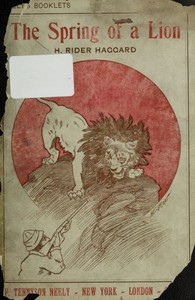
THE SPRING OF A LION.
The story which is narrated in the following pages came to me from the lips of my old friend Allan Quatermain, or Hunter Quatermain, as we used to call him in South Africa. He told it to me one evening when I was stopping with him at the place he bought in Yorkshire. Shortly after that, the death of his only son so unsettled him that he immediately left England, accompanied by two companions, who were old fellow-voyagers of his, Sir Henry Curtis and Captain Good, and has now utterly vanished into the dark heart of Africa. He is persuaded that a white people, of whom he has heard rumors all his life, exists somewhere on the highlands in the vast, still unexplored interior, and his great ambition is to find them before he dies. This is the wild quest upon which he and his companions have departed, and from which I shrewdly suspect they never will return. One letter only have I received from the old gentleman, dated from a mission station high up the Tana, a river on the east coast, about three hundred miles north of Zanzibar; in it he says they have gone through many hardships and adventures, but are alive and well, and have found traces which go far toward making him hope that the results of their wild quest may be a "magnificent and unexampled discovery." I greatly fear, however, that all he has discovered is death; for this letter came a long while ago, and nobody has heard a single word of the party since. They have totally vanished.
It was on the last evening of my stay at his house that he told the ensuing story to me and Captain Good, who was dining with him. He had eaten his dinner and drunk two or three glasses of old port, just to help Good and myself to the end of the second bottle. It was an unusual thing for him to do, for he was a most abstemious man, having conceived, as he used to say, a great horror of drink from observing its effects upon the class of men--hunters, transport riders, and others--among whom he had passed so many years of his life. Consequently, the good wine took more effect on him than it would have done on most men, sending a little flush into his wrinkled cheeks, and making him talk more freely than usual.
Dear old man! I can see him now, as he went limping up and down the vestibule, with his gray hair sticking up in scrubbing-brush fashion, his shrivelled yellow face, and his large dark eyes, that were as keen as any hawk's and yet soft as a buck's. The whole room was hung with trophies of his numerous hunting expeditions, and he had some story about every one of them, if only you could get him to tell them. Generally he would not, for he was not very fond of narrating his own adventures, but to-night the port wine made him more communicative.
"Ah, you brute!" he said, stopping beneath an unusually large skull of a lion, which was fixed just over the mantelpiece, beneath a long row of guns, its jaws distended to their utmost width. "Ah, you brute! you have given me a lot of trouble for the last dozen years, and will, I suppose, to my dying day."
"Tell us the yarn, Quatermain," said Good. "You have often promised to tell me, and have not."
"You had better not ask me to," he answered, "for it is a longish one."
"All right," I said, "the evening is young, and there is some more port."
Thus adjured, he filled his pipe from a jar of coarse-cut Boer tobacco that was always standing on the mantelpiece, and still walking up and down the room, began:
"It was, I think, in the March of 1869 that I was up in Sikukuni's country. It was just after old Sequati's time, and Sikukuni had got into power--I forget how. Any way, I was there. I had heard that the Bapedi people had got down an enormous quantity of ivory from the interior, and so I started with a wagon-load of goods, and came straight away from Middelburg to try and trade some of it. It was a risky thing to go into the country so early, on account of the fever, but I knew that there were one or two others after that lot of ivory, so I determined to have a try for it, and take my chance of fever. I had got so tough from continual knocking about that I did not set it down at much. Well, I got on all right for awhile. It is a wonderfully beautiful piece of bush veldt, with great ranges of mountains running through it, and round granite koppies starting up here and there, looking out like sentinels over the rolling waste of bush. But it is very hot--hot as a stew-pan--and when I was there that March, which, of course, is autumn in that part of Africa, the whole place reeked of fever. Every morning, as I trekked along down by the Oliphant River, I used to creep out of the wagon at dawn and look out. But there was no river to be seen--only a long line of billows of what looked like the finest cotton wool tossed up lightly with a pitchfork. It was the fever mist. Out from among the scrub, too, came little spirals of vapor, as though there were hundreds of tiny fires alight in it--reek rising from thousands of tons of rotting vegetation. It was a beautiful place, but the beauty was the beauty of death; and all those lines and blots of vapor wrote one great word cross the surface of the country, and that word was 'fever.'
"It was a dreadful year of illness, that. I came, I remember, to one little kraal of Knobnoses, and went up to see if I could get some maas (curdled buttermilk) and a few mealies. As I got near, I was struck with the silence of the place. No children began to chatter, and no dogs barked. Nor could I see any native sheep or cattle. The place, though it had evidently been recently inhabited, was as still as the bush round it, and some guinea fowl got up out of the prickly pear bushes right at the kraal gate. I remember that I hesitated a little before going in, there was such an air of desolation about the spot. Nature never looks desolate when man has not yet laid his hand upon her breast; she is only lonely. But when man has been and has passed away, then she looks desolate.
"Well, I passed into the kraal, and went up to the principal hut. In front of the hut was something with an old sheepskin kaross (rug) thrown over it. I stooped down and threw off the rug, and then shrank back amazed, for under it was the body of a young woman, recently dead. For a moment I thought of turning back, but my curiosity overcame me; so going past the woman, I went down on my hands and knees and crept into the hut. It was so dark that I could not see anything, though I could smell a great deal--so I lit a match. It was a 'tand-stickor' match, and burnt slowly and dimly, and as the light gradually increased I made out what I thought was a lot of people, men, women, and children, fast asleep. Presently it burnt up brightly, and I saw that they, too, five of them altogether, were quite dead. One was a baby. I dropped the match in a hurry, and was making my way out of the hut as hard as I could go, when I caught sight of two bright eyes staring out of a corner. Thinking it was a wildcat or some such animal, I redoubled my haste, when suddenly a voice near the eyes began first to mutter, and then to send up a succession of awful yells. Hastily I lit another match, and perceived that the eyes belonged to an old woman, wrapped up in a greasy leather garment. Taking her by the arm, I dragged her out, for she could not, or would not, come by herself, and the stench was overpowering me. Such a sight as she was--a bag of bones, covered over with black, shrivelled parchment. The only white thing about her was her wool, and she seemed to be pretty well dead except for her eyes and her voice. She thought that I was a devil come to take her, and that is why she yelled so. Well, I got her down to the wagon, and gave her a "tot" of Cape smoke, and then, as soon as it was ready, poured about a pint of beef-tea down her throat, made from the flesh of a blue vilderbeeste I had killed the day before, and after that she brightened up wonderfully. She could talk Zulu--indeed, it turned out that she had run away from Zululand in T'Chaka's time--and she told me that all the people that I had seen had died of fever. When they had died, the other inhabitants of the kraal had taken the cattle and gone away, leaving the poor old woman, who was helpless from age and infirmity, to perish of starvation or disease, as the case might be. She had been sitting there for three days among the bodies when I found her. I took her on to the next kraal, and gave the headman a blanket to look after her, promising him another if I found her well when I came back. I remember that he was much astonished at my parting with two blankets for the sake of such a worthless old creature. 'Why did I not leave her in the bush?' he asked. Those people carry the doctrine of the survival of the fittest to its extreme, you see.
"It was the night after I had got rid of the old woman that I made my first acquaintance with my friend yonder," and he nodded toward the skull that seemed to be grinning down at us in the shadow of the wide mantelshelf. "I had trekked from dawn till eleven o'clock--a long trek--but I wanted to get on; and then had the oxen turned out to graze, sending the voorlooper to look after them, meaning to inspan again about six o'clock, and trek with the moon till ten. Then I got into the wagon and had a good sleep till half-past two or so in the afternoon, when I got up and cooked some meat, and had my dinner, washing it down with a pannikin of black coffee--for it was difficult to get preserved milk in those days. Just as I had finished, and the driver, a man called Tom, was washing up the things, in comes the young scoundrel of a voorlooper driving one ox before him.
"'Where are the other oxen?' I asked.
"'Koos!' he said, 'Koos! (chief), the other oxen have gone away. I turned my back for a minute, and when I looked round again, they were all gone except Kaptein here, who was rubbing his back against a tree.'
"'You mean that you have been asleep, and let them stray, you villain. I will rub your back against a stick,' I answered, feeling very angry, for it was not a pleasant prospect to be stuck up in that fever trap for a week or so while we were hunting for the oxen. 'Off you go, and you too, Tom, and mind you don't come back till you have found them. They have trekked back along the Middelburg Road, and are a dozen miles off by now, I'll be bound. Now, no words; go, both of you.'
"Tom, the driver, swore and caught the lad a hearty kick, which he richly deserved, and then, having tied old Kaptein up to the disselboom with a reim, they got their assegais and sticks and started. I would have gone too, only I knew that somebody must look after the wagon, and I did not like to leave either of the boys with it at night. I was in a very bad temper indeed, although I was pretty well used to these sort of occurrences, and soothed myself by taking a rifle and going to kill something. For a couple of hours I poked about without seeing anything that I could get a shot at, but at last just as I was again within seventy yards of the wagon, I put up an old Impala ram from behind a mimosa thorn. He ran straight for the wagon, and it was not till he was passing within a few feet of it that I could get a decent shot at him. Then I pulled, and caught him halfway down the spine; over he went, dead as a doornail, and a pretty shot it was, though I ought not to say it. This little incident put me into rather a better temper, especially as the buck had rolled over right against the after part of the wagon, so I had only to gut him, fix a reim round his legs, and haul him up. By the time I had done this the sun was down, and the full moon was up, and a beautiful moon it was. And then there came down that wonderful hush that sometimes falls over the African bush in the early hours of the night. No beast was moving, and no bird called. Not a breath of air stirred the quiet trees, and the shadows did not even quiver; they only grew. It was very oppressive and very lonely, for there was not a sign of the cattle or the boys. I was quite thankful for the society of old Kaptein, who was lying down contentedly against the disselboom, chewing the cud with a good conscience.