Public-domain ebook
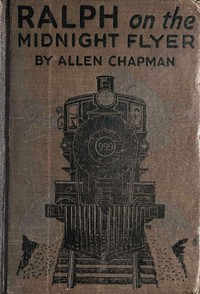
Ralph on the Midnight Flyer; or, The Wreck at Shadow Valley
English428 downloads on Project GutenbergDownload EPUB
Public-domain ebook sourced from Project Gutenberg #67030.
Public-domain ebook
English428 downloads on Project GutenbergDownload EPUB
Public-domain ebook sourced from Project Gutenberg #67030.
The opening · free to read
“What do you think, Ralph? Would any of our Great Northern employees be foolish enough to join this wildcat strike?”
“Well, what do you think yourself?” asked Ralph Fairbanks, with some impatience in his tone. “You know these roughnecks as well as I do.”
The general manager, in whose office at Rockton they were sitting, threw up both hands and fairly snorted his disgust.
“I’ve been a long time at the railroad game,” he declared; “but I never yet understood the psychology of a maintenance of way man. No, sir. In some things they are as loyal to the road as I am myself. And then they suddenly go off at a tangent because of something that, for the life of me, I cannot see is important.”
“There lies the difficulty—the germ of the whole trouble,” Ralph Fairbanks said thoughtfully.
He was a young fellow of attractive personality—good looking, too. The girls had begun to notice the young railroader, and had he not been so thoroughly devoted to his calling—and to the finest mother a fellow ever had—Ralph might have been somewhat spoiled by the admiration accorded him in certain quarters.
Just now, however, having been called in from the train dispatchers’ department where he worked, the young fellow’s attention was deeply engaged in the subject the general manager had brought up. Ralph was an extraordinary employee of the Great Northern. His superiors trusted him thoroughly. And having worked his way up from the roundhouse, switch tower, as fireman and engineer, to the train dispatcher’s grade, he was often called upon by the railroad officials for special duties.
The general manager stared at the young fellow after his last remark for fully a minute before asking:
“What do you mean by that? What is the germ of the whole trouble?”
“The fact that the officials cannot see things just as the men see them.”
“Oh!”
“No getting away from the fact that the laborer seldom looks at a thing as his superior looks at it,” Ralph pursued earnestly. “A rule promulgated by some officer of the road seems to him the simplest way of getting at a needed result. But after it is spread on the board at the roundhouse, for instance, it creates a riot.”
“So it does. And I am hanged if I have been able to understand in some cases why the men go off half-cocked over some simple thing.”
“Not simple at all to them. It is often a rule that lops off some cherished privilege. It may be something that looks as though it were aimed at the laborer’s independence.”
“Bah!” ejaculated the general manager with more than a little disdain in his tone.
“You see!” laughed Ralph. “You can’t see it in the same way that I can, for instance. You make an order, say, changing the style of the caps the men wear around the roundhouse and switch towers, and see what a row you’ll have on your hands. Some ‘lawyer’ among ’em will see a deliberate attempt for somebody to graft—or worse. Those caps they get for a quarter and can buy in the little stores that crop up around every railroad yard. The hogheads and firemen wear them. Everybody wears them. You order that the cap hereafter worn shall be quite different from the present cap, and you’ll start something that you’ll never be able to stop save by buckling down to the boys.”
“But why?” demanded the official. “Tell me! What is the reason? Another cap might not cost them a penny more——”
“Or might not cost them as much. That would make no difference. You strike at his independence in changing the style of the cap. And his independence is the most cherished possession of the railroader. You should know that.”
“I know that they think they are independent,” growled the general manager. “But like the rest of us, they are just about as independent as the hog on the cake of ice.”
The young train dispatcher laughed again. He could really appreciate the mental attitude of both the disgruntled railroad workers, at this time stirred up all over the country from ocean to ocean, and the higher officials of the road, who realized fully that unless all branches of the railroad pulled together during the next few months there would surely come financial wreckage to many systems.
The Great Northern was really in better circumstances than many trunk lines at the time. But on the division the headquarters of which were here in Rockton, friction had developed. The shopmen talked strike; the yardmen were disgruntled; the section hands of the division talked more than they worked. Altogether the situation was so serious that the general manager himself found it necessary to look the field over.
And it was not strange that he should have called Ralph Fairbanks into conference. Young as the latter was, he was a link between the officials and the workmen at large.
“Look here, Ralph,” said the general manager suddenly, swinging about in his chair with one leg over its arm and pointing his lighted cigar at the young fellow, “I’m going to ask you a pointed question. What do you think of Bart Hopkins?”
“Mr. Hopkins—the division super?” returned Ralph briskly and looking straight into the general manager’s face. “I think that Mr. Hopkins has a lovely daughter. As the boys say, she’s a peach!”
“No,” replied the general manager gloomily, “she’s a Cherry—a different kind of fruit. But I am not asking your opinion of Cherry Hopkins. How about Bart?”
“I guess I haven’t been thinking much about him,” confessed Ralph slowly. “He has been here in charge for three months, and to tell the truth I have not spoken to him half-a-dozen times. He has nothing to do, of course, with the dispatchers’ department. Mr. Hopkins is a pleasant-spoken man.”
“You know blamed well that I am not asking, either, about Bart Hopkins’ social qualities,” said the exasperated general manager. “What do you think of him as a railroad man? What is he doing here?”
A flash of feeling came into Ralph Fairbanks’ face and he looked steadily at his old friend and superior.
“What did you expect him to do here?”
“Confound it all! I don’t want to be catechised. I want you to answer me. I want to know what you think of the man’s work?”
“You want it straight, then, do you?” asked Ralph sharply.
“Yes, I do.”
“Then I think he will end in setting everybody by the ears and bringing on a strike that may spread to every division of the Great Northern. You have forced this answer from me. Remember, you must not quote me.”
“I won’t snitch,” said the general manager, with a wry grin. “I understand. Then you take the men’s view of Bart? You believe he is a trouble-maker?”
“As sure as you are two feet high!” exclaimed Ralph, with conviction.
“Huh! He has already brought about changes that have saved the division a mint of money.”
“The other changes he has made will cost the road a good deal more—if there is a strike.”
“Actually, do you believe there will be a strike, Ralph?”
“If Andy McCarrey has his way, there will be. And Mr. Hopkins is playing right into McCarrey’s hands.”
“I can’t believe that Bart would deliberately do anything to bring on trouble.”
The book keeps going
Reading is free forever. Sign up and watch scenes appear while you read.



Scenes Storieta drew for other classics.
New illustrated classics
Once or twice a month: the latest books to get full character casts, scene art, and free comic editions. No account needed.