Issued Weekly. Entered as Second-class Matter at the New York Post Office, by STREET & SMITH, 79-89 Seventh Ave., New York. Copyright, 1912, by STREET & SMITH. O. G. Smith and G. C. Smith, Proprietors.
Statement of ownership, management, circulation, etc., of NICK CARTER STORIES, published weekly, at New York City, required by the Act of August 24, 1912.... Editor, W. E. Blackwell, 32 W. 75th Street, New York City.... Managing editors, business managers, publishers and owners, Street & Smith, 79-89 Seventh Avenue, New York City.... Known bondholders, mortgagees, and other security holders, holding 1 per cent. or more of total amount of bonds, mortgages, or other securities: None.... Signed by George C. Smith, for Street & Smith.... Sworn to and subscribed before me this 30th day of September, 1912, Chas. W. Ostertag, Notary Public No. 31, New York County (my commission expires March 30th, 1913).
TERMS TO NICK CARTER STORIES MAIL SUBSCRIBERS.
(Postage Free.)
=Single Copies or Back Numbers, 5c. Each.=
3 months 65c. 4 months 85c. 6 months $1.25 One year 2.50 2 copies one year 4.00 1 copy two years 4.00
=How to Send Money=--By post-office or express money order, registered letter, bank check or draft, at our risk. At your own risk if sent by currency, coin, or postage stamps in ordinary letter.
=Receipts=--Receipt of your remittance is acknowledged by proper change of number on your label. If not correct you have not been properly credited and should let us know at once.
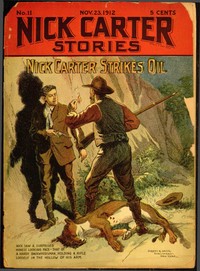
=No. 11.= NEW YORK, November 23, 1912. =Price Five Cents.=
These words, uttered in a loud, angry voice, were followed by a fierce oath, and the man to whom they were addressed raised his hand, and there was a look of pain on his pale face.
“I wish you wouldn’t swear,” he said gently. “Be calm, and tell me just what you mean.”
The first speaker looked ashamed of himself, and probably would have answered in a quiet way if another man who was standing near had not put in:
“Don’t pay any attention to him, Mr. Judson. Let him rave. If he’s such a fool that he can’t make money, it’s not your fault, and he has no business to complain to you.”
“But,” said Mr. Judson, “he makes a serious charge against----”
The first speaker did not hear this, for he was angry almost beyond his control, “mad clean through,” as the saying is in that part of the country, Colorado, where the scene took place.
He did not hear, because he broke in violently:
“I’ve been swindled, robbed, do you hear? And you’re just as much to blame as if you’d been the only one in the scheme. You wear the clothes of a preacher, but, by----! you’re a wolf in sheep’s clothing, and you deserve to be shot on the spot. If you want to keep that pious skin of yours whole, you’d better not come around Hank Low’s way.”
“But, Mr. Low, listen to me,” the clergyman begged.
“Not a word, you black-coated devil! When I think of the way my wife and kids have been cheated by a sneak thief of a minister, it puts murder in my heart, it does! I won’t talk to you, for fear I’ll forgit and take the law into my own hands. Geddap, Jenny.”
The man’s old mare responded to the command and a lash of the whip, and jogged away, dragging the rickety old wagon in which sat the angry Hank Low alone.
The clergyman turned, with a sigh, to his companion.
“I’m afraid, Mr. Claymore,” he said, “that all is not as it should be in this matter.”
“Pooh!” returned Claymore easily; “you mustn’t mind the howling of such a wild man. He doesn’t know what he’s talking about. He won’t hurt you.”
“Oh! that isn’t what I fear. I don’t like to hear a man talk like that, because it shows that he believes he has been wronged. There might be some truth in it. If so, I should be the first to make it right.”
“But there isn’t anything wrong. It was all a plain matter of business. Hank Low had a lot of land that he couldn’t do anything with. We asked him his price for it, we had a dicker with him, and he sold. What could be simpler, or fairer, than that?”
Instead of answering, the clergyman looked over the ground where they were standing. It was a level, but rocky, spot between high hills.
No house was in sight, but a half mile farther up the valley was Hank Low’s cabin.
Three miles in the other direction was the small village of Mason Creek, and some miles beyond that the city of Denver.
This spot where they stood had been part of Hank Low’s farm.
He had had a hard struggle trying to make a living out of his land, and had not succeeded very well, and there was a heavy mortgage to be lifted, besides.
One day a couple of men came to Mason Creek and spent a good deal of time tramping about the country.
One of them was William Claymore.
After a few days of tramping about, Claymore offered to buy the most useless part of Hank Low’s farm.
He mentioned the name of Reverend Elijah Judson as a man who was interested with him in some kind of a plan.
Nothing very definite was said about it, but Low understood that the clergyman meant to put up a private school for young ladies, and wanted the land for that purpose.
A deal was made by which Low was able to pay off his mortgage, but nothing more.
He would have been content with that if he had not discovered, when it was too late, that the parties who bought his land had no idea of putting up a school, or anything of that sort.
It was at the time when the fact was just becoming known that oil could be found in great quantities in the far western lands.
Claymore and his companion, by making secret tests of the soil, had come to the conclusion that this worthless end of Hank Low’s farm was the best place in the State for oil wells. So they bought several acres for next to nothing.
It might be supposed that their next step would be to sink wells and build a refinery, or a pipe line. But such things cost money, and neither Claymore nor his partner had any left to speak of.