Public-domain ebook
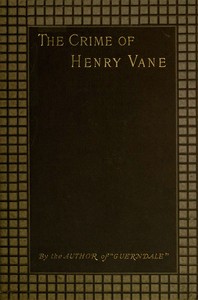
The Crime of Henry Vane: A Study with a Moral
Language: en292 downloads on Project Gutenberg
Subjects
In: Novels·American Literature
Public-domain ebook sourced from Project Gutenberg #67164.
Public-domain ebook
Language: en292 downloads on Project Gutenberg
Subjects
In: Novels·American Literature
Public-domain ebook sourced from Project Gutenberg #67164.
The opening · free to read
Nos. 10 to 20 Astor Place, New York.
THE CRIME OF HENRY VANE.
"----Make a fool of yourself, like Vane."
"I am not so sure that is fair to Vane," said John; "no one can go through what he did, and keep perfectly sound."
"I'll leave it to the crowd," said the Major; "what say you, boys?"
All were unanimous. There was no excuse for a crime like Vane's. Evidently they all knew Vane. He was damned without one dissenting voice.
"Who was Vane?" said I, "and what did he do? Which commandment did he break? He must have made merry with them all--or, rather, have kept them all to get such a judgment in this club."
A babel of voices arose. All these men were intimate friends; and they were sitting in one of the small smoking-rooms of the Columbian Club in New York. John had just engaged himself to be married, and we had given him a dinner; or, as Pel Schuyler put it, we were "recording his mortgage." Schuyler was a real-estate broker.
"Now, look here," said John, "how many of you fellows know Vane personally?"
No one, apparently. There was a moment's silence. Then the Major spoke up. "Bah!" said he, "I have heard the story these ten years." "So have I!" chimed in several others. "My brother knew Vane in Paris," said Pel. "I had it from Mrs. Malgam herself," simpered Daisy Blake, fatuously.
"Well, at least, I know nothing of it," I said; "tell it for my benefit, John."
"Yes, yes," cried they, "let's hear the correct and only version according to John."
It was that critical moment in a dinner, when the fireworks of champagne have sputtered out, and the burgundy invites to somnolence. All had lit their cigars, and felt more like listening than talking. John did not smoke.
"I will," said he. "At that time, I was his best--I may say, his only friend."
"And I say, still," said the Major, "he acted like a fool and criminally. There can be no excuse for such conduct."
John shrugged his shoulders and began. Of course, I do not mean that he told the whole story just as I have written it. He related the bare facts, with little comment and without conversations. Whether you condemned the man or excused him, John thought, his story might be understood, even if his folly were not forgiven. The crowd at the club did neither; and, perhaps, their judgment is the judgment of the world; and the world is probably right. But we may learn from folly; it is sometimes more suggestive than common sense. There is the ordinary success and there is the exceptional failure; that is pleasanter, but this is more instructive. Extreme cases fix the law.
The world is probably right; and, to those of us who are healthily adapted to our environment, the world is enough. Blessed are they who are fitted, for they shall survive. The world is enough; but the poet sang, love is enough. Shall we say, love is surplusage? The world is always right; and how virtuously the healthy world reproves what is morbid! How all the world unites in condemning him who is not fully content with itself! For such an one it cannot even spare its pity. There is a kind of personal animus in its contempt.
Let us hasten to join our little voices to swell the universal song. So John told the story--plainly and coldly, the more adversely for the lingering doubt; so we tell the story, and the doubt lessens as we state the facts, and quite vanishes as we reach the end. It is the story of a common crime, and the criminal is no friend of ours, as he was of John's. Moreover, Schuyler called the criminal a fool.
I.
IN April, 1873, Henry Vane was sitting on the perron of a small summer house in Brittany, poking the pebbles in the driveway with his cane. He had been there for half an hour, and there was nothing in his appearance and attitude to indicate that he would not be there for half an hour more. There was one red pebble, in particular, which he had an especial desire to prod out from among the others, which were gray. But it was round and slippery, and slid about the ferruled end of his cane. After poking it some time, he desisted and held the cane in his hands in front of his knees, which, as the next step of the porch was not much lower, were as high as his chin. "C'en est fait de moi," he muttered.
Henry Vane, though a New Yorker, had been brought up in France, and in the French language his thoughts came most readily. He had just seen, for the last time, an old friend of his--a girl, whom he had known in infancy, in childhood, in maidenhood; and whom it seemed incredible, impossible, intolerable, that he should know no more. It was upon the piazza of her uncle's house that he was sitting; and she was to leave the next day for Switzerland.
He was of age that day, and was "his own man now." "And hers," he thought, bitterly. She did not love him, however; and, at his request, had just told him so.
"Décidément, c'en est fait de moi," he muttered again, and gave the pebble a vicious dig, which sent it flying into an acacia bush that stood in a green tub by the side of the driveway.
He was twenty-one that day, and had come into his fortune. His fortune was not much--four thousand a year, left him by his grandmother and invested in government bonds. Still, twenty thousand francs made him distinctly a rentier; and twenty thousand francs seemed a good deal, shared with the girl he loved. But it seemed very little for him alone; genteel poverty in fact. He certainly could neither yacht nor race. Travelling--except _en étudiant_--was equally out of the question.
Vane was a flippant young fellow, with a French education; fond of the world, of which, as he then thought, he knew much. Yet the Figaro and the Bois de Boulogne and the Palais-Royal, or even the Français, did not seem to satisfy him, that day. And all for a little "Mees Anglaise!" How his friends would laugh at him! He was very young--they would say; very young for a grande passion. And then they would laugh again. But Vane felt sure that he should never get over it.
What the deuce did fellows do in his position? He felt a wild desire for adventure and excitement; but excitement and adventure were expensive; unless there happened to be a war, and you went officially. But he had not many illusions of romance in war. He knew men who had been at Woerth and Gravelotte. Then there was travel. But this, also, was expensive. Old Prunier, the Professor, had made an expedition through Soudan the year before, and it had cost him eight hundred thousand francs. Moreover, you had to be up on rocks and beetles and things, to make your trip of any use to the world. And Vane had not yet given up all idea of being of use in the world. Besides, even Prunier's expedition had not ended in much, except a row with the Portuguese missionaries on the subject of the slave trade. These Christian slavers had met Prunier's remonstrances with the plausible argument that it was better for the negroes to be slaves in a Christian country, and save their souls, than free on earth and damned when they died. Prunier had consequently reported a crying need for a better article of missionary in Central Africa. But Vane could not go as a missionary. He felt that his confidence in Providence, at that moment, was not hardy enough to bear transplanting into the native South African mind, through the medium of a Turanian dialect.
He might seek the land of his nativity, and make his four thousand a year, eight thousand. His father's business, for the moment, lay in Bellefontaine. He did not in the least know where Bellefontaine was, but the name had a civilized sound. And she was going to Switzerland.
Vane must have clenched his hands at this point; for he felt a decided pricking in his left forefinger. And he observed several thorns on the stem of the rose she had given him. For she had given him a rose. That much favor had been shown him. He got into his mother's little phaeton and drove home--with his rose. So far, his investments in life had not been successful. The account with fortune might read somewhat like this--Debtor, an English girl: to ten years' love and an indefinite amount of devotion and sentiment. Creditor, by the English girl: one rose (with thorns). That is, if he had put the Dr. and Cr. sides right. He never could remember which was which. At all events, the returns on his investment were not large. And he, with his uncertainty about debtor and creditor, to think of competing with the practical Yankee of Bellefontaine! No; he would leave his four thousand a year where it was--a somewhat insignificant part of the national debt. Meantime, what would become of him? What should he do? He felt an idle outsider's curiosity to know what the deuce he would do.
Of one thing he felt certain, his orbit in life would be highly eccentric. He had no raison d'être; and it is difficult to predict the direction taken by a body without raison d'être. The curve of such a comet has no equation. He could no longer view life with gravity; and it is quite impossible to calculate the orbit of a body without gravity. He might bring up anywhere from Orion to the Great Bear. Only one thing was certain--he could not, for the present, bring up in Switzerland; and yet, oddly enough, that seemed to be the only part of any possible terrestrial orbit that had an attraction. But attraction decreases as the square of the distance. Assuming, for the sake of argument, that he was now two miles from her, and loved her with his whole heart; if he were twelve thousand miles away, he would love her only one divided by the square of six thousand--only one thirty-six-millionth part as much. In other words, he would have thirty-five million nine hundred and ninety-nine thousand nine hundred and ninety-nine thirty-six millionths of his heart left--left to bestow upon the dusky beauties of the Pacific. Damn the dusky beauties of the Pacific. He would see his sister Mary. After all, she was dearer to him than the dusky beauties of the Pacific could possibly be.
When the boy arrived home, he drove to the stable, and alighting, threw the reins to a groom. He was perfectly sure that his life was broken; but a groom is a necessary adjunct of any life at all. He rolled a cigarette and strolled toward the house, still holding the rose, by the stem, between the first and second fingers of his left hand. Momentarily his thoughts had wandered from the English girl; he was still entirely busied in constructing a proper dénouement for himself. The romance of his life, he felt, was gone; but he desired that his career should be consistent with his tragic part in life. She had left him enough self-esteem for that.
So he entered the house.
II.
THE next few weeks seemed long enough to Vane; but, fortunately, we may make them short. They must be told; they were part of his life; how large a part, no one--possibly not even himself--ever knew.
When Vane entered the main door, which François, the old butler, did not open for him as usual, he saw nothing of his mother. One or two of her shawls were lying, as if hastily thrown off, on the carved oak chair in the hall. The day was cool, and the embers of the morning fire were still red in the chimneyplace. The cigarette did not satisfy him; so he pulled out a cigar, and looking for a lighter, noticed a yellow envelope near him, back downward on the floor; close by it was a thin sheet of paper. Taking this, he was about to twist it up, when he saw that it was a telegram. He opened it and read his name, and the message, "_Mary is dead. Tell your mother for us. Pray, come directly. Gresham._"
The book keeps going
Reading is free forever. Sign up and watch scenes appear while you read.



Scenes Storieta drew for other classics.
New illustrated classics
Once or twice a month: the latest books to get full character casts, scene art, and free comic editions. No account needed.