Public-domain ebook
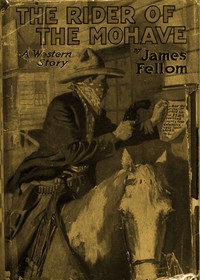
The Rider of the Mohave: A Western Story
by James Fellom
Language: en490 downloads on Project Gutenberg
Subjects
In: Romance·Crime, Thrillers and Mystery·Adventure
Public-domain ebook sourced from Project Gutenberg #67186.
Public-domain ebook
by James Fellom
Language: en490 downloads on Project Gutenberg
Subjects
In: Romance·Crime, Thrillers and Mystery·Adventure
Public-domain ebook sourced from Project Gutenberg #67186.
The opening · free to read
It was three in the morning, but Geerusalem had not yet closed its eyes. There was too much undug gold in the hills; it was too handy—too easy come, easy go; the days, too short; the pleasures, too wanton, too alluring. The camp of Geerusalem promenaded, gambled, danced, fought, debauched the night away, waiting for to-morrow. Far out on desolate Soapweed Plains, rose the intermittent, yelping wail-bark of a coyote.
The back door of a little store that fronted on the main street opened cautiously. The interior of what was a kitchen was dark; the flower-garden yard into which it gave, was also dark. The shadowy form of a man emerged and halted; he peered carefully about through the gloom. A smaller figure followed, pausing on the threshold—a woman, her white apron and snowy hair quite visible. The man turned, took her in his arms impulsively, and held her close to his breast.
“Don’t you worry, ma. I’ll be droppin’ round again, two weeks from to-night—sure’s sic ’em!” he whispered, as he kissed her.
The woman wept softly. “Oh, Jerome, darling, why don’t you quit this awful thing?” she sobbed, clinging to him. “Don’t you know how my heart’s just breaking?”
“Too late, ma. I oughter’ve quit ’fore I begun. If I started quittin’ now, they wouldn’t let me, would they? But I’m tellin’ you; don’t think about me. They can’t ketch me. I’ve bin goin’ it three years, ain’t I? Well, then, when you see Tinnemaha Pete, tell him to leave you a chunk of that ore. An’ see that he don’t tell nobody about findin’ it. I figger it’s a bonanza. Mebby, that’ll mean better days. Well, we’ll see what’s doin’. Now, I’d better be scootin’, honey. An’ don’t you worry, see?” He kissed her again, tenderly, many times, breathing his last injunction into her ear.
A few seconds later he had slipped like a shadow across the yard and was stealing out of an alleyway between two adobe buildings, heading for the back street. That street was black, deserted, the nocturnal population of the camp confining itself to the bright lights and attractions that converted the one business thoroughfare into a brilliant avenue, noisy with ribald merrymaking and adventure.
Near by stood his horse. He reached it and, with a vigilant glance about, threw back one of the flaps of his saddlebags and plunged a rummaging hand inside. It came forth with a folded piece of wrapping paper and several nails he had placed there the day before.
With a reckless chuckle, he wound his bandanna around his face leaving only his eyes exposed; then he mounted and rode off to the next cross street, and thence to the brilliantly lighted hub of the town. The bulletin board of the Geerusalem Searchlight, an afternoon newspaper, loomed big and black on the edge of the sidewalk, in the full glare of window lights. It was one of those moments when the immediate vicinity was clear of promenaders.
Seeing this, the rider spurred over to the bulletin board, unfolded the sheet of wrapping paper, and nailed it on the black surface with the butt of his six-shooter. Then, he caracoled his horse about, fired a volley into the air and, throwing the whole strength of his lungs into a wild howl, waved his hat to a crowd of men standing before the Miners’ Hotel, and dashed away around the nearest street corner, bound for the lonely, trailless reaches of the Mohave Desert far to the south.
The horde of curious night revelers swarming to the spot, a few seconds later, read with varying degrees of emotion the rough printed notice on the bulletin board:
I bin lookin three year for Sheriff Warburton an cant find him. Ill give $5,000 to git akquainted with the county fameous detektive.
Your lovin bandit, Billy Gee.
Lemuel Huntington had told himself a thousand times that his Dot must have an education. He had long since become infatuated with the notion. It had him gripped as tenaciously as the seductive toils of romance had the imaginative Dot enmeshed. It was a consuming mania with him.
“If I got to steal the money, she’s goin’ to college—the dream of her darlin’ dead mother. S’help me, I’ll turn thief if I got to!”
Lemuel, the failure, was fifty-one—the age when most men begin to slow down, whether they want to or not. Twenty years before, he and his little bride had left a perfectly good living in Iowa to try a short cut to fortune in California. The fact that more often than not distance is a most captivating beckoner, did not occur to these happy newlyweds until they reached the Golden State and found that a tremendous army—also seeking sudden wealth—had preceded them, and was daily being augmented by regiments of recruits from the four corners of the globe.
The discovery appalled them—their capital being alarmingly small; and nearly two years of drifting from little town to little town, just managing to get by, took the heart out of them.
Then, one day, Lemuel brought home news of a tract of government land known as Soapweed Plains, on the north rim of the Mohave Desert, with enticing reports of rich mineral belts in the adjacent mountain ranges. It looked like the opportunity for which they had waited. They would homestead, and in a few years Huntington would be a name indelibly branded on the cattle industry of the State. And there was the further golden prospect of rich mines!
Packing their few belongings, husband and wife bought tickets to the dismal wind-whipped station of Mirage, on the Mohave & Southwestern Railroad, and spent two everlasting days shooing a trinity of stubborn burros over a hell waste, into the new land of promise. But again the captivating beckoner had tricked them. Soapweed Plains was a sweltering realm of sagebrush, sand and sidewinders, twenty-five miles wide, divided off from the rest of the desert universe by a horseshoe barricade of saw-edge peaks and table mountains that abutted a sky-line mesa to the south—and by serenading coyotes by night.
In despair, the Huntingtons filed on two quarter sections of sand and rubble, the west side of their claims overlapping a bunch-grass hill; the narrow strip on the east was handy to those scant benefits of irrigation so grudgingly bestowed by the tepid disappearing-reappearing Mohave River. Here, at least, they might coax a living out of the soil, said Lemuel dolefully. It was a permanent anchorage, if nothing more, sighed his wife. And they started grubbing away a site for a home and killing the sidewinding rattlesnakes.
Soon, they found that the potato thrived, as did the melon and alfalfa; found, too, that it was a paradise for bees. They contrived to get a cow and heifer, a span of desert-broke horses, and a rattletrap buckboard. Prospectors learned about the Huntington ranch and, finding it handier to go there after certain commodities than to far-off Mirage, began patronizing it. Its popularity grew. As a result, Lemuel added a stock of bacon, beans, condensed milk, sugar, matches, and such staple supplies to his assorted farm products, and reaped a comfortable profit therefrom.
Then Dot came—and the lonely brush ranch became the nucleus of Lemuel and Emily’s resurrected hopes, for they began planning wonderful things for their first-born, and, not the least among these things, an education that would make her a great lady of accomplishments some day.
But the years dragged by, one after the other, in that out-of-the-way land, so woefully lacking in transportation—empty-handed years almost, that held out scarcely more than a possibility at any time that those precious plans of theirs would ever be fulfilled. It would take a fat purse indeed to send Dot to select Longwell Seminary in San Francisco and keep her there in becoming luxury until she blossomed forth a chosen daughter of California’s élite.
When Dot was twelve her brave little mother died, and for a long time afterward, Lemuel went about like a man desperately searching for something he had lost without knowing just what it was. His resurrected hopes died with her, and were buried. Everything slowed down to a point where he merely held on to a bare living for himself and his child.
To-day, he was a failure, that child eighteen, while the only remaining echo of the precious plans to make Dot a grand lady was this secret wild mania of his, seething in the core of his brain, to see that daughter educated before they laid him beside the trim little grave in the garden.
Perhaps it was this same mania of his that now led him to haunt the nearest place where brains forgathered—the gold camp of Geerusalem, four miles northeast of the Huntington ranch—and to get to hobnobbing with its insolent brotherhood of mining engineers, promoters, assayers, and attorneys—a type of individual that looms up in the mind of the crude Southwest as prodigious as totem poles, omniscient and omnipotent.
Whatever it was that made Lemuel enjoy being the butt of this uppish fraternity’s quips and sneers, and come back regularly for more, hardly matters. Month in and month out, as often as he could get away from the ranch, he would saddle a horse and ride to Geerusalem, and spend the day strutting around with the forty-five caliber brains of the camp. Accordingly, day after day, Dot, the imaginative, was left to herself and the weaving of her wistful, romantic dreams.
She was a bright little body, this eighteen-year-old daughter of Lemuel, the failure; face so frank and sensitive, hair so soft and wavy and glossy, throat so round and smooth. Her eyes were large and brown, and sometimes quite sad from gazing too long into the monotonous distances out of whose blue haze nothing of living substance ever came. She had grown to charming young womanhood, but she still retained the fanciful mind of her pinafore days—the little story-teller had survived as her playmate, Frank Norris would have said—with all a youngster’s fascination for impossible stories of impossible beings.
She would sit by the hour dreaming of handsome blond heroes rescuing beautiful maidens from the clutches of Tatarian villains, with wicked flowing black mustaches and bushy eyebrows, of magnificent daredevil bandits succoring helpless widows and orphans, of notorious Billy Gee even, about whose wild, desperate exploits up and down the Mohave and Colorado Deserts she had heard so much, of hairbreadth escapes, furious bloody duels, and brilliant weddings.
The isolated ranch was an ideal spot for the painting of just such thrilling mind pictures. She could sit on the front porch and look across the gray desolation of plain that stretched to the violet and yellow scallop of range twenty miles eastward, and visualize in that void of undulating air currents every scene her fertile imagination conjured up for her. She lived those scenes, every one of them. They were big moments in her life; palpitating, vivid moments—moments that made her dreary, humdrum existence worth while to her.
“Nothing ever happens out here,” she would sometimes murmur to the eternal sameness of the plains. “Nobody ever comes this way, even. I wish daddy would sell the ranch and move to Geerusalem or somewhere—where things happen, where people laugh and talk and visit.”
The book keeps going
Reading is free forever. Sign up and watch scenes appear while you read.



Scenes Storieta drew for other classics.
New illustrated classics
Once or twice a month: the latest books to get full character casts, scene art, and free comic editions. No account needed.