Public-domain ebook
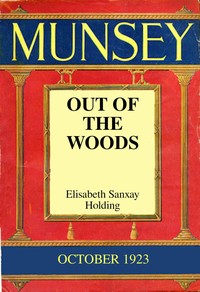
Out of the Woods
English420 downloads on Project GutenbergDownload EPUB
Public-domain ebook sourced from Project Gutenberg #67254.
Public-domain ebook
English420 downloads on Project GutenbergDownload EPUB
Public-domain ebook sourced from Project Gutenberg #67254.
The opening · free to read
When you learn that this story begins with the heroine setting off through the woods to visit her grandmother, who was ill, you may guess that it is the familiar tale of Little Red Riding Hood. I must admit that that is what it is, and I warn you that you may count upon a very artless little heroine and a wolf of insinuating manners and glib tongue; but this grandmother will not be eaten up.
Nor did Ethel carry a basket containing a little pat of butter and a cake. She had, instead, a large and luxurious box of candied fruit under her arm; and instead of singing through the woods, she wore a sulky and miserable expression. Unfortunately red hoods are not in vogue, for such a thing would have been notably becoming to her little gypsy face. However, she was young enough and lovely enough to look well in anything, even a sulky expression.
She was not without some excuse for her discontented air. Ethel was one of those unfortunate little bones of contention so often to be found in divided families, and she had been so much disputed over and argued about, and so rarely consulted or even questioned, that she had grown to think of herself as a helpless pawn in an incomprehensible game, where she could never win anything.
The disputes had begun long before she was born. Her father’s family had that pride of newly acquired wealth beside which pride of ancestry shrinks to nothing. Indeed, to spring from splendid ancestors may often make one feel a little humble, but to feel that one is vastly more important than any of one’s forbears makes for arrogance.
The Taylors had objected very much to the marriage of their only son. Even when the marriage was made, and there was no earthly use in objecting, they kept on, in a very unpleasant way. All the misfortunes which the young man brought upon his wife and child by his recklessness and folly only increased their anger against the victims; and when he died, they all came forward with helpful suggestions as to what he should have done when he was alive.
Ethel had been a small girl of nine then, and not yet looked upon as guilty; but when she refused to leave her mother and take advantage of the offers made by several of the Taylors, she lost their sympathy. Her mother, with criminal selfishness, hadn’t made the least attempt to persuade her child to leave her. On the contrary, she had gone back to her own people, and had lived with them in quiet contentment.
It was to these people of hers that the Taylors so strongly objected. She herself was a quiet and inoffensive creature who gave little trouble, but her parents were Italians, and poor, and not ashamed of either of the two things.
Dr. Mazetti had been professor of romance languages in a small Western college, but he had become so absorbed in the enormous commentary upon Dante which he was writing that he found his teaching very much in the way; so he gave up his chair. Mrs. Taylor, the paternal grandmother, had spoken about this.
“Of course,” she had said, not very pleasantly, “it’s a good thing to have faith in your husband’s work; but suppose it’s not a financial success?”
“We don’t expect it to be,” replied Mrs. Mazetti, in her excellent English. “Such work as that is not undertaken for money.”
“Do you mean to say that you’ll permit your husband to give up his—” began Mrs. Taylor, but the other interrupted her.
“A man does not ask the permission of others to do what he thinks best,” she said quietly. “I should be ashamed of myself if I were even to suggest that he should sacrifice his life’s work on my account.”
“What about yourself? Aren’t you sacrificing—”
“I sacrifice nothing,” said Mrs. Mazetti. “I am very, very happy and proud.”
And so she was, and so was her only child until she married young Taylor; and so she was again when she came home with the little Ethel, to live with those simple, gentle people once more. Not for long, however, for she died some two years later.
Then the arguments and disputes began again, and this time the Taylors won. Children of eleven are pitifully easy to bribe, and while Ethel was still dazed and stricken after the loss of her mother, all these relations competed for her favor. She was petted and pampered as she had never been before in her life.
It is regrettable to admit that she liked all this, liked the toys and the pretty clothes and the indulgence better than the benign and quiet régime of her grandfather Mazetti, who believed that children should be literally “brought up” to the level of the wiser and more experienced adults about them, instead of bringing a whole household down to childish standards. He was always very patient and gentle, but he was too fond of talking about Dante, and of relating anecdotes about an Italian poet who insisted upon being tied into his chair, so that he couldn’t run away from his studies.
Moreover, old Dr. Mazetti had no money to spend upon toys and clothes. The Taylors took no interest in Dante or any other poet, but they took Ethel to the circus; so she said she wanted to live with Aunt Amy, her father’s sister.
She wasn’t aware, at the time, how terribly she had hurt the Mazettis. They said very little. Indeed, they discussed it in private, and decided that it was their duty to say very little. Aunt Amy could give Ethel material benefits which they could not give; and if the child preferred that sort of thing, it was, after all, neither unnatural nor unexpected.
“Each must find his own,” said Dr. Mazetti. “What is joy for one is a burden for another.”
So they let her go, and they did it beautifully, without saddening her little heart with reproaches or tears. She came back to visit them once a month or so, but somehow, in her new existence, this quiet old couple had begun to seem very foreign, very unreal.
She was abroad with her aunt when Dr. Mazetti died. Though she grieved for him honestly, she was too young and too busy to nourish any sorrow long.
When Ethel Taylor came home, at nineteen, her grandmother seemed like a little ghost from the past, utterly unconnected with her present life. She still went to visit the old lady, and sat in the familiar room in her little cottage, where the bronze bust of Dante appeared to impose a dignified calm; but these visits were nothing but interludes to real life, and real life, just now, was a miserable thing.
The trouble was that Aunt Amy kept on being Aunt Amy, while the childish Ethel and the nineteen-year-old one were entirely different persons. Aunt Amy wanted her to come out, and to be a nice, happy débutante like other girls; but something in Ethel’s blood rebelled against that. She called it a “modern spirit,” and never realized that instead of being modern, it was the old Mazetti strain, come down to her from people who for generations had not lived by bread alone.
She told her aunt that she wanted to be a singer.
“That’s a charming accomplishment,” said Aunt Amy affably.
“I mean I want really to study—for years and years!”
“Certainly, dear, if you can find the time.”
“Time!” said Ethel. “What else do I ever do but waste time?”
“Naturally you can’t neglect your social duties—”
“Duties!”
“Please don’t repeat my words in that odd way,” said Aunt Amy, a little hurt. “If you want to study singing, there’s no reason why you shouldn’t, so long as you’re not excessive about it.”
“But I want to be excessive! I want to give all my time to it! I want to be a professional singer!”
Aunt Amy laughed, not in order to be irritating, but because she really thought it was funny. Not being a woman of much penetration, she told some of her friends about that absurd little Ethel’s fantastic idea.
As a result, the girl was teased about it. Ethel couldn’t endure being teased. She had that queer lack of self-confidence, combined with tremendous resolution and a little vanity, that belong to young artists, and she felt that she was absurd, although she really knew that she wasn’t. She was ashamed to practice now, and at the same time she exulted in her clear, strong, flexible voice. When she was asked to sing, she refused; yet sometimes, when she knew there were people in the drawing-room, she would go up the stairs or through the hall, singing her loudest and sweetest, half terrified, half delighted, at the glorious flood of melody that rose from her heart.
She didn’t want anything else. She couldn’t and wouldn’t be bothered with “social duties.” She wanted to work hard, all day and every day, until she was mistress of this great gift of hers, until she could sing in reality as she did in imagination. She had fits of black depression, when the sounds that came from her throat seemed a mockery of what she intended. At other moments she was in wild spirits, because she was sure she had made a little progress.
Her changing humors were so marked that Aunt Amy was gravely perturbed. She felt that Ethel was becoming “eccentric,” which was the worst thing any one could be, and she attributed it all to this annoying obsession with singing. In all good faith, she did what she thought best for the girl—she stopped her lessons.
Ethel wept and stormed and entreated and argued until she was almost ill, but without moving Aunt Amy.
“No!” that lady said firmly. “If you’ll put all that nonsense out of your head, and lead a normal, sensible life like other girls, I’ll let you take up singing again in a year.”
She hoped and believed that within a year’s time such a pretty and delightful girl would surely find something better to think about.
The book keeps going
Reading is free forever. Sign up and watch scenes appear while you read.



Scenes Storieta drew for other classics.
New illustrated classics
Once or twice a month: the latest books to get full character casts, scene art, and free comic editions. No account needed.