Public-domain ebook
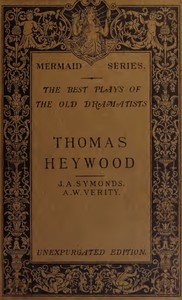
Thomas Heywood
Language: en1,719 downloads on Project Gutenberg
Subjects
In: Plays/Films/Dramas·British Literature
Public-domain ebook sourced from Project Gutenberg #67267.
Public-domain ebook
Language: en1,719 downloads on Project Gutenberg
Subjects
In: Plays/Films/Dramas·British Literature
Public-domain ebook sourced from Project Gutenberg #67267.
The volume gathers the surviving dramas of Thomas Heywood, one of the most prolific early‑modern English playwrights. It opens with a series of literary quotations, from a witty exchange between Francis Beaumont and Ben Jonson to a Keats verse on the Mermaid Tavern, followed by a formal title page that lists the five works included: A Woman Killed with Kindness, The Fair Maid of the West, The English Traveller, The Wise Woman of Hogsdon and The Rape of Lucrece. An extensive introductory essay then situates Heywood within the bustling theatre of the late‑Elizabethan and early‑Jacobean era, noting his reputation as a “prose Shakespeare” and his habit of writing for the stage rather than for print. The editor’s notes explain the historical context of each play, the author’s complaints about unauthorized publications, and the practical realities of a dramatist whose output once numbered two hundred and twenty works.
Heywood’s voice is plain and vigorous, reflecting the vernacular of a seventeenth‑century actor‑writer who favored domestic realism over lofty poetry. His style blends straightforward dialogue with occasional lyrical touches, and his plots often intertwine everyday English life with romantic or seafaring adventures. Readers who enjoy the gritty texture of early modern drama, scholars of Elizabethan theatre, fans of Shakespeare’s contemporaries, or anyone drawn to sincere, character‑driven stories of love, honor and ordinary folk, will find his plays rewarding. The collection offers a glimpse of a playwright whose humanity and modest elegance still resonate across two centuries.
The opening · free to read
Even as it is, the few lines in Heywood’s Hierarchy of Angels on the nicknames of the poets of his day are among the raciest scraps of information which we possess about those dramatists. The miscellaneous nature of Heywood’s literary labours justifies us in classing him, together with Robert Greene, among the earliest professional littérateurs of our language. His criticism is often quite as valuable as his dramatic poetry. The whole of the running dialogue between Apuleius and Midas in Love’s Mistress, for example, contains a theory of the relation of poets to the public, while the prologues to A Challenge for Beauty and The Royal King and Loyal Subject are interesting as showing to what extent the dramatists of the Elizabethan age pursued their art with conscious purpose and comparison.
We may notice how careless, in common with many of his contemporaries, Heywood was concerning the fate of his dramatic writings. Plays, and comedies in particular, were written, not to be read and studied, but to be acted. This we should never forget while passing judgment upon the unequal work of the Elizabethan playwrights. In the Address to the Reader, prefixed to the English Traveller, Heywood complains that this tragi-comedy had been published without his consent, and apologises for coming forward to father it before the world, adding, not without a sly poke at Jonson and his school:--
“True it is that my plays are not exposed unto the world in volumes, to bear the title of works (as others); one reason is, that many of them by shifting and change of companies had been negligently lost; others of them are still retained in the hands of some actors, who think it against their peculiar profit to have them come in print; and a third that it never was any great ambition in me to be in this kind voluminously read.”
In the preface to the Rape of Lucrece he repeats his complaints against the clandestine and unauthorised publication of his plays, with this declaration of his own habit of dealing with them:--
“It hath been no custom in me of all other men (courteous readers) to commit my plays to the press; the reason, though some may attribute to my own insufficiency, I had rather subscribe, in that, to their severe censure, than, by seeking to avoid the imputation of weakness, to incur greater suspicion of honesty; for though some have used a double sale of their labours, first to the stage, and after to the press; for my own part I here proclaim myself ever faithful to the first, and never guilty of the last.”
He then proceeds to show that the pirated editions of his plays in mangled copies have forced him to right himself before the public by superintending the issue of a certain number of his works. In the prologue to If you Know not Me, you Know Nobody, the same apology is reiterated in terms which throw a curious light upon the short-hand reporters of plays for the press, employed by piratical booksellers to the prejudice of authors and theatre managers:--
“Some by stenography drew The plot; put it in print (scarce one word true): And in that lameness it hath limped so long, The author now to vindicate that wrong Hath took the pains, upright upon its feet To teach it walk, so please you sit, and see’t.”
Of the twenty-three plays in Mr. Pearson’s collection, four--namely, the two parts of Edward IV. and the two parts of _If you Know not Me, you Know Nobody_--are histories of the old-fashioned sort, rudely dramatised from English chronicles, and seasoned with comic and pathetic episodes. Of the two series, Edward IV. has in it more of Heywood’s special quality; the interlude of the Tanner of Tamworth and the romance of Mistress Shore displaying his double power of dealing with drollery and passion in the simplest and most natural style. In truth, the second part of Edward IV., which begins with a dull, confused account of that king’s wars in France, becomes a romantic drama on the legend of Jane Shore. This is chiefly remarkable for the way in which Heywood sustains the character of Master Shore, who is the very mirror of sound English middle-class Christianity. The erring wife’s portrait is touched with striking, if somewhat sentimental, appeals to natural sympathy. Both are excellent examples of the dramatist’s homely art and honest humanity, though nothing can be balder and more artless than the manner of their death together on the stage. If you Know not Me, you Know Nobody is a chronicle of the reign of Queen Elizabeth, including her early dangers and the late glories of the defeat of the Armada. The whole series of scenes breathes the strongest English patriotism and the most enthusiastic Protestant feeling. It is a pity that, hastily and clumsily pieced together, a drama so interesting in its matter should almost be valueless as a work of art. It was published as a companion to S. Rowley’s When you See Me, you Know Me, which has been reprinted by Dr. Karl Elze.
The Late Lancashire Witches and the Wise Woman of Hogsdon are comedies of English life, without that element of romantic interest which Heywood usually added to the domestic drama. The plot of the latter play turns upon the quackeries and impostures of a professed fortune-teller; but to mention it in the same breath with Jonson’s Alchemist would be ridiculous. The Lancashire Witches, though it attempts, in one scene at least, to touch the deeper interest of witchcraft, deals for the most part only with the vulgar and farcical aspects of the subject. It has nothing in common with The Witch of Edmonton or Middleton’s Witch. A household turned topsy-turvy, a coursing-match spoiled, a farm-servant changed into a gelding, and a bridegroom bewitched with a charmed codpiece-point upon his wedding night, are among its insipid drolleries. In Fortune by Land and Sea, The English Traveller, The Fair Maid of the Exchange, and both parts of The Fair Maid of the West, Heywood displays to better advantage his predilection for homespun stories, dealing chiefly with the incidents of country life and the adventures of English captains on the high seas. Pure comedy and pure tragedy were neither of them suited to his genius. He required a subject in which the familiar events of English domestic life might be contrasted with the romantic episodes of sea-roving and of foreign travel. To interweave these motives with the addition of pathos and sentiment, was just what he could do successfully. No dramatist has painted more faithful home pictures. None have thrown more natural light upon the pursuits of English gentlemen in the first half of the seventeenth century. The merit of all these five plays is considerable. It would have been impossible even for Fletcher to realise a difficult scene with greater ease and delicacy than are displayed in the interview between young Geraldine and Wincott’s wife in The English Traveller. A pair of lovers, who have been parted, meet again and renew their old vows in the bedroom of the girl just made a wife. The calm strength and honourable feeling displayed by this Paolo and his Francesca in their perilous interview are the result of unsuspecting innocence and sweetness. If the situation is almost unnatural and disagreeable, the poet has contrived to invest it with the air of purity, reality, sincerity, and health. Fortune by Land and Sea is richer in scenes which reveal Heywood at his best. The opening of this play is one of his most vigorous transcripts from contemporary English country life. Frank Forrest, a daring and high-blooded youngster, evades his careful father, and flies off to a neighbouring tavern, less for the sake of drinking than in order to meet spirited companions. One of them picks a quarrel with him about his respect for his old father, and the boy is killed. The grief of old Forrest, the challenge given by the brother to Frank’s murderer, the duel that ensues, and young Forrest’s escape, are all set forth with photographic reality and force. Event huddles upon event, and the whole proceeds with the simplicity of truth. These scenes only form a prelude to the play, which, like most of Heywood’s, contains a double plot; but at the same time they are its salt. The Fair Maid of the West, a romantic drama in two parts, sets forth the adventures of the Devonshire Captain Spencer and his love Bess Bridges, who is introduced to us as the mistress of a Plymouth inn. It may be said in passing, that few tavern-scenes in our Elizabethan drama, not even those of Dekker, are better painted than those which form the introduction to Act I. Battles with pirates, slavery in Fez, and adventures in Florence form the staple of the drama, which must have presented many attractions to an English audience of the age of Stukeley, Sherley, and Drake. The Fair Maid of the Exchange is another play belonging to what the Germans style das bürgerliche Drama. To my mind its sentiment is sickly, and its story, in spite of many beautiful passages, disagreeable. Phillis is the Fair Maid; and the real hero of the piece is a cripple, who saves her from a ruffianly assault, and who falls in love with her. She returns his love; but Heywood had not the courage to develop this situation. Therefore he makes the cripple plead the cause of another suitor to the Fair Maid, who at the end of the play transfers her affections with a levity and a complacency that would be offensive in real life. The charm of this comedy consists in a certain air of April-morning freshness; it has, moreover, one of Heywood’s most exquisite songs, a lyric that deserves to rank with Dekker’s, and which is made for music: “Ye little birds that sit and sing.”
The seven plays on English domestic subjects which I have now enumerated, are all of them eclipsed in their own kind by Heywood’s masterpiece, A Woman Killed with Kindness. Leaving that, the finest bourgeois tragedy of our Elizabethan literature, for future comment, we come to another group of Heywood’s plays, which may perhaps be best described as romances. Of these, The Four Prentices of London, a juvenile performance of the poet, is both the least interesting, and by far the most extravagant. Guy, Eustace, Tancred, and Godfrey, the four sons of the Duke of Boulogne, and at the same time ’prentices in London shops, start off like Paladins, and win their laurels in the first Crusade. Whether this absurd play was intended, like Fletcher’s Knight of the Burning Pestle, for a parody of chivalrous romances, or whether, as its dedication to “the Honest and High-spirited ’Prentices, the Readers” seems to imply, it was meant for a hyperbolical compliment to the courage of London counter-jumpers, is not a very important matter. The latter is the more probable supposition. The plot is a tissue of sanguinary and sentimental adventures, with a certain admixture of good-humoured sarcasm on the London cits, that may have gratified their ’prentice-lads. The old quarto has for frontispiece a curious woodcut of the four knightly shop-boys. The Royal King and Loyal Subject is a drama with an ideal intention. Pretending to be founded upon English history, it really sets forth the contest of generosity between a monarch and one of his great nobles. In the course of this play Heywood has used some of the motives that add pathos to Patient Grissil; the King of England exposes the Lord Marshal to a series of humiliations and studied insults before, as a climax to the favour he intends to heap upon him, he unites his own family and that of his subject by a triple bond of marriage. The whole situation is better in conception than in execution. I take it to be one of Heywood’s earlier dramatic essays. A Challenge for Beauty tells the tale of a proud Portuguese Queen, who thinks herself the fairest woman of the world, but who is brought at the end of the play to admit that she is vanquished as much in beauty by an English lady as her husband’s captains are surpassed in courage and courtesy by English gentlemen. The most interesting portion of the drama is subordinate to the subject which supplies the title. The contest of generosity between a noble Spaniard, Valladaura, and an English captain, Montferrers, who has been sold into slavery together with a friend that he dearly loved, displays all that innate gentleness and chivalry which Lamb recognized as the fairest of Heywood’s characteristics. Valladaura finds his old enemy Montferrers in the slave-market, pays down his price, and sets him free. Montferrers cannot accept freedom while his friend remains a slave. Valladaura buys them both, taking Montferrers with him to remain, an honoured guest, in his own house. Now begins the duel of courtesy between the two men. Valladaura loves a lady, Petrocella, and beseeches the Englishman to plead his suit with her. Montferrers executes the task, though he also loves Petrocella, and discovers in the course of his wooing that she returns his passion. The use he makes of her avowal is to bind her over to accept the Spaniard’s suit. But Valladaura is no whit less chivalrous. He resigns the lady to the man who has deserved her best. Those who have not studied the working out of such strained situations in the Lustspiele of Heywood or of Fletcher, can hardly imagine what flesh and blood reality these poets gave to almost inconceivable improbabilities. The vigorous and natural play of passions under strange disguises and painful conditions--the hesitations of divided allegiance--confusions of sex--contradictory emotions, pleased our play-going ancestors; and the dramatists had the skill to display the truth of human nature beneath the mask and garb of romantic fantasies. Under other hands, or in an age of less directness, such motives would have been ridiculous or offensive. A Maidenhead well Lost, is a romance of this type with Italian characters. While challenging comparison with similar comedies by Fletcher, Ford, Massinger, and others, it is but a tasteless and feeble production. Heywood was so thorough an Englishman that, for the full exercise of his poetic faculty, he needed a subject smacking of his native soil.
The book keeps going
Reading is free forever. Sign up and watch scenes appear while you read.



Scenes Storieta drew for other classics.
New illustrated classics
Once or twice a month: the latest books to get full character casts, scene art, and free comic editions. No account needed.

![Cover of Robert Greene: [Six Plays]](/covers/55769.jpg)