
Public-domain ebook
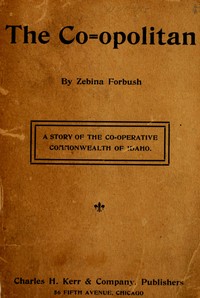
The Co-opolitan: A Story of the Co-operative Commonwealth of Idaho
Language: en369 downloads on Project Gutenberg
Subjects
In: Novels·American Literature
Public-domain ebook sourced from Project Gutenberg #67321.
Public-domain ebook
Language: en369 downloads on Project Gutenberg
Subjects
In: Novels·American Literature
Public-domain ebook sourced from Project Gutenberg #67321.
The opening · free to read
THE CO-OPOLITAN ❧ A Story of the Co-operative Commonwealth of Idaho.
BY ZEBINA FORBUSH.
“’Tis coming up the Steep of Time And this old World is growing brighter.” —_Gerald Massey._
CHICAGO: CHARLES H. KERR & COMPANY. 1898.
Copyright 1898 By CHARLES H. KERR & COMPANY.
Library of Progress. No. 26. Quarterly. $1.00 a year. February, 1898. Entered at the Postoffice, Chicago, as second-class matter.
PREFACE.
This volume is given to the public without other excuse than the simple fact that it has been written. If it is read it may do some good, but in any event it cannot do injury. If it is not read the hour which knew it will pass with it, and countless hours, like waves in Time’s ocean, will roll on multitudinously, with their burdens of good and evil, and pass also.
Because the writer believed he had a thought to express, which, if heeded, would help, in some slight degree, to right human wrongs, he ventured to offer it in this form. He had discovered by experience that no radical and permanent reform can be successfully effected without the consent of what are called “the substantial business interests” of the established system.
He has also observed that the system now in operation is constantly undergoing changes, and that our predecessors in its control, of a quarter of a century ago, would scarcely recognize the system by which we live to-day. These changes have been accomplished through evolution only. Numbers count for nothing. Millions submit readily to the will of one.
Education counts for everything, and if we had been taught that to stand on our heads an hour a day was essential to salvation most of us would observe that form without question. Some, however, are superior to error and are strong enough to be and to do right. But these are scattered. They argue with their unthinking neighbors and are ridiculed for their pains. Such methods never did succeed and the world is as much out of gear with righteousness to-day as it was in the dark ages.
This is the trouble with political Co-operation. It cannot succeed except in a very slight measure. Why? Because industrial and commercial education are against it. Because the Industrial System is against it. Because the great, the powerful and strong are against it. Political Co-operation has no money with which to compete with the competitive system. Righteousness without money is a will-o’-the-wisp as against Mephisto, with millions in the competitive system.
Co-operation must enter the lists with means and weapons similar to its opponents, or else it will fail. Therefore the writer proposes that the profits of co-operation be matched against the profits of competition, and if co-operation can “win out” then the profit system is dead.
Let us raise the cry of Industrial Co-operation against Industrial Competition, and then go to work. When we are strong enough we will do what Industrial Competition in the form of corporations and syndicates has done. We will become political. Industrially we can grow as all industrial institutions have, and when we are grown to a magnitude which forces recognition, the world is ours and again belongs, not to a few, but to all of us.
This little volume is designed to show, in part, what an opportunity we have to plant the flag of Industrial Co-operation on American soil and defend it as it cannot be defended in any other country.
Yours Fraternally, THE AUTHOR.
THE CO-OPOLITAN.
CHAPTER I. THE YEAR 1897.
During the entire existence of the great American republic no year seemed more hopeless to the masses of its people than the year 1897.
It is true that the dark hours of conflict, when separation from Great Britain was sought at the cannon’s mouth, and later, when civil strife nearly rent the nation in twain, seemed, to superficial observers, to be more fraught with danger.
But the problems of those times could be and were readily understood. Success to the arms of the patriots, in the one case, and the Unionists in the other, was a simple solution, although distressing in its pursuit and difficult of achievement.
But this year was one which was the culmination of many years of singular abundance, blessed by nature in almost every conceivable way, and yet by a strange contradiction of circumstances full of sorrow, distress, hunger and poverty.
The wealth of this, the richest country in the world, was made valueless by reason of the belief on the part of its people that it must borrow the right to use that wealth from other nations. The supplies of food, clothing and materials of all kinds were vast, and yet the inhabitants for some cause were not able to obtain them, although their needs were great. There were now a few rich and many—very many—extremely poor.
It was this strange, contradictory, confusing and incomprehensible condition which made men hopeless. Where to look for help, what to do, the cause, the consequence, the evil and the remedy, were all subjects of agitation and deep concern. Everybody except those few who were satisfied with any condition which did not disturb their own happiness, had views on these subjects and had conceived of some remedy. And the multiplicity of these views and the innumerable varieties of remedies proposed, seemed to aggravate the general despair and produce an increasing paralysis of action.
It was in January of that dismal year that I found myself in the great city of Chicago. I, too, had been affected by the universal depreciation of property, so that a fortune of fifty thousand dollars, which I had inherited from my parents, was now dubiously estimated to have dwindled to something like ten thousand dollars. I knew it was not my fault.
Bank stocks, railroad stocks and mining stocks, represented the bulk of my poor, deceased father’s savings and investments.
Much of this could not attract buyers at any price. Some could not be given away. The rest was convertible into gold at a few cents on the dollar.
But I was too young, being only twenty-five years of age, to become despondent over the loss of money, and I had traveled so extensively about my own country and seen its countless opportunities that I felt a certain elation in the prospect of building up a fortune of my own.
So that, although a stranger in Chicago, with no friends nearer than Massachusetts, and without the smallest idea of a plan for the future, I yet had a firm belief in God, man, my country and myself.
I did not even doubt the system which had robbed me of my fortune, and was inclined to look upon all who denounced it as hostile to the best interests of mankind.
My education was, in a large measure, responsible for this. Born in Salem, Massachusetts, one of the oldest, sleepiest and most conservative of American cities, educated in her schools and in one of the staid old colleges, for which New England was justly famous, how could I have imbibed anything but ancient, sleepy and conservative theories of political economy, and fine, staid and somewhat musty notions of the end and purpose of man?
It is true that my extensive travels had broadened me somewhat mentally. They had taught me the value of individual men and had rather obliterated sectional pride, which I was willing to confess was the besetting sin of the average New Englander; they had made me acquainted with manners and customs and had produced in me a capability of adjusting myself to delicate situations.
But this sort of breadth, while excellent and serviceable, did not render me tolerant of ideas which were at variance with those commonly accepted. My distinguishing characteristic, on which I prided myself not a little, was an almost encyclopedic knowledge of the history and resources of my own country. I mention this particularly now, because I had occasion, later on, to turn my knowledge to a very useful purpose.
I was inclined to remain in Chicago. There was no reason for it which I had defined to myself, and I really believe that, of all the dismal places I had ever seen, Chicago was the most dismal at that time. I did not have any occupation, attraction or hope to keep me in this maelstrom of the human ocean.
I did not like it. I had no friends in it. I did not seem to find companions. Indeed, I was happy in being alone, and enjoyed a certain discontent, which was productive of thoughtfulness, and which set me to expressing my thoughts on paper.
Governed by an instinctive prudence, which is characteristic of the New England mind, I had selected a room in a respectable private house, where there were also two other roomers, and took my meals at a neighboring restaurant.
One day after I had been settled in Chicago for, perhaps, two or three weeks, the sun shone so brightly and the weather was so mild that I was tempted to stroll out, on so exceptional an occasion for Chicago, into the suburbs of the great city. As I wandered along aimlessly, watching the gay sleighing parties, I saw one of the young men who roomed in the same house coming toward me from the opposite direction.
I had become so far acquainted with him as to have learned that his name was Thompson, and had overheard some of his conversation with companions who called at his room. What I had heard and seen did not impress me favorably. He seemed to entertain and express views of an economic nature which were not in accord with my New England notions, and I was disposed to avoid him. My first impulse, in fact, was to cross this street and continue my way alone. Before I could do this, however, Thompson hailed me with a cheerful, courteous and familiar “How do you do?” So cordial, good-natured and attractive seemed his manner, devoid of all affectation or obtrusiveness, that I stopped, returned his salutation and suddenly became conscious of a desire to have company in my walk. So I asked him which way he was bound, and on his replying that he was simply taking a stroll we both turned into a side street, and continuing the walk together entered into conversation.
Thompson was really a remarkable looking man. I marveled, as I walked along with him, that I had not noticed this in the two weeks that we had roomed in the same house, but probably it was because we saw each other only once in awhile in the hallway as we passed. I now observed that he was a man fully six feet tall, erect and powerfully built, with a thoughtful, clean-shaven face, strong features and great earnest, commanding eyes. Indeed it seemed to me that I never had seen such eyes before. One felt that they belonged to a master and that this man was a natural leader of his kind. But I then thought, and afterward learned, that he was not only a leader but a thinker. Such a man could, if his heart was enlisted in any cause, sacrifice not merely life, but, if need be, reputation for the good cause in which he believed.
“I have thought, Mr. Braden,” said he, as we sauntered along together, “that you might be interested in a little project some of us have to improve the condition of the masses of our people. Have you ever studied the question of co-operation?”
The book keeps going
Reading is free forever. Sign up and watch scenes appear while you read.



Scenes Storieta drew for other classics.
New illustrated classics
Once or twice a month: the latest books to get full character casts, scene art, and free comic editions. No account needed.