Public-domain ebook
A Likely Story
by Damon Knight
Language: en410 downloads on Project Gutenberg
Subjects
In: Science-Fiction & Fantasy·Humour·Novels
Public-domain ebook sourced from Project Gutenberg #67364.
Public-domain ebook
by Damon Knight
Language: en410 downloads on Project Gutenberg
Subjects
In: Science-Fiction & Fantasy·Humour·Novels
Public-domain ebook sourced from Project Gutenberg #67364.
The opening · free to read
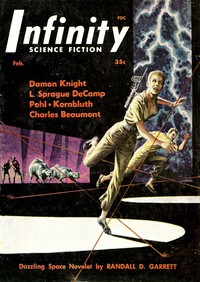
[Transcriber's Note: This etext was produced from Infinity Science Fiction, February 1956. Extensive research did not uncover any evidence that the U.S. copyright on this publication was renewed.]
That was the damnedest December I ever saw in New York. Whatever the weather is, Manhattan always gets the worst of it--frying hot in summer, snow or slush up to your ankles in winter--and all along the seaboard, it was a mean season. Coming in from Pennsylvania the day before, we'd been held up twice while the tracks were cleared. But when I stepped out of the hotel that night, the Saturday after Christmas, it was like a mild October; the air was just cool, with a fresh hint of snow in it. There was a little slush in the gutters, not much; the pavements were dry.
I was late, or I would have gone back and ditched the rubbers; I hate the foolish things to begin with, one reason I moved to the country--out there, I wear house slippers half the year, galoshes the rest; there's no in-between. I took off my gloves, opened my scarf, and breathed deep lungfuls while I walked to the corner for a cab. I began to wonder if it had been smart to move 90 miles out of town just because I didn't like rubbers.
The streets didn't seem overcrowded. I got a cab without any trouble. Nobody was hurrying; it was as if the whole population was sitting peacefully at home or in some bar, in no rush to be anywhere else.
"Listen," I said to the cabbie, "this is still New York, isn't it?"
He jerked his chin at me. "Hah?"
"Where's the crowds?" I said. "Where's the rotten weather? What happened?"
He nodded. "I know whatcha mean. Sure is funny. Crazy weather."
"Well, when did this happen?"
"Hah?"
"I said, how long has this been going on?"
"Cleared up about three o'clock. I looked out the winda, and the sun was shinin'. Jeez! You know what I think?"
"You think it's them atom bombs," I told him.
"That's right. You know what I think, I think it's them atom bombs." He pulled up opposite a canopy and folded down his flag.
In the lobby, I found an arrow-shaped sign that said, "MEDUSA CLUB."
The Medusa Club is, loosely speaking, an association for professional science fiction writers. No two of them will agree on what science fiction is--or on anything else--but they all write it, or have written it, or pretend they can write it, or something. They have three kinds of meetings, or two and a half. One is for club politics, one is for drinking, and the third is also for drinking, only more so. As a rule, they meet in people's apartments, usually Preacher Flatt's or Ray Alvarez', but every year at this time they rent a hotel ballroom and throw a whingding. I'm a member in bad standing; the last time I paid my dues was in 1950.
Rod Pfehl (the P is silent, as in Psmith) was standing in the doorway, drunk, with a wad of dollar bills in his hand. "I'm the treasurer," he said happily. "Gimme." Either he was the treasurer, or he had conned a lot of people into thinking so. I paid him and started zigzagging slowly across the floor, trading hellos, looking for liquor.
Tom Q. Jones went by in a hurry, carrying a big camera. That was unusual; Tom Q. is head components designer for a leading radio-TV manufacturer, and has sold, I guess, about two million words of science fiction, but this was the first time I had ever seen him in motion, or with anything but a highball in his hand. I spotted Punchy Carrol, nut-brown in a red dress; and Duchamp biting his pipe; and Leigh MacKean with her pale protoNordic face, as wistful and fey as the White Knight's; and there was a fan named Harry Somebody, nervously adjusting his hornrims as he peered across the room; and, this being the Christmas Party, there were a lot of the strangest faces on earth.
Most of them were probably friends of friends, but you never knew; one time there had been a quiet banker-type man at a Medusa meeting, sitting in a corner and not saying much, who turned out to be Dorrance Canning, an old idol of mine; he wrote the "Woman Who Slept" series and other gorgeous stuff before I was out of knee pants.
There were two blue-jacketed bartenders, and the drinks were eighty-five cents. Another reason I moved to the country is that the amusements are cheaper. Nursing my collins, I steered around two broad rumps in flounced satin and ran into Tom Q. He snapped a flashbulb in my face, chortled something, and went away while I was still dazzled. Somebody else with a lemon-colored spot for a head shook my left hand and muttered at me, but I wasn't listening; I had just figured out that what Tom had said, was, "There's no film in it!"
Somebody fell down on the waxed floor; there was a little flurry of screams and laughter. I found myself being joggled, and managed to put away an inch of the collins to save it. Then I thought I saw Art Greymbergen, my favorite publisher, but before I could get anywhere near him Carrol's clear Sunday-school voice began calling, "The program is about to begin--please take your seats!" and a moment later people were moving sluggishly through the bar archway.
I looked at my watch, then hauled out my copy of the little mimeographed sheet, full of earnest jocularity, that the club sent out every year to announce the Party. It said that the program would begin somewhere around 10, and it was that now.
This was impossible. The program always pivoted on Bill Plass, and Bill never got there, or anywhere, until the party was due to break up.
But I looked when I got down near the bandstand, and by God there he was, half as large as life, gesturing, flashing his Charlie Chaplin grin, teetering like a nervous firewalker. He saw me and waved hello, and then went on talking to Asa Akimisov, Ph.D. (A-K-I-M-I-S-O-V, please, and never mind the Akimesian, or Akimsiov.)
Maybe it was them atom bombs, I found a vacant folding chair with a good view of the platform, and a better one of a striking brunette in blue. Akimisov got up on the platform, with his neck sticking out of his collar like a potted palm (he had lost forty pounds, again) and began telling jokes. Ace is the second funniest man in Medusa, the first being Plass; the peculiar thing is that Plass writes humor professionally, and delivers his annual set-pieces the same way--the rest of the time he is merely a perfectly fascinating morbid wit--but Akimisov, who writes nothing but the most heavily thoughtful fiction in the business, bubbles with humor all the time, a poor man's Sam Levenson. I was going to write an article once proving that a writer's personality on paper was his real one turned inside out, but I fell afoul of some exceptions. Like Tom Q., who was still flashing his bulbs over at the side of the platform, and being noisily suppressed--you could paper him all over with his published stories, and never know the difference.
The program was good, even for Medusa. Ned Burgeon, wearing a sky-blue dinner jacket and a pepper-and-salt goatee, played his famous twenty-one-string guitar; a dark-haired girl, a new one to me, sang in a sweet, strong contralto; there was a skit involving Punchy Carrol as a dream-beast, L. Vague Duchamp as a bewildered spaceman, and B. U. Jadrys, the All-Lithuanian Boy, as a ticket agent for the Long Island Railroad. Then came Plass's annual monologue, and there is just nothing like those. I'm not exaggerating out of parochial pride (once a year is enough Medusa for me): the simple truth is that Plass is a comic genius.
He had his audience laid out flat, gasping and clutching its sides. Why should a man like that waste his time writing fiction?
Toward the end he paused, looked up from his notes, and ad-libbed a biting but not very funny wisecrack about--well, I'd better not say about what. A certain member in the audience stiffened and half got up, and there was a little embarrassed murmur under the laughter, but it was over in a minute. Bill looked flustered. He went back to his prepared speech, finished, and got a roar of applause.
I did my share, but I was worried. Bill can charm the rattles off a snake; if he wanted to go in for quack-doctoring, nut cultism or Canadian mining stock, let alone night-club comedy, he could be a millionaire. That gaffe simply hadn't been like him, at all. Still, it was Bill's Dostoevskian soul that made him the funny man he was, and God only knew what had been happening to him in the year since I'd been in town....
Akimisov, as m.c., delivered the final words. He bowed, straightened, and his pants fell down.
In the dressing room, when I got back there, Bill was busy apologizing to the member on whose toes he had trodden--that apology would have soothed a tiger with a toothache--and Akimisov, with a bewildered expression, was holding up his pants. That was what I was curious about; it was another false note--I didn't think Ace would stoop that low for a laugh. The pants were too big for him, of course, but Ace had always struck me as the kind of guy who wears a belt and suspenders.
He did; but the tongue had come out of the belt-buckle, and all the suspenders buttons had popped, all at once. Scouts were being sent out to look for a belt that would fit.
I wandered out into the hall again. I was beginning to get a peculiar feeling on one drink. Too many fresh vegetables; I can't take it like I used to. So I went to the bar and got another.
When I came out, the brunette in the blue evening gown was standing near the doorway listening to Larry Bagsby. Next thing I knew, she let out a whoop, grabbed her bosom, and fetched Larry a good one on the ear. This was unfair. I was a witness, and Larry hadn't done a thing except look; her overworked shoulder straps had simply given way, like Akimisov's suspenders.
Curiouser and curiouser.... The noises around me were picking up in volume and tempo, for all the world like a dancehall scene in a Western movie, just before somebody throws the first table. There was a thud and a screech off to my right; I gathered that somebody else had fallen down. Then a tinkle of bursting glass, and another little chorus of shouts, and then another thud. It went on like that. The crowd was on the move, in no particular direction; everybody was asking everybody else what was going on.
I felt the same way, so I went looking for Ray Alvarez; you can always count on him to tell you the answer, or make one up.
Tom Q. went by, flashing that camera, and it wasn't till the mob had swallowed him that I realized he wasn't replacing the bulb between shots--the same one was blazing over and over.
Well, a few years ago it was silly putty; the year before that, Diarrhetics. This year, everlasting flash bulbs--and no film in the camera.
Ned Burgeon passed me, his grin tilting his whiskers dangerously near the lighted stub in his cigarette holder; he was carrying the guitar case as if he were wading ashore with it. I saw Duchamp off to one side, talking to somebody, gesturing emphatically with his pipe.
It isn't so, but occasionally you get the impression that science fiction writers are either very tall or very short. I watched H. Drene Pfeiffer stilt by, Ray Bolgerish in an astonishing skin-tight suit of horseblanket plaid, followed by Will Kubatius and the heldentenor bulk of Don W. Gamble, Jr. I lowered my sights. Sandwiched between the giants there ought to have been half a dozen people I'd have been glad to see--if not Alvarez, then Bill Plass or his brother Horty; or Jerry Thaw; Bagsby; Preacher Flatt, who looks too much like a marmoset to be true.... But no: down on those lower levels there was nobody but an eleven-year-old boy who had got in by mistake, and the ubiquitous fan, Harry _You_-Know, the one with the glasses and all that hair. I tacked, veering slightly, and beat across the room the other way.
The book keeps going
Reading is free forever. Sign up and watch scenes appear while you read.



Scenes Storieta drew for other classics.
New illustrated classics
Once or twice a month: the latest books to get full character casts, scene art, and free comic editions. No account needed.