Public-domain ebook
Grist
Language: en489 downloads on Project Gutenberg
Subjects
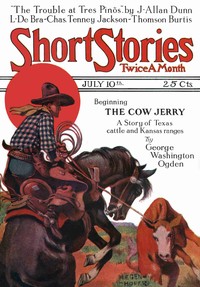
Short storiesDogs -- FictionMurder -- Investigation -- FictionGold mines and mining -- Alaska -- Fiction
Public-domain ebook sourced from Project Gutenberg #67421.
Public-domain ebook
Language: en489 downloads on Project Gutenberg
Subjects
Public-domain ebook sourced from Project Gutenberg #67421.
The opening · free to read
He threw back his head and howled eerily. His muzzle lifted to the stars and the most mournful sound known to man poured from his throat and was echoed and reëchoed by the hooded cedars and the rocks about him. He could not have told you why he howled. Dogs are not prone to introspection. But he knew that his master, who should be in the cabin yonder, would never come out again. He knew that the dying wisps of smoke from the chimney would never billow out in thick gray clouds again. And he knew that the other man—who had come out so hastily and gone swinging down the river trail—would never, never return.
Cheechako was chained. It had originally been a mark of disgrace, an unbearable humiliation to a malamute pup, but he did not mind it any longer. His master had made sleeping quarters for him that were vastly warmer than a snow-bed even in the coldest weather, and Cheechako wholeheartedly approved. He was comfortable, he was fed, and Carson released him now and then to stretch his legs and swore at him affectionately from time to time, and no reasonable dog will demand any more. Or so Cheechako viewed it, anyhow.
But now his muzzle tilted up. His eyes half-closed, and from his throat those desolate and despairing howls poured forth. A-a-o-oooo-e-e! A-a-o-oooo-e-e! They were a dirge and a lament. They were sounds of grief and they were noises of despair. Cheechako could not explain their meaning at all, but when a man dies they spring full-bodied from that man’s dog’s throat.
The hooded cedars watched, and echoed back the sound. The rocks about him watched, and gave tongue stilly in a faint reflection of his sorrow. The river listened, and babbled absently of sympathy and rippled on. The river has seen too many men die to be disturbed. The wilds listened. For many miles around the despairing, grief-stricken howling reached. To tree and forest, and hill and valley, the thin and muted wailing bore its message. Only the cabin seemed indifferent, though the tragedy was within it. Somewhere within the four log walls Carson lay sprawled out. Cheechako knew that he was dead without knowing how he knew. There had been a shot. Later, the other man had come out hastily with a pack on his back. He had taken the river trail and disappeared.
And long into the night, until the pale moonlight faded and died, Cheechako howled his sorrow for a thing he did not understand. Of his own predicament, the dog had yet no knowledge. It was natural to be chained. Food was brought when one was chained. That there was now no one to bring him food, that no one was likely to come, and that the most pertinacious of puppy teeth could not work through the chain that bound him; these things did not disturb him. His head thrown back, his eyes half-closed, he howled in an ecstasy of grief.
And while he gave vent to his sorrow in the immemorable tradition of his race, a faint rumbling set up afar off in the wilds. It was hardly more than a murmur, and maybe it was the wind among the trees. Maybe it was a minor landslide in the hills not so many miles away—a few hundred tons of earth and stone that plunged downward when the thaw of spring released its keystone. Maybe it was any one of any number of things, even a giant spruce tree crashing thunderously to the ground. But it lasted a little too long for any such simple explanation. If one were inclined to be fanciful, one would say it was the mill of one of the forest gods, grinding the grist of men’s destinies, and set going now by the murder of which Cheechako howled.
Certainly many unrelated things began to happen which bore obscurely upon that killing. The man who had fled down-river reflected on his cleverness and grinned to himself. He opened thick sausage-like bags and ran his fingers through shining yellow dust. Remembering his security against detection or punishment, he laughed cacklingly.
And very far away—away down in Seattle—Bob Holliday found courage to ask a girl to marry him, and promised to go back to Alaska only long enough to gather together what capital he had accumulated, when they would be married. Most of what he owned, he told her, was in a placer claim that he and Sam Carson worked together. He would sell out to Sam and return. But he would not take her back to the hardships he had endured. He was filled with a fierce desire to shield and protect her. That meant money, Outside, of course. And he started north eagerly for the results of many years’ suffering and work, which Sam Carson was guarding for him.
And again, in a dingy small building a sleepy mail clerk discovered a letter that had slipped behind account-books and been hidden for months on end. He canceled its stamp and dropped it into a mail bag to go to its proper destination.
Then, the rumbling murmur which might have been the mill of a forest god off in the wilds stopped abruptly. The grist had had its first grinding.
But the mill was not put away. Oh, no. Cheechako howled on until the moonlight paled and day came again. And the letter that had lain so long was dropped into a canoe and floated down to the coast in charge of a half-breed paddleman. And Bob Holliday sped north for Alaska and his partner, Sam Carson, who guarded a small fortune that Holliday had earned in sweat and agony and fierce battle with the wilds and winter snows. Holliday was very happy. The money his partner held for him would mean comforts and even luxuries for the girl he loved.
The mill of the forest god was simply laid aside for a little while. They grind, not slowly—these mills of the gods—but very swiftly, more swiftly than the grist can come to their grinding stones. Now and then they are forced to wait for more. But everything upon the earth comes to them some time. High ambitions and most base desires, and women’s laughter and red blood gushing, and all hopes and fears and lusts and terrors together disappear between the millstones and come out transformed into the product that the gods desire.
The mill was merely waiting.
The place had that indefinable air of desertion that comes upon a wilderness cabin in such an amazingly short time. The wood-pile, huge, yet clearly but the remnant of a winter’s supply, had not yet sprouted any of the mosses and lichens that multiply on dead wood in the short Alaskan summer. The axe, even, was leaned against the door. Chips still rested on blades of the quickly-growing grass that comes before the snow has vanished. A pipe rested on a bench before the house. But the place was deserted. The feel of emptiness was in the air.
Holliday had drawn in his breath for a shout to announce his coming when the curious desolation all about struck home. It was almost like a blow. Every sign and symbol of occupancy. Every possible indication that the place was what it seemed to be—the winter quarters of an old-timer thriftily remaining near his claim. And then, suddenly, the feeling of emptiness that was like death.
He disembarked in silence, his forehead creased in a quick and puzzled frown. He was walking swiftly when he climbed the bluff, glancing sharply here and there. A sudden cold apprehension made him hesitate. Then he shook himself impatiently and moved more quickly still.
Within ten yards of the door he stopped stock-still. And then he fairly rushed for the cabin and plunged within.
It was a long time later that he came out. He was very pale, and looked like a man who has been shaken to the core. He was swearing brokenly. Then he made himself stop and sit down. With shaking fingers he filled his pipe and lighted it.
“In his bunk,” he said evenly to the universe. “A bullet through his head. No sign of a fight. It isn’t credible—but there isn’t a sign of any dust or any supplies, and somebody else had been bunking in there with him. Murder, of course.”
He smoked. Presently he got up and found a path which he followed. At its end he saw what he was looking for. He poked about the cradle there, and expertly fingered the heap of gravel that had been thawed and dug out to be washed when summer came again.
“He’d cleaned up,” he said evenly. “He must have had a lot of dust, and the man with him knew it. I’ve got to find that man.”
His hands clenched and unclenched as he went back toward the cabin. Then he calmed himself again. His eyes searched for a suitable spot for the thing he had to do.
And then, quite suddenly, “My God!” said Holliday.
It was Cheechako, who had dragged himself to the limit of his chain and with his last atom of strength managed to whimper faintly. Cheechako was not pretty to look at. It had been a very long time since the night that he howled to the stars of his grief for the man who was dead. And he had been chained fast. Cheechako was alive, and that was all.
He lay on the ground, looking up with agonized, pitiful eyes. Holliday stared down at him and reached for his gun in sheer mercy. Then his eyes hardened.
“No-o-o. I guess not. You’ll be Sam’s dog. You’ll have to stay alive a while yet. Maybe you can pick out his murderer for me.”
He unbuckled the collar that Cheechako’s most frenzied efforts had not enabled him to reach, and took the mass of skin and boniness beneath down toward his canoe. With a face like stone he tended Cheechako with infinite gentleness.
And that night he left Cheechako wrapped up in his own blankets while he carved deeply upon a crudely fashioned wooden cross. His expression frightened Cheechako a little, but the dog lay huddled in the blankets and gazed at him hungrily. Cheechako hoped desperately that this man would be his master hereafter. Only, he also hoped desperately that he would never, never use a chain.
Cheechako learned much and forgot a little in the weeks that followed. When he could stand on his wabbling paws, Holliday took him off invalid’s diet and fed him more naturally canine dishes—the perpetual dried or frozen fish of the dog-teams, for instance. Cheechako wolfed it as he wolfed everything else, and in that connection learned a lesson. Once in his eagerness he leaped up to snatch it from Holliday’s hand. His snapping teeth closed on empty air, and he was soundly thrashed for the effort. Later, he learned not to snarl or snap if his food was taken squarely from between his teeth. When he had mastered that, he was tamed. He understood that he was not to try to bite Holliday under any circumstances whatever. And when he had mastered the idea he was almost pitifully anxious to prove his loyalty to Holliday. The only thing was that in learning that he got it into his head that he was not to snarl at or try to sink his teeth in any man.
That was possibly why Holliday was disappointed when he took the dog grimly downstream and made his inquiries as to who had come down in the two weeks after Carson’s murder. He found the names of every arrival, and he grimly pursued every one who might have been the man he was looking for. Each one had a plausible tale to tell. Most of them were known and could prove their whereabouts at the time of Carson’s death. But enough had trapped or wintered inland near their claims to make the absence of any explanation at all no proof of guilt. That was where Cheechako was to come in.
The book keeps going
Reading is free forever. Sign up and watch scenes appear while you read.



Scenes Storieta drew for other classics.
New illustrated classics
Once or twice a month: the latest books to get full character casts, scene art, and free comic editions. No account needed.