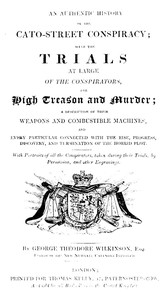
Thursday, February 24, 1820.
Whereas Arthur Thistlewood stands charged with high treason, and also with the wilful murder of Richard Smithers, a reward of One Thousand Pounds is hereby offered to any person or persons who shall discover and apprehend, or cause to be discovered or apprehended, the said Arthur Thistlewood, to be paid by the lords commissioners of his majesty’s treasury; upon his being apprehended and lodged in any of his Majesty’s gaols. And all persons are hereby cautioned upon their allegiance not to receive or harbour the said Arthur Thistlewood, as any person offending herein will be thereby guilty of high treason.
SIDMOUTH.
The above-named Arthur Thistlewood is about forty-eight years of age, five feet ten inches high, has a sallow complexion, long visage, dark hair, (a little grey), dark hazel eyes and arched eye-brows, a wide mouth and a good set of teeth, has a scar under his right jaw, is slender made, and has the appearance of a military man; was born in Lincolnshire, and apprenticed to an apothecary at Newark; usually wears a blue long coat and blue pantaloons, and has been a lieutenant in the militia.
The particular part of the plan of the traitorous conspirators, which had been frustrated by their arrest the previous evening, was the following; and its atrocity fully justified the alarming impression which the first rumours had created.
It had been ascertained by the gang, that the greater part of his majesty’s ministers were to dine together at the Earl of Harrowby’s, and this was considered as a favourable opportunity for effecting their entire extermination: Thistlewood was to have knocked at Lord Harrowby’s door, with a letter, purporting to be a despatch, or with a red box, such as is used in all the public offices, desiring it to be delivered immediately to the cabinet ministers at dinner, without delay. The servant, it was supposed, would immediately proceed with the despatch, while Thistlewood, with another of the conspirators, entered the hall as if to wait. They were immediately to open the street-door, others were to come in with hand-grenades, which were to be thrown into the house; and, in the confusion produced by them, all the rest of the conspirators were to rush into the dining-room, where the ministers were at dinner, and the work of assassination was to have been instantly begun.
The sensations thus excited in the public mind, were by no means allayed, when, in the course of the day, the details of the horrible transaction began to develope themselves; every one felt a breathless anxiety to probe to the bottom the secret workings of so detestable a conspiracy, confidence between man and man became weakened, and that social intercourse which constitutes the peculiar charm of society in this happy country, seemed to be placed at the mercy of the midnight assassin; the only hope left to the upright and the loyal portion of the community was, that the discovery would finally terminate in the beneficial result of purging society of some of the foulest members that apparently ever moved in it.
For some time previous to the day on which the arrests took place, it had been known to his Majesty’s government, that an attempt at the assassination of his Majesty’s ministers was meditating, and that Arthur Thistlewood was at the bottom of it. On Tuesday, the 22d of February, certain advice was received, that the attempt was to be made on Wednesday night, at the Earl of Harrowby’s, in Grosvenor-square. It is supposed that the Earl of Harrowby’s was fixed upon, because, being nearer the outlet from London than the residence of any other of the cabinet ministers (Lord Westmoreland’s excepted, who lives in the same square,) escape out of town, after the attempt had been made, would have been more easy. Be this as it may, the conspirators, as soon as they had ascertained that the cabinet dinner was to be held there, lost no time in arranging their dreadful and diabolical project.
The place chosen to arrange finally their proceedings, to collect their force, and to arm themselves, was near the Edgeware-road. John-street is a short distance on the road, and intersected by another street, called Cato-street.
Cato-street is rather an obscure street, and inhabited by persons in an humble class of life; it runs from John-street into Queen-street, and is parallel with Newnham-street. It is open at one end for the admission of carriages, but is closed by posts at the other. The premises occupied by the conspirators consisted of a three-stall stable, with a loft above, in a very dilapidated condition. They are the property of General Watson, and have been recently in the possession of an old servant of his, who had turned cow-keeper. From this man they had been engaged by some of the diabolical crew whose machinations have been so happily discovered. The people in Cato-street were utterly ignorant that the stable was let until Wednesday, when several persons were seen to go in and out, and carefully to lock the door after them. Some of these individuals carried sacks, and parcels of various descriptions.
For two or three hours previous to the entrance of the stable, the police-officers were on the spot, making their observations, but still no suspicion was excited of the real object of their attack; and so well was the plan of surprise laid, that, until the discharge of fire-arms was heard, every thing remained perfectly quiet.
Thus accurately informed of the intentions of the conspirators, warrants were issued to apprehend them while they were assembled. These warrants were put into the hands of the police-officers, under the able direction of Richard Birnie, Esq., the chief magistrate of Bow-street. A detachment of the Coldstream Guards from Portman-street barracks, were also ordered to accompany the police-officers. They proceeded to the place of meeting in Cato-street, the police-officers proceeding first. The conspirators had taken the precaution to place a sentinel below.
The military consisted of the picket-guard of the 2d Coldstream Regiment, which was stationed in Portman-street barracks. It consisted of thirty men, including a sergeant and corporal, and commanded by Captain Frederick Fitzclarence, who happened to be on duty at the time. They were called out about a quarter to eight o’clock; each man provided with twenty rounds of ball cartridge. The detachment immediately proceeded in the direction of the Edgware-road. The men were not acquainted with the business on which they were called out. They supposed a fire had taken place, and that they had been sent for to protect the property. On their arrival within about sixty yards of the house in Cato-street, John-street, the place of the meeting, they were halted for a few minutes, during which they were ordered by Captain Fitzclarence to fix bayonets and shoulder arms. They were also enjoined to observe the strictest silence. The detachment then marched on, but had not proceeded more than a few yards when they heard the noise of fire-arms. They were then ordered to advance in double quick time, and instantly came in junction with the civil officers, who had arrived previously on the ground, and were engaged with the party in the house.
The only approach to this pandemonium was by a narrow ladder. Ruthven, one of the principal Bow-street officers, led the way, and he was followed by Ellis, Smithers, Surman, and others of the patrol. On the door being opened, about twenty-seven or thirty men were seen within, all armed in some way or other; and some of them engaged either in charging fire-arms, or in girding themselves in belts similar to those worn by the military, while others were in close and earnest deliberation. There were tables about the room, on which lay a number of cutlasses, bayonets, pistols, sword-belts, pistol-balls in great quantities, ball-cartridges, &c.
As the officers entered the room, the conspirators all started up, when Ruthven, who had been furnished with a warrant from the magistrates, exclaimed--“We are peace-officers! Lay down your arms!” In a moment all was confusion. The notorious Arthur Thistlewood, opposed himself to the officers, armed with a cut-and-thrust sword of unusual length. Ruthven attempted to secure the door, and Ellis, who had followed him into the room, advanced towards the man, and, presenting his pistol, exclaimed--“Drop your sword, or I’ll fire instantly!” Thistlewood brandished his sword with increased violence, when Smithers, the other patrol, rushed forward to seize him; and on the instant the ruffian stabbed him to the heart. Poor Smithers fell into the arms of his brother-officer, Ellis, exclaiming--“Oh, God! I am----” and in the next instant was a corpse.
Whilst this deed was doing, the lights were extinguished, and a desperate struggle ensued, in which many of the officers were severely wounded. Surman, one of the patrol, received a musket-ball on the temple, but fortunately it only glanced along the side of his head, tearing up the scalp in its way. The conspirators kept up an incessant fire; whilst it was evident to the officers that many of them were escaping by some back way. Mr. Birnie exposed himself every where, and encouraged the officers to do their duty, whilst the balls were whizzing round his head. At this moment Captain Fitzclarence (a young officer well known for his gallantry and gentlemanly conduct) arrived at the head of the detachment of the Coldstream Guards. They surrounded the building, and Captain Fitzclarence, with Sergeant Legge and three files of grenadiers entered the stable, where the first object that presented itself to their sight, was one of the party running out of the stable, apparently with intention to make his escape. He was seized by one of the soldiers, when the ruffian instantly approached the gallant captain, and presented a pistol at his breast; but, as he was in the act of pulling the trigger, Sergeant Legge rushed forward, and, whilst attempting to put aside the destructive weapon, received the fire upon his arm. Fortunately for this brave man, the ball glanced along his arm, tearing the sleeve of his jacket, from the wrist to the elbow, and only slightly wounding him.
A black man was the next that was started from his place of concealment; he was armed with a cutlass. He also aimed a blow at Captain Fitzclarence, but was seized and secured by one of the soldiers, James Basey, without any injury to the latter but a slight cut on the finger. Then addressing himself to his friends in the house, he exclaimed, “Fight on while you have a drop of blood in you--you may as well die now as at another time.”
The detachment was then ordered to rush forward which they did, headed by their captain, who darted into a stall, and seized by the collar a fellow who was standing in it, and who grappled with him with one hand, while he attempted to fire a pistol at him with the other, which did not go off, the powder flashing in the pan. The miscreant still holding firmly by the coat, the captain called out to his men to disengage him. Two of them, James Revel and James Basey, immediately seized him, and he surrendered himself, saying, “Do not kill me, and I’ll tell you all.” This scene took place in the stable on the ground-floor. It was a three-stalled stable, with a hay-loft over it, with which it communicated by a ladder placed at one end. The detachment led by Captain Fitzclarence then mounted the ladder and into the loft, now filled with smoke, and only illuminated by the occasional flashes of the fire-arms of the conspirators.