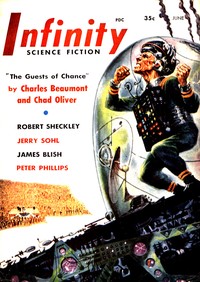
Immortality? Like anything else, it may be a matter of definition, or just of the point of view....
"THE STAR" by Arthur C. Clarke was by all odds the most popular story in the first issue of INFINITY, and probably one of the most popular science-fiction stories to be published anywhere in 1955. It was also highly controversial, and in "Rebuttal" Betsy Curtis presents the other side of the question--plus an idea that seems to be totally new. The result, we think you'll agree, is one of the outstanding science-fictional events of 1956.
[Transcriber's Note: This etext was produced from Infinity Science Fiction, June 1956. Extensive research did not uncover any evidence that the U.S. copyright on this publication was renewed.]
They brought Father Phillip Burt to St. Luke's as our "share" of the research project on the mysterious disease which afflicted most of the crew of the recently returned Phoenix Nebula expedition. News of the disease, of course, was not spread beyond the research teams, as the public seems to fear a plague worse than damnation itself. And it didn't seem to be a very serious disease: Father Phillip was easily the worst case of all; and although several members of the expedition had died, their deaths could be evaluated as due to secondary infections of common enough earth origin. Very few of the crew members were in actual pain; but Father Phillip was in constant agony which no amount of sedation seemed to calm.
I ran the customary tissue cultures and biopsies, including those on internal organs not customarily available. We were given an excuse for getting internal samples of tissue when Father Phillip's appendix flamed into infection. And although I did not find a general infecting organism, what I did find was enough to send me trotting up to his room on the double.
I suppose I should explain here that I, Father Niccolo Molina, am head research pathologist for St. Luke's and that I don't, therefore, meet the patients personally very often. But Father Phillip I had to meet.
His day nurse, Sister Mary Felicia, met me at the door in her crisp white teflon overall.
"Father is very uncomfortable today," she told me. "The incision is not healing at all and he keeps trying to talk and then breaking off in the middle of a sentence with the pain."
"Talking about anything in particular?" I asked suspiciously.
"The merest chit-chat. The weather ... pleasantries about the hospital ... jokes about doctors in particular. He doesn't have a very high regard for doctors, it seems. Thinks they are notable atheists, I gather." She smiled.
"Many thanks for the diagnosis, Sister," I told her gravely. Then I added, "I suppose you are having to maintain a considerable quarantine and decontamination routine as Father's nurse?"
"Oh yes. In this wing, you know, we are all in solitary, approaching no persons other than our patient and the doctors ... sometimes for as much as three months after the end of a case. It provides excellent time for a retreat, which is why most of us apply for such duty." She pointed to the small prie-dieu in her tiny cubicle, which stood as a buffer between the contagion room and the hallway of the ward.
"If I am right about the nature of Father Burt's disease," I told her, "you will soon see the end of this case, and without any three months' decontamination, either."
She smiled again. "You couldn't say a happier thing," she said, "even though I shall probably apply for a leprosy case if I am relieved of this one. I've become very concerned about Father Phillip."
"Good. He needs your prayers as no man probably ever needed them before. I'll see him now." I crossed her small room and opened the inner door and went in.
Father Phillip was lying flat in the narrow white bed, his arms lying listlessly on either side of the slight hump of his body under the sheet. The big bulge halfway down was his knees over a pillow, the usual position for post-operative appendectomies.
He squeezed out a smile with an effort. "Morning, doctor," he said.
"Father Nick," I smiled back. "Father Nick Molina of Pathology, Father."
His wasted body jerked as if with a knife thrust. Then he said, "Excuse me. I had forgotten that there were doctors who were not laymen. I'm sorry." He drew up a shoulder against his cheek in a curious gesture, then shivered.
"Sorry for what?" I asked.
"Just sorry, I guess...." He winced and was silent.
"Sorry for me?"
"Well, yes."
"That I'm not a layman?"
"You could put it that way."
"That's a very interesting statement, Father, and one about which I want to know a good deal more after I've asked you some other questions. You see, I think I know what's the matter with you, and it's definitely curable."
"It is not curable." His voice had a flat finality, and his lips drew into a thin firm line.
"Let me ask you the questions anyway, Father," I said. He gave no other sign, "Have you ever looked through a microscope?"
"At the little beasties? Yes, in college."
"Well, that's what I have just finished doing with a number of slivers of living tissue from your body. Do you know what I saw that would bring me up here?"
"I might," he answered warily.
"What do you think?"
"Cancer, maybe."
"No, cancer cells have their own pattern of behavior which is very pretty and, of course, no longer at all deadly. You do not have cancer; but the cells of your kidneys, for instance, are doing something I've never seen live kidney cells doing."
"And what is that?" he said, as if he really couldn't care less.
"Nothing in particular. This is unheard of indeed. Kidney cells are busy little widgets doing a tremendous job night and day. Like the individual muscle fibers of the heart, they work on year after year with no vacations, no coffee breaks, secure in the knowledge of their purpose."
"No pseudo-sermons, please, Father!" Father Phillip's voice was stern. "You don't have to Peter Rabbit up biology for me."
"A scholar indeed to have heard of Peter Rabbit," I laughed but he did not smile. Then I asked, "Do you want to see how real kidney cells--yours---are behaving? I have a projecting microscope in the basement. Do you want to see what's going on?"
"Not particularly. If you think you can cure me, go ahead and try."
"Are you willing to pray for your own recovery?"