Storieta
Save & sign up
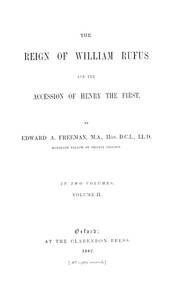
Cover of The Reign of William Rufus and the Accession of Henry the First, Volume 2 (of 2)

About this book

Edward A. Freeman’s two‑volume study of the late eleventh‑ and early twelfth‑century English monarchy is a meticulously annotated scholarly work. Volume II opens with a series of “Additions and Corrections” that reference specific pages, notes, and earlier passages, revealing Freeman’s habit of cross‑referencing his own text and a wide range of primary sources, from the Anglo‑Norman chronicles of William of Malmesbury to Scandinavian sagas and the writings of Orderic Vitalis. The opening chapter, titled “The Wars of Scotland, Northumbria, and Wales, 1093–1098,” situates the political tension between England and its northern neighbours, foregrounding the pivotal events of Anselm’s appointment and the ensuing conflict that shaped the transition from William Rufus to Henry I.

The narrative voice is that of a nineteenth‑century historian, dense with footnotes, Latin quotations, and careful philological commentary. Freeman’s prose is formal, often digressive, and assumes familiarity with medieval historiography and the geography of the British Isles. Readers who relish detailed source criticism, enjoy the interplay of charter evidence with narrative history, and have a keen interest in the Norman period’s political and ecclesiastical dynamics will find this volume rewarding.

Who appears in this book

  • William RufusMiddle‑aged Norman king, short cropped hair, trimmed beard, regal crimson mantle, gold chain, crown, solemn expression
  • Henry IYoung Anglo‑Norman monarch, shoulder‑length hair, clean‑shaven face, white surcoat with blue embroidery, jeweled circlet, confident gaze
  • AnselmElderly archbishop, bald head with tonsure, thin beard, simple white cassock, gold cross pendant, contemplative eyes

Opening lines

Freeman—A Project Gutenberg eBook ADDITIONS AND CORRECTIONS. VOL. II. p. 19, note 3 . This picture of the two natives, most likely churls, carrying the King’s body on the cart, is singularly like the story of Rufus’ own end to which we shall come presently. p. 27, l. 5 . I should not have said “ a relic,” as I find that the black cross of Scotland is a relic of great fame, as indeed is almost implied in the story. p. 27, note 5 . See vol. i. p. 167. p. 28, note 5 . Munch ( Det Norske Folks Historie , ii. 471–475, for an introduction to which I have to thank Professor Fiske of Cornell University) connects this entry with the account of Magnus’ dealings with Man, spoken of in p. 138 , and with every likelihood supposes an earlier expedition of Magnus in 1093, in which he appeared in both Scotland and Man, and which the writers of the Sagas have confounded with his expedition in 1098.

Keep reading free · start reading with no account

New illustrated classics

A new classic, drawn, in your inbox.

Once or twice a month: the latest books to get full character casts, scene art, and free comic editions. No account needed.