Public-domain ebook
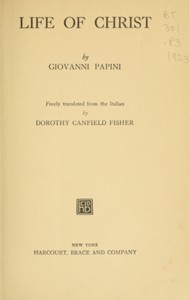
Life of Christ
Language: en1,270 downloads on Project Gutenberg
Subjects
In: Biographies·Philosophy & Ethics·Religion/Spirituality
Public-domain ebook sourced from Project Gutenberg #67486.
Public-domain ebook
Language: en1,270 downloads on Project Gutenberg
Subjects
In: Biographies·Philosophy & Ethics·Religion/Spirituality
Public-domain ebook sourced from Project Gutenberg #67486.
Giovanni Papini’s Life of Christ is a polemical biography that opens with a candid translator’s note, explaining why certain Italian passages have been omitted or altered for an English‑speaking audience. The introduction immediately frames the work as a response to the “modern Italy” debate, positioning the book as a bridge between scholarly criticism and popular devotion. Rather than presenting a straightforward chronological account, Papini launches into a sweeping cultural critique, describing centuries of attempts to “kill” Christ in the hearts of men and cataloguing the myriad “new religions” that have sprung up in his stead. This sets the tone for a text that is as much an argument about the relevance of Christ today as it is a recounting of his historical life.
The voice is unmistakably early‑twentieth‑century Italian modernist, dense with rhetorical flourishes, irony, and a fervent, almost theatrical, zeal. Papini’s style blends scholarly reference with vivid, sometimes baroque, imagery, making the work appealing to readers who enjoy intellectually vigorous essays that challenge conventional hagiography. Those interested in the intersection of theology, philosophy, and cultural history, especially readers who appreciate a vigorous, argumentative prose rather than a devotional narrative, will find this book engaging.
The opening · free to read
The only other explanation which may be necessary is in connection with the omission of occasional sentences, paragraphs and of one or two chapters. In the case of individual sentences or phrases, they were usually omitted because they contained an allusion sure to be obscure to non-Italian readers. A characteristic example of such omissions is in the scene of the crucifixion where Christ is described as being nailed to the cross with outstretched arms like an owl nailed with outstretched wings to a barn-door. This revolting country-side custom being unknown to American readers, a reference to it could only cloud the passage.
Since translators into English who omit passages are usually accused of suppressing valuable material which might displease too-narrow Anglo-Saxon readers, it is perhaps as well to explain that the excision of paragraphs here and there, and of a few chapters, is in no sense an expurgation, because this Life of Christ is very much of the same quality throughout. It simply seemed to me that such occasional lightening of the text would make it more acceptable to English-speaking readers, so much less tolerant of long descriptions and minute discussions than Italians.
I quite realize that this may seem a slight and arbitrary basis for making actual excisions in an author’s work, and I understand that the translator is not at all responsible for the matter which he translates, but only for the truthfulness with which he presents the text given him to set into another language. I was moved first by the fact that the passages omitted are of no more importance than any other passages in the book; and secondly by the author’s wish expressly stated in his Introduction, to have this a readable book which will hold those who pick it up, rather than to have it a book of exact learning or great literature. This translation was made with the purpose of allowing the general American reading-public to form an opinion on a book which has aroused a great deal of discussion in modern Italy; and to carry out this purpose, the occasional omissions mentioned and a certain freedom in the rendering of the Italian seemed to me justifiable.
Dorothy Canfield Fisher.
For five hundred years those who call themselves free spirits because they prefer prison life to army service have been trying desperately to kill Jesus a second time—to kill Him in the hearts of men.
The army of His enemies assembled to bury Him as soon as they thought they heard the death-rattle of Christ’s second death. Presumptuous donkeys mistaking libraries for their stables, top-heavy brains pretending to explore the highest heavens in philosophy’s drifting balloon, professors poisoned by the fatal strong drink of philology and metaphysics, armed themselves. Paraphrasing the rallying-cry of Peter the Hermit to the crusaders, they shouted “Man wills it!” as they set out on their crusade against the Cross. Certain of them drew on their boundless imaginations to evolve what they considered proof positive of a fantastic theory that the story of the Gospel is no more than a legend from which we can reconstruct the natural life of Jesus as a man, one-third prophet, one-third necromancer, one-third demagogue, a man who wrought no miracles except the hypnotic cure of some obsessed devotees, who did not die on the cross, but came to Himself in the chill of the sepulcher and reappeared with mysterious airs to delude men into believing that He had risen from the dead.
Others demonstrated as certainly as two and two make four that Jesus was a myth developed in the time of Augustus and of Tiberius, and that all the Gospels can be reduced to a clumsy mosaic of prophetic texts. Others conceived of Jesus as a good, well-meaning man, but too high-flown and fantastic, who went to school to the Greeks, the Buddhists, and the Essenes and patched together His plagiarisms as best He could to support His claim to be the Messiah of Israel. Others made Him out to be an unbalanced humanitarian, precursor of Rousseau and of divine democracy; an excellent man for his time but who to-day would be put under the care of an alienist. Others to get rid of the subject once for all took up the idea of the myth again, and by dint of puzzlings and comparisons concluded that Jesus never was born anywhere in any spot on the globe.
But who could have taken the place of the man they were trying to dispose of? The grave they dug was deeper every day, and still they could not bury Him from sight.
Then began the manufacture of religions for the irreligious. During the whole of the nineteenth century they were turned out in couples and half dozens at a time: the religion of Truth, of the Spirit, of the Proletariat, of the Hero, of Humanity, of Nationalism, of Imperialism, of Reason, of Beauty, of Peace, of Sorrow, of Pity, of the Ego, of the Future and so on. Some were only new arrangements of Christianity, uncrowned, spineless Christianity, Christianity without God; most of them were political, or philosophic, trying to make themselves out mystics. But faithful followers of these religions were few and their ardor faint. Such frozen abstractions, although sometimes helped along by social interest or literary passions, did not fill the hearts which had renounced Jesus.
Then attempts were made to throw together facsimiles of religion which would make a better job of offering what men looked for in religion. Free-Masons, Spiritualists, Theosophists, Occultists, Scientists, professed to have found the infallible substitute for Christianity. But such mixtures of moldy superstition and worm-eaten necromancy, such a hash of musty rationalism and science gone bad, of simian symbolism and humanitarianism turned sour, such unskillful rearrangements of Buddhism, manufactured-for-export, and of betrayed Christianity, contented some thousands of leisure-class women, of condensers of the void ... and went no further.
In the meantime, partly in a German parsonage and partly in a professor’s chair in Switzerland, the last Anti-Christ was making ready. “Jesus,” he said, coming down from the Alps in the sunshine, “Jesus mortified mankind; sin is beautiful, violence is beautiful. Everything that says ‘yes’ to Life is beautiful.” And Zarathushtra, after having thrown into the Mediterranean the Greek texts of Leipzig and the works of Machiavelli, began to gambol at the feet of the statue of Dionysius with the grace that might be expected of a German, born of a Lutheran minister, who had just stepped down from a chair in a Swiss University. But, although his songs were sweet to the ear, he never succeeded in explaining exactly what he meant when he spoke of this adorable “Life” to which men should sacrifice such a living part of themselves as their need to repress their own animal instincts: nor could he ever say in what way Christ, the true Christ of the Gospels, opposed Himself to life, He who wanted to make life higher and happy. And the poor syphilitic Anti-Christ, when insanity was close upon him, signed his last letter, “The Crucified One.”
And still Christ is not yet expelled from the earth either by the ravages of time or by the efforts of men. His memory is everywhere: on the walls of the churches and the schools, on the tops of bell-towers and of mountains, in street-shrines, at the heads of beds and over tombs, thousands of crosses bring to mind the death of the Crucified One. Take away the frescoes from the churches, carry off the pictures from the altars and from the houses, and the life of Christ fills museums and picture-galleries. Throw away breviaries and missals, and you find His name and His words in all the books of literature. Even oaths are an involuntary remembrance of His presence.
When all is said and done, Christ is an end and a beginning, an abyss of divine mystery between two divisions of human history. Paganism and Christianity can never be welded together. Before Christ and After Christ! Our era, our civilization, our life, begins with the birth of Christ. We can seek out what comes before Christ, we can acquire information about it, but it is no longer ours, it is signed with other signs, limited by other systems, no longer moves our passions; it may be beautiful, but it is dead. Cæsar was more talked about in his time than Jesus, and Plato taught more science than Christ. People still discuss the Roman ruler and the Greek philosopher, but who nowadays is hotly for Cæsar or against him; and where now are the Platonists and the anti-Platonists?
Christ, on the contrary, is still living among us. There are still people who love Him and who hate Him. There is a passion for the love of Christ and a passion for His destruction. The fury of so many against Him is a proof that He is not dead. The very people who devote themselves to denying His ideas and His existence pass their lives in bringing His name to memory.
We live in the Christian era, and it is not yet finished. If we are to understand the world, our life, ourselves, we must refer to Christ. Every age must re-write its own Gospel. More than any other, our own age has so re-written its own Gospel, and therefore the author ought perhaps to justify himself for having written this book. But the justification, if there is need of such, will be plain to those who read it.
There never was a time more cut off from Christ than ours, nor one which needed Him more. But to find Him, the old books are not enough. No life of Christ, even if it were written by an author of greater genius than any who has ever lived, could be more beautiful and perfect than the Gospels. The candid sobriety of the first four stories can never be improved upon by any miracle of style and poetry. And we can add very little to the information they give us.
But who reads the Gospels nowadays? And who could read them, even if he set himself at it. Glosses of philologists, comments of the exegetical experts, varying readings of erudite marginal editors, emendations of letters, such things can provide entertainment for patient brains. But the heart needs something more than this.
Every generation has its preoccupations and its thoughts, and its own insanities. The old Gospels must be re-translated for the help of the lost. If Christ is to remain alive in the life of men, eternally present with us, it is absolutely necessary to resuscitate Him from time to time; not to color Him with the dyes of the present day, but to represent with new words, with references to things now happening, His eternal truth and His never-changing story.
The world is full of such bookish resuscitations of Christ, learned or literary: but it seems to the author of this one that many are forgotten, and others are not suitable. To write the history of the stories of Christ would take another book and one even longer than this one. But it is easy to divide into two great divisions those which are best known and most read: (1) Those written by orthodox authors for the use of the orthodox; (2) and those written by scientists for the use of non-believers. Neither the first nor the second can satisfy those who are seeking in such lives for Life.
The book keeps going
Reading is free forever. Sign up and watch scenes appear while you read.



Scenes Storieta drew for other classics.
New illustrated classics
Once or twice a month: the latest books to get full character casts, scene art, and free comic editions. No account needed.