Public-domain ebook
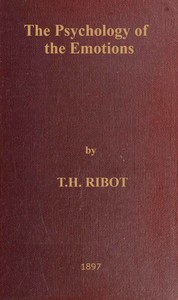
The Psychology of the Emotions
by Th. Ribot
Language: en4,064 downloads on Project Gutenberg
Subjects
Public-domain ebook sourced from Project Gutenberg #67585.
Public-domain ebook
by Th. Ribot
Language: en4,064 downloads on Project Gutenberg
Subjects
Public-domain ebook sourced from Project Gutenberg #67585.
The work is a scholarly treatise on the psychology of feeling, opening with a broad critique of the field’s neglect of emotions in favor of perception, memory and attention. Ribot argues that despite recent advances by William James and Carl Lange, the study of affect remains under‑represented in contemporary bibliographies, and he sets out to remedy this by adopting a physiological approach that treats emotions as autonomous, biologically rooted states rather than mere by‑products of intellect. The introduction outlines a two‑part structure: the first examines general affective phenomena such as pleasure, pain and the nature of emotion; the second surveys specific emotions, fear, anger, sympathy, the ego, sexual instinct, tracing their evolution, physiological bases and pathological forms. Ribot promises a systematic, historically informed analysis that avoids digression, aiming to illuminate the “conducting thread” that links the myriad manifestations of feeling.
Written in the rigorous, formal prose of late‑19th‑century French psychology, the book reflects the era’s blend of philosophical speculation and emerging experimental science. Its dense, systematic style will appeal to readers who enjoy detailed theoretical arguments, historical overviews of scientific debates, and a focus on the biological underpinnings of mental life. Scholars of psychology, philosophy of mind, and the history of science, as well as anyone interested in a deep, academically oriented exploration of emotions, will find Ribot’s methodical approach rewarding.
The opening · free to read
The psychology of states of feelings, it is generally recognised, is still in a confused and backward condition. Although it has benefited in some measure by the contemporary allurement of psychological research, it must be acknowledged that it has only exerted a moderate seduction upon workers; the preference has been given to other studies, such as those of perception, of memory, of images, of movement, of attention. If any proof is necessary we may find it in the bibliographies, now published in Germany, America, and France, which give the psychological inventory of each year; of the whole number of books, memoirs, and articles which appear, less than the twentieth part, on an average, relates to the feelings and emotions. It is a very small part compared to the part played by the emotions and passions in human life, and this region of psychology is not deserving of such neglect. It is true that in recent years W. James and Lange seem to have brought this state of stagnation to an end. Their thesis, paradoxical in appearance, has aroused, especially in America, many discussions, criticisms, defences, and, what is of more value, observations and researches.
It must be acknowledged that for those who have any care for precision and clearness the study of the feelings and emotions presents great difficulties. Internal observation, always an uncertain guide which leads us but a little way, is here especially questionable. Experiment has given some very useful results, but they are much less important and numerous than in other regions of psychology. Detailed researches and monographs are lacking, so that the subject abounds with questions on which little light has yet been thrown. Finally, the dominant prejudice which assimilates emotional states to intellectual states, considering them as analogous, or even treating the former as dependent oh the latter, can only lead to error.
We have, in fact, in every study of the psychology of feeling to choose between two radically distinct positions, and this choice involves a difference in method. Concerning the final and essential nature of states of feeling there are two contrary opinions. According to one, they are secondary and derived, the qualities, modes, or functions of knowledge; they only exist through it; they are “confused intelligence”: that is the intellectualist thesis. According to the other, they are primitive, autonomous, not reducible to intelligence, able to exist outside it and without it; they have a totally different origin: that is the thesis which under its present form may be called physiological. These two doctrines exhibit variations which I ignore, as I am not writing their history, but they all come into one or the other of these two great currents.
The intellectualist theory, which is of considerable age, has found its most complete expression in Herbart and his school, for whom every state of feeling only exists through the reciprocal relation of representations; every emotion results from the co-existence in the mind of ideas which agree or disagree; it is the immediate consciousness of the momentary elevation or depression of psychic activity, of a free or impeded state of tension. But it does not exist by itself; it resembles musical harmonies and dissonances, which differ from elementary sounds though only existing through them. Suppress every intellectual state, and feeling vanishes; it only possesses a borrowed life, that of a parasite. The influence of Herbart still persists in Germany, and, with some exceptions (Horwicz, Schneider, etc.), complete or mitigated intellectualism predominates.
The doctrine which I have called physiological (Bain, Spencer, Maudsley, James, Lange[1]) connects all states of feeling with biological conditions, and considers them as the direct and immediate expression of the vegetative life. It is the thesis which has been adopted, without any restriction, in this work. From this standpoint feelings and emotions are no longer a superficial manifestation, a simple efflorescence; they plunge into the individual’s depths; they have their roots in the needs and instincts, that is to say, in movements. Consciousness only delivers up a part of their secrets; it can never reveal them completely; we must descend beneath it. No doubt it is awkward to have to invoke an unconscious activity, to call in the intervention of an obscure and ill-determined factor; but to wish to reduce emotional states to clear and definite ideas, or to imagine that by this process we can fix them, is to misunderstand them completely and to condemn ourselves beforehand to failure.
It may be doubted whether all the English writers here mentioned can be strictly classed with the physiological school as understood by M. Ribot. With regard to Mr. Spencer, for instance, this is indicated by a brief summary of his own position in a private letter to the Rev. Angus Mackay, who had presented a statement of the “confused intelligence” theory, “which I conceive to be a part of the truth,” wrote Mr. Spencer, adding that “joined with the dimly aroused association of ideas derived from the experiences of the individual, I hold that the body of the emotion consists more largely of the inherited associations of experiences and still more vague states of consciousness which result from excitement of them.” It is clear that the evolutionary view does not necessarily fall wholly into the “physiological” group.—ED.
For the rest, this is neither the place to criticise the intellectualist thesis, nor to justify the other in passing; the whole work is devoted to this task.
The book consists of two parts. The first studies the more general manifestations of feeling: pleasure and pain, the characteristic signs of this form of psychic life, everywhere diffused under manifold aspects; then the nature of emotion, a complex state which in the order of feelings corresponds to perception in the order of knowledge.
The second deals with the special emotions. This detailed study is of great importance for reasons which will be explained later on, especially because we must not rest in generalities; it furnishes a means of control and verification. The nature of the emotional life cannot be understood unless we follow it in its incessant transformations—that is to say, in its history. To separate it from social, moral, and religious institutions, from the æsthetic and intellectual movements which translate it and incarnate it, is to reduce it to a dead and empty abstraction. Thus an attempt has been made to follow all the emotions one after the other in the progress of their development, noting the successive movements of their evolution or their retrogression.
The pathology of each emotion has been sketched to complete and throw light on the study. I have tried to show that beneath an appearance of confusion, incoherence, and promiscuity, there is, from the morbid to the normal, from the complex to the simple, a conducting thread which will always bring us back to the point of origin.
A work which has for its aim to set forth the present situation of the psychology of feeling and emotion might have been made very long. By eliminating every digression and all historical exposition, it has been made as short as possible.
TH. RIBOT.
CONTENTS.
In all affective manifestations there are two elements: the motor states or impulses, which are primary; the agreeable or painful states, which are secondary—Unconscious (organic or protoplasmic) sensibility; micro-organisms—Chemical interpretation; psychological interpretation—Are there pure states of feeling?—Affirmative facts—The period of needs, the instinct of conservation-The period of primitive emotions—How they may be determined; the genetic or chronological method—Fear, anger, affection, the self-feeling, sexual emotion—Are joy and grief emotions?—The abstract emotions and their conditions—The passions are the equivalent in feeling of an intellectual obsession.
_Part I._—GENERAL PSYCHOLOGY.
Its anatomical and physiological conditions; pain nerves, transmission to the centres—Modifications of the organism accompanying physical pain: circulation, respiration, nutrition, movements—Are they the effects of pain?—Pain is only a sign—The analgesias: unconsciousness of pain and intellectual consciousness—Retardation of pain after sensation—Hyperalgesia—Nature of pain: theory that it is a sensation; theory that it is a quality of sensation—Pain may result from the quality or the intensity of the stimulus—Hypotheses regarding its ultimate cause: it depends on a form of movement, a chemical modification.
Identity of all the forms of pain—Evolution of moral pain: (1) the pure result of memory; (2) connected with representations; positive form, negative form; (3) connected with concepts—Its external study; physical signs—Therapeutics—Conclusions—A typical case of hypochondriasis.
Subject little studied—Is Pleasure a sensation or a quality?—Its physical concomitants: circulation, respiration, movements—Pleasure, like pain, is separable: physical and moral anhedonia—Identity of the different forms of pleasure—The alleged transformation of pleasure into pain—Common ground of the two states—Hypothesis of a difference in kind and in degree—Simultaneity of two opposite processes: what falls under consciousness is the result of a difference—Physiological facts in support of the above.
Utility of the pathological method—Search for a criterion of the morbid state; abnormal reaction through excess or defect; apparent disproportion between cause and effect; chronicity—I. Morbid pleasures, not peculiar to advanced civilisation—Different attempts at explanation—This state cannot be explained by normal psychology: it is the rudimentary form of the suicidal tendency—Classification—Semi-pathological pleasures: those destructive of the individual, those destructive of the social order—II. Abnormal pains—Melancholic type—Whence does the painful state arise in its permanent form? from an organic disposition? or from a fixed idea?—Examples of the two cases.
Two methods of study—Affirmative thesis founded on observation, deduction, and psycho-physics—Negative thesis: the psychological trinity; confusion between consciousness and introspection—Diversity of temperaments.
The beginning of life—I. Conditions of existence of pleasure and pain; lowering and heightening of vital energy—Féré’s experiments—Meynert’s theory—II. Finality of pleasure and pain—Exceptions: explicable cases; irreducible cases.
Analogy between perception and emotion—Constituent elements of emotion—Summary of the theory of James and Lange—Application of this theory to the higher emotions (religious, moral, æsthetic, intellectual)—Illegitimate confusion between the quality and intensity of emotion—Examination of a typical case: musical emotion—The most emotional of all the arts is the most dependent on physiological conditions—Proofs: its action on animals, on primitive man, on civilised man; its therapeutic action—Why certain sensations, images, and ideas awaken organic and motor states, and, consequently, emotion—They are connected either with natural or social conditions of existence—Differences and resemblances between the two cases—Antecedents of the physiological theory of emotion—Dualist position, or that of the relation between cause and effect—Unitary position; its advantages.
The book keeps going
Reading is free forever. Sign up and watch scenes appear while you read.



Scenes Storieta drew for other classics.
New illustrated classics
Once or twice a month: the latest books to get full character casts, scene art, and free comic editions. No account needed.