Public-domain ebook
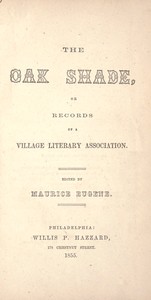
The Oak Shade, or, Records of a Village Literary Association
Language: en479 downloads on Project Gutenberg
Subjects
In: Short Stories·Humour·Novels
Public-domain ebook sourced from Project Gutenberg #67605.
Public-domain ebook
Language: en479 downloads on Project Gutenberg
Subjects
In: Short Stories·Humour·Novels
Public-domain ebook sourced from Project Gutenberg #67605.
The opening · free to read
PREFIXED TO THE FOLLOWING TALE, AND SUPPOSED TO HAVE BEEN WRITTEN BY THE SECRETARY OF THE JUNTO.
The author of the following paper vouches for the correctness of the whole story, having himself received it from the person who enacted the part of the spirit therein. When it was read at our meeting, a large number of listeners, who had been enjoying themselves in promiscuous conversation, were seated around the table in a cheerful circle. Although some were at first inclined, perhaps more from a habit to find fault than from a displeasure at the tale itself, to cavil at and doubt it rather than to be amused, there was an honest and bewitching humor in the face of the speaker which alone seemed to entitle his story to full belief: so that by the time he had finished it, but one or two continued serious, whilst all the rest at once agreed that it was creditable in every particular. Whether they were not influenced to this conclusion more through their mirth than their careful judgment, I could not well ascertain; yet I am disposed to think, they merely meant to “take the story for what it was worth.”
An old gentleman now advanced, who had not only been careful all his life long to avoid the frivolities of the world, but who had also experienced some of its rough realities, if true inferences were deducible from his care-worn appearance and thread-bare garments. Not satisfied with what had been read, the old man gazed inquiringly into the speaker’s face, and then so overwhelmed the poor fellow with troublesome questions, that he resolved from that moment never to read or narrate another story, without previously demanding a solemn pledge from his auditory that they will remain content with what he may choose to give them, and under no circumstances trouble him for further explanations. Whilst thus pelted with the old man’s queries to his great relief a smiling little gentleman stepped up, and turning to the questioner, told him that every story would be spoiled by too much minuteness in its narration; that wherever he found a blank he should fill it up with his own fancy, otherwise he would experience nothing but annoyance; and that the moral of the tale he had heard, simply warned him against too strong a love for worldly things,--a warning for which I could see no necessity in his case,--so that if he should ever be tempted by spirits or ghosts, he might avoid the alarming fatalities which so seriously afflicted poor Hans Dundermann.
S----Y.
HANS DUNDERMANN: THE DUTCH MISER.
One of the most foolish and deplorable passions that could possibly influence the conduct of men, is that wretched penuriousness so frequently encountered in our intercourse with some of our fellows. We often find it the object of hatred and contempt, of disgust and ridicule, and even of a bitter malice which, if not just, seldom secures censure or elicits rebuke. We rarely see it exhibited to a very marked degree in men of substantial intelligence or liberal experience in the socialities of life, and its generous interchanges of friendship. When discovered in such, it is usually the part of discretion to avoid, if possible, a close intimacy with them. The wider range of their knowledge, and their greater sagacity, though rendering them less contemptible, only make them the more dangerous. It not unfrequently, however, constitutes the ruling principle of those not possessed of a superior order of intellect, and whose ideas of life are measured by the narrow aims for which they contend and struggle. This may, perhaps, be greatly owing to the fact that wealth consists of material things, which they can readily see and appreciate; whilst the riches that pertain to mind and heart, not being directly visible to them, are beyond their comprehension.
I have a German acquaintance who resides in a small village at which I occasionally sojourn, and who is known by the euphonious nomenclature of Dutch Hans Dundermann. Whether this be the name he lawfully inherited from his paternal ancestors, or whether certain peculiarities of which he is remarkably possessed, and which are by no means well calculated to render him an agreeable companion, or make him a desirable neighbor, can claim the credit of having obtained for him so musical an appellation, the villagers have not yet been able positively to determine. However he may have acquired this title of recognition, which can be matter of small consequence to the present generation of the villagers, and much less to their rising posterity, he is one of those inveterate misers who have no scruples to check their desire for acquisition, and whose parsimonious propensities invariably incur general ridicule and displeasure. Whatever of good may be in their compositions is totally overshadowed by the sordid motives which usually govern them, and thus they always prove successful in arousing the disgust of all with whom they may come in contact. This miserly element in Hans Dundermann’s character is so exceedingly prominent that it is supposed to counterbalance and control his entire nature. It is constantly urging him to the commission of acts which his neighbors readily construe into heinous offences, and it has accordingly earned for him no very enviable reputation. To describe to any one acquainted with him the height of petty and disgusting meanness, it is only necessary to use his name in the adjective form; and the attempts to do so are not unfrequently even more ridiculous than the subjects which occasion them. Hans, however, though he may exert himself to increase his store, if not absolutely lazy, is not free from the slowness of his native race; to which he adds a stupidity so excessively Dutch, that scarcely anything beyond the glitter of a coin can make the least impression upon his mind.
After thus briefly introducing my acquaintance in as favorable a manner as circumstances permit, I will narrate a little incident in the adventurous portion of his life, which occurred whilst he was yet in the vigor of manhood physically, and intellectually no better off than he is now. Time, which never progresses without making some changes, has utterly failed to renovate or improve him. Whilst advancing years have worn upon his bodily powers, apparently the only thing impressible about him, experience has had no effect, either for the better or worse, upon his mind, into which no idea, unless connected with his ruling desire, seems capable of penetrating. A life so selfish, and absorbed in the contemplation of one thing, and that by no means as well intended to expand his intellect as to contract his heart, can afford but little of adventure; yet the trifles which we sometimes encounter in such a life, are so peculiar in their nature, or so marked in their effects, that we welcome and enjoy them the more. They often provoke our merriment or elicit our surprise, excite our admiration or awaken our sympathies. The cold torpor which becomes natural to the inactive man through the eternal sameness of his daily career, renders him a fitting and interesting object for our gaze when he is drawn into positions demanding the exercise of his energies. Whatever may be the effect of the occurrences here related--whether their recital may interest or prove tedious--they certainly constitute the most prominent events in the life of my acquaintance, the Dutch miser of the village.
A party of young men who had for years been in the habit of congregating twice each week at the southern corner of the village school-house, to review the gossip of the neighborhood and amuse themselves with boyish sports on the pleasant play-grounds of the scholars; or, by way of variety, occasionally to contrive some idle mischief to disturb the equanimity of the usually quiet and industrious villagers; at one of these frequent meetings determined to exhibit, in some extraordinary manner, Hans Dundermann’s passion for money. Various expedients were accordingly suggested, and duly discussed and considered, until they finally resolved upon one supposed to be capable of accomplishing the end in view. After levying a contribution amongst themselves of all the antiquated coin they could obtain,--for they wisely concluded that he could not be aroused from his accustomed stupidity but through the instrumentality of such a token,--the sum was secretly conveyed to him. This was accompanied by a very mysterious letter, which purported to be the favor of some supernatural power. It spoke of the coin as coming from an almost inexhaustible fund, and generously concluded by fully recognising him as a judicious person to be entrusted with the care and keeping of so valuable a treasure. As was anticipated, this had a marvelous effect upon him. He straightways connected it with a standing tale of the village, which he had heard upon different occasions, and which had more than once greatly excited his curiosity. It was a well-circulated tradition, (and what town has not a similar one?) that many years before the village numbered a score of substantial buildings, vast treasures were undoubtedly hidden in its immediate vicinity. He had frequently heard how a wealthy Englishman, at a time the date whereof was never definitely fixed, had lived near the village in all imaginable splendor, and how he had died without leaving even so much as a shilling to be found upon his entire premises. This splendid gentleman (so runs the tradition,) had been the descendant of a prominent English nobleman attached to the house of Lancaster, who, when the Red Rose drooped under the terror inspired by the triumph of the house of York, had gathered together his estates, which of course were very large, and retired from the kingdom. The union of the two Roses, which followed the extinction of the Plantagenets, and the partiality exhibited by Henry VII. towards the Lancastrians, never tempted him to return. The last of his descendants, inheriting all his wealth, yet depressed by the death of friends and connexions, eventually emigrated to America, and took up his abode near the village. Here he revelled in all the luxuries that riches could supply, and when nothing was discovered after his decease, the great surprise of the villagers soon conjured up numerous tales of hidden wealth, which have ever since been carefully transmitted to each succeeding generation. It was with one of these that Hans associated the mysterious epistle.
After they had thus interested the miser’s feelings, one of the company visited him on the evening of the following day. When brought into the presence of Hans, he commenced a train of very vague remarks, as though he had something important to reveal, yet seemed doubtful whether it were better to make it known than to treasure the secret. Confining himself to the subjects which he knew were ever uppermost in Hans’ thoughts, he soon succeeded in drawing the miser into a very animated conversation, which, however, was rendered somewhat uneasy by his mysterious demeanor. From some cause or other, perhaps because he was thinking of the matter at the time, for he had thought of little else during the entire day, Hans immediately surmised that his visitor sustained some connexion with the singular letter he had received. This impression was not only strengthened more and more by every word that fell from the stranger, but his very dress, which gave him the appearance of a fashionable gentleman of the preceding century, seemed to confirm it. When, however, his visitor introduced the general carelessness of the world, a point upon which Hans had always been well decided, and to which alone, he had often said, was to be attributed all the poverty in it, he became certain that his surmise was correct, and watched carefully for something which might reveal the rich mine referred to in that mysterious and treasured billet. When he had been worked into a state of uncontrollable anxiety and excitement, the stranger, still preserving his mysterious air, suddenly rose from his seat, and rolling his eyes upwards in an agonized manner, preceded by several terrible yawns, he rapidly repeated a few very singular words, not found in Hans’ vocabulary, if in any other. This had the desired effect, for it so surprised and stupefied the poor Dutchman that the stranger, in the increasing darkness, readily made his exit unobserved. After the miser had somewhat recovered from the shock occasioned to his nerves and ascertained that his visitor had vanished, it was clear to him that the stranger could not have disappeared as he had entered, but must either have sunk through the floor or ascended through the ceiling. Recollecting the supplicating manner in which he had turned up his eyes, Hans quickly inferred that the latter was the course he had taken, and under the exciting circumstances of the occasion, it was not long before the inference became a conviction which has ever since been most sacredly believed and maintained.
The book keeps going
Reading is free forever. Sign up and watch scenes appear while you read.



Scenes Storieta drew for other classics.
New illustrated classics
Once or twice a month: the latest books to get full character casts, scene art, and free comic editions. No account needed.