Public-domain ebook
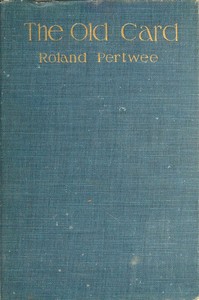
The Old Card
Language: en506 downloads on Project Gutenberg
Subjects
Public-domain ebook sourced from Project Gutenberg #67611.
Public-domain ebook
Language: en506 downloads on Project Gutenberg
Subjects
Public-domain ebook sourced from Project Gutenberg #67611.
The opening · free to read
Eliphalet Cardomay stepped from his first-class compartment to the platform. Potter, his dresser, having descended from the train while it was still in motion, respectfully held open the carriage door lest his august master should soil his beautiful wash-leather gloves.
It was gratifying to observe how the station porters touched their caps.
On the seat of the compartment he had vacated lay an open suit-case, several brown-paper-covered plays, copies of the Era and the Referee, an umbrella and a travelling cap. It was part of the dresser’s duties to clear up the débris occasioned by Mr. Cardomay. A man who carries in his head all the emotions and all the lines—_Hamlet_, Richard III., The Silver King, and countless other rôles of lesser importance—could hardly be expected to give attention to such a trifling matter as his own personal property.
Eliphalet accepted a bundle of letters from an obsequious advance agent, returned, with condescension, the tentative salutes of several members of his company, and passed down the long grey platform with springing step. The yellow smoke of the Midlands was as violets to his nostrils and as balm to his eyes.
With quiet satisfaction he noted how the ticket-collector at the barrier, instead of demanding his ticket, allowed him to pass with a polite “Good morning, Sir.” After all, it is something to be known.
Mr. Cardomay invariably walked to his lodging, thereby giving a large section of his future public the opportunity of studying his features at close range, unadorned by the artifices of the make-up box or the beneficent influences of limelight. This walk also gave him a chance of seeing whether the effect of his billing justified the cost.
For twenty-five years had Eliphalet Cardomay “featured on the road,” and there was little left for him to learn about Provincial Theatrical Management.
The poster which preceded him to town displayed a well-proportioned man, whose head tilted fearlessly upon broad shoulders, and whose eyes shone as with a smouldering fire. A full growth of hair projected from under the curving brim of a Trilby hat. He wore a flowing tie, a fur-collared coat, and in his right hand carried an ivory-topped Malacca cane of original design. It was a striking poster, executed many years before, and everyone who knew it, and knew Eliphalet, marvelled how the original still continued to realise the picture in every detail.
The reader will have judged, and judged rightly, that our hero is one of the Old School—the school of graceful calisthenics, and meticulous elocution—but let him beware of anticipating too far; for, although Eliphalet Cardomay’s histrionics might savour of the obsolete, he will not find in the man himself those traits usually allied to actors of this calibre.
In all his long career no one had ever heard Eliphalet address a fellow-performer as “laddie,” nor a theatrical landlady as “Ma.” Neither did he borrow half-crowns at the Bodega, nor absorb tankards of Guinness’s stout in the wings. In fact, Eliphalet Cardomay was a very estimable fellow, hedged about and wing-clipped by stale conventions of his calling, which, in spite of his bitterly-learnt knowledge of their existence, he was never able to supersede by modern methods.
The almost impertinent disregard for old stage processes and old accepted technique which brings notoriety and admiration to the actor of to-day was as unattainable to Eliphalet as the peak of Mount Parnassus.
Twenty-five years before, a London newspaper had prophesied that he would mature and become big. He did mature, but on the lines of his beginning, and when at last he returned to London—the Mecca of his dreams—he was driven by laughter back to the provinces whence he had come.
In the hearts of provincial playgoers there were still warm places for Eliphalet Cardomay, and the rich cadences of his voice never failed to arouse strange emotions and irrepressible yearnings in the bosoms of impressionable young ladies, who wrote and confided their admiration with surpassing regularity and singular lack of reserve.
To his own company he was always courteous and considerate, but a trifle remote. He wrapped himself about in mystery, and as no one knew exactly how to take him very few made the attempt.
“The public man should always be an enigma.”
He addressed this statement to a very voluble young member of his company, who frequented bars and lavished cigarettes upon total strangers.
“Be mysterious if you wish to succeed,” he continued, developing the theme. “Your never-ceasing ‘Have a spot,’ and your ever-open cigarette-case, are the most obvious things that ever happened.”
Naturally Eliphalet Cardomay was looked upon as something of a joke. A man with a name like that could hardly expect anything else. Yet to him the name Eliphalet, which his sire, a once-distinguished tragedian, had borne before him, was one of his most cherished possessions. Like a blare of trumpets it rang out from a hundred hoardings. It was electric—original—arresting. A title to juggle with; and yet, so strange is the human mind, so averse to aught but the copper coinage of the language, that his few intimate friends and the inner circles of all provincial Green Rooms knew, spoke and thought of him by no other appellation than “The Old Card.”
Let it be clearly understood that no one called him the Old Card to his face; for, although regarded as a joke, Eliphalet was clearly loved by his fellows, and if at times they indulged in the gentlest of leg-pulling there was not one amongst them who would willingly have caused him the slightest pain or distress.
But to return to our hero, striding briskly over the cobble streets on the particular Sunday morning on which our narrative opens. Every feature of the ugly midland town was familiar to him and every feature good. Taking a turning to the right, he pursued his way through a narrow and deserted alley between two factories. There was an acute angle a little further down, and here on a wall facing him a full-length prototype of himself had been posted.
Eliphalet stopped and saluted his printed image.
“Old boy,” he said, “we are back—back home again. I deserted you for a while—a little while—but I’ve learnt my lesson, old friend, and we will see the rest of the show out together.”
There was a tremor in his voice as he spoke the words and an unnatural mist before his eyes. It was this same mist, perhaps, that delayed his noticing that the billsticker had applied the last sheet of the poster at least ten inches too high, with the result that the feet were practically attached to the knees. Mr. Cardomay made a note of the fact in a small book he carried for the purpose and continued his walk.
Two factory girls nudged each other as he passed them by.
“See who it was? Mister What-you-call Cardomay.”
“Oh, I like ’im. ’E’s good! When’ll we go?”
The rest of their remarks drifted out of earshot, but Eliphalet Cardomay felt a tinge of pride warming his bosom. He was back again—back home.
The excellent Mrs. Booker, best of landladies, greeted him with every indication of respectful devotion.
“It’s a treat to see you again, sir, it is indeed,” she said, opening the door of the comfortable little parlour, where a jolly fire was burning in the grate and reflecting its rays on many framed and autographed photographs of the celebrated artists the room at one time or another had accommodated.
“When I heard you’d gorn to London, I said to Booker, ‘There! we’ve lorst ’im,’ and ’e says, ‘I believe we ’ave,’ and I says, ‘That’s what we ’ave done; for, depend on it, if London gets hold of ’im, it’ll claim ’im as their own and never let ’im go.’”
Eliphalet’s lips tightened a little. He drew off his gloves and cast them on the embossed green plush sofa, and quoted:
“The clinging magic runs, They will return as strangers, They will remain as sons.”
“I returned as a son—and could not remain as a stranger.” Then, observing that his remarks were entirely lost upon his audience, he concluded:
“Did you get me a small leg of lamb, Mrs. Booker?”
She nodded gravely.
“A beautiful leg,” she replied; “with a black-currant tart to follow. I ’aven’t forgotten your little likes, sir.”
Eliphalet smiled beatifically.
“You are an excellent good woman,” he said. Then, stretching himself luxuriously, “Yes, there is no doubt at all—it is very good to be back again.”
He cast a loving and possessive eye over the homely surroundings, shook out his table napkin, and drew up a chair to the table, as a king might sit at a banquet.
Probably the reader is wondering what this story is all about, and certainly it might have been a distinct advantage to have begun at the beginning rather than the end. Having committed ourselves so far, however, there is no option but to retrace our steps to a period some three months prior to the foregoing incident.
The book keeps going
Reading is free forever. Sign up and watch scenes appear while you read.



Scenes Storieta drew for other classics.
New illustrated classics
Once or twice a month: the latest books to get full character casts, scene art, and free comic editions. No account needed.