Public-domain ebook
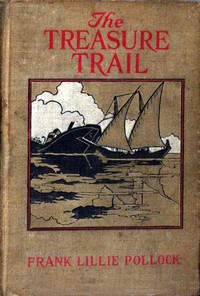
The Treasure Trail
Language: en468 downloads on Project Gutenberg
Subjects
Public-domain ebook sourced from Project Gutenberg #67627.
Public-domain ebook
Language: en468 downloads on Project Gutenberg
Subjects
Public-domain ebook sourced from Project Gutenberg #67627.
The opening · free to read
“Lord! what a haul!” Elliott murmured to himself, glancing over his letter while he waited with the horses for Margaret, who had said that she would be just twelve minutes in putting on her riding-costume. The letter was from an old-time Colorado acquaintance who was then superintending a Transvaal gold mine, and, probably by reason of the exigencies of war, the epistle had taken over two months to come from Pretoria. Elliott had been able to peruse it only by snatches, for the pinto horse with the side-saddle was fidgety, communicating its uneasiness to his own mount.
“And managed to loot the treasury of over a million in gold, they say, and got away with it all. The regular members of the Treasury Department were at the front, I suppose, with green hands in their places,” he read.
It was a great haul, indeed. Elliott glanced absently along the muddy street of the Nebraska capital, and his face hardened into an expression that was not usual. It was on the whole a good-looking face, deeply tanned, with a pleasant mouth and a small yellowish moustache that lent a boyishness to his whole countenance, belied by the mesh of fine lines about the eyes that come only of years upon the great plains. The eyes were gray, keen, and alive with a spirit of enterprise that might go the length of recklessness; and their owner was, in fact, reflecting rather bitterly that during the past ten years all his enterprises had been too reckless, or perhaps not reckless enough. He had not had the convictions of his courage. The story of the stealings of a ring of Boer ex-officials had made him momentarily regret his own passable honesty; and it struck him that in his present strait he would not care to meet the temptation of even less than a million in gold, with a reasonable chance of getting away with it.
This subjective dishonesty was cut short by Margaret, who hurried down the veranda steps, holding up her brown riding-skirt. She surveyed the pinto with critical consideration.
“Warranted not to pitch,” Elliott remarked. “The livery-stable man said a child could ride him.”
“You’d better take him, then. I don’t want him,” retorted Margaret
“This one may be even more domestic. What in the world are you going to do with that gun?”
“Don’t let Aunt Louisa see it; she’s looking out the window,” implored Margaret, her eyes dancing. “I want to shoot when we get out of town. Put it in your pocket, please,—that’s against the law, you know. You’re not afraid of the law, are you?”
“I am, indeed. I’ve seen it work,” Elliott replied; but he slipped the black, serviceable revolver into his hip pocket, and reined round to follow her. She had scrambled into the saddle without assistance, and was already twenty yards down the street, scampering away at a speed unexpected from the maligned pinto, and she had crossed the Union Pacific tracks before he overtook her. From that point it was not far to the prairie fields and the barbed-wire fences. The brown Nebraska plains rolled undulating in scallops against the clear horizon; in the rear the great State House dome began to disengage itself from a mass of bare branches. The road was of black, half-dried muck, the potent black earth of the wheat belt, without a pebble in it, and deep ruts showed where wagons had sunk hub-deep a few days before.
A fresh wind blew in their faces, coming strong and pure from the leagues and leagues of moist March prairie, full of the thrill of spring. Riding a little in the rear, Elliott watched it flutter the brown curls under Margaret’s grey felt hat, creased in rakish affectation of the cow-puncher’s fashion. Now that he was about to lose her, he seemed to see her all at once with new eyes, and all at once he realized how much her companionship had meant to him during these past six months in Lincoln,—a half-year that had just come to so disastrous an end.
Margaret Laurie lived with her aunt on T Street, and gave lessons in piano and vocal music at seventy-five cents an hour. Her mother had been dead so long that Elliott had never heard her mentioned; the father was a Methodist missionary in foreign parts. During the whole winter Elliott had seen her almost daily. They had walked together, ridden together, skated together when there was ice, and had fired off some twenty boxes of cartridges at pistol practice, for which diversion Margaret had a pronounced aptitude as well as taste. She had taught him something of good music, and he confided to her the vicissitudes of the real estate business in a city where a boom is trembling between inflation and premature extinction. It had all been as stimulating as it had been delightful; and part of its charm lay in the fact that there had always been the frankest camaraderie between them, and nothing else. Elliott wished for nothing else; he told himself that he had known enough of the love of women to value a woman’s friendship. But on this last ride together he felt as if saturated with failure—and it was to be the last ride.
Margaret broke in upon his meditations. “Please give me the gun,” she commanded. “And if it’s not too much trouble, I wish you’d get one of those empty tomato-cans by the road.”
“You can’t hit it,” ventured Elliott, as he dismounted and tossed the can high in the air. The pistol banged, but the can fell untouched, and the pinto pony capered at the report.
“Better let me hold your horse for you,” Elliott commented, with a grin.
“No, thank you,” she retorted, setting her teeth. “Now,—throw it up again.”
This time, at the crack of the revolver, the can leaped a couple of feet higher, and as it poised she hit it again. Two more shots missed, and the pinto, becoming uncontrollable, bolted down the road, scattering the black earth in great flakes. Elliott galloped in pursuit, but she was perfectly capable of reducing the animal to submission, and she had him subjected before he overtook her.
“It’s easier than it looks,” Margaret instructed him, kindly. “You shoot when the can poises to fall, when it’s really stationary for a second.”
“Thank you—I’ve tried it,” Elliott responded, as they rode on side by side, at the easy lope of the Western horse. The wind sang in their ears, though it was warm and sunny, and it was bringing a yellowish haze up the blue sky.
“‘Weh, weh, der Wind!’”
hummed Margaret, softly.
“‘Frisch weht der Wind der Heimath zu; Mein Irisch Kind, wo weilest Du——?’”
“What a truly Western combination,—horses, Wagner, and gun-play!” remarked Elliott.
“Of course it is. Where else in the world could you find anything like it? It’s the Greek ideal—action and culture at once.”
“It may be Greek. But I know it would startle the Atlantic coast.”
“I don’t care for the Atlantic coast. Or—yes, I do. I’m going to tell you a great secret. Do you know what I’ve wanted more than anything else in life?”
“Your father must be coming home from the South Seas,” Elliott hazarded.
“Dear old father! He isn’t in the South Seas now; he’s in South Africa. No, it isn’t that. I’m going to Baltimore this fall to study music. I’ve been arguing it for weeks with Aunt Louisa. I wanted to go to New York or Boston, but she said the Boston winter would kill me, and New York was too big and dangerous. So we compromised on Baltimore.”
“Hurrah!” said Elliott, with some lack of enthusiasm. “Baltimore is a delightful town. I used to be a newspaper man there before I came West and became an adventurer. I wish I were going to anything half so good.”
“You’re not leaving Lincoln, are you?” she inquired, turning quickly to look at him.
“I’m afraid I must.”
“When are you going, and where?” she demanded, almost peremptorily.
“I don’t exactly know. I had thought of trying mining again,” with a certain air of discouragement.
Margaret looked the other way, out across the muddy sheet of water known locally as Salt Lake, where a flock of wild ducks was fluttering aimlessly over the surface; and she said nothing.
“I suppose you know that the bottom’s dropped out of the land boom in Lincoln,” Elliott pursued. “I’ve seen it dropping for a month; in fact, there never was any real boom at all. Anyhow, the real estate office of Wingate Elliott, Desirable City Property Bought and Sold, closed up yesterday.”
“You don’t mean that you have—”
“Failed? Busted? I do. I’ve got exactly eighty-two dollars in the world.”
She began to laugh, and then stopped, looking at him half-incredulously.
“You don’t appear to mind it much, at least.”
“No? Well, you see it’s happened so often before that I’m used to it. Good Lord! it seems to me that I’ve left a trail of ineffectual dollars all over the West!”
“You do mind it—a great deal!” exclaimed Margaret, impulsively putting a hand upon his bridle. “Please tell me all about it. We’re good friends—the very best, aren’t we?—but you’ve told me hardly anything about your life.”
The book keeps going
Reading is free forever. Sign up and watch scenes appear while you read.



Scenes Storieta drew for other classics.
New illustrated classics
Once or twice a month: the latest books to get full character casts, scene art, and free comic editions. No account needed.