Storieta
Sign up
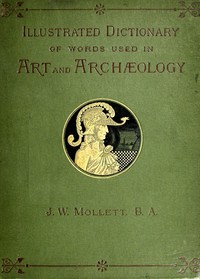
Cover of An Illustrated Dictionary of Words used in Art and Archaeology
 Explaining terms frequently used in works on architecture, arms, bronzes, Christian art, colour, costume, decoration, devices, emblems, heraldry, lace, personal ornaments, pottery, painting, sculpture, &c., with their derivations.

Public-domain ebook

An Illustrated Dictionary of Words used in Art and Archaeology Explaining terms frequently used in works on architecture, arms, bronzes, Christian art, colour, costume, decoration, devices, emblems, heraldry, lace, personal ornaments, pottery, painting, sculpture, &c., with their derivations.

by John W. Mollett

English3,809 downloads on Project GutenbergDownload EPUB

Public-domain ebook sourced from Project Gutenberg #67629.

About this book

This work is an illustrated dictionary that gathers and refines the terminology most commonly encountered in the study of art and archaeology. It begins by explaining that the present edition expands on the French reference of M. Ernest Bosc, adding roughly 250 new engravings to the original 450 and replacing Bosc’s text with definitions drawn from the leading authorities of the day, Martigny for Christian antiquities, Meyrick for medieval armour, Planché and Fairholt for costume, Boutell and Mrs. Palliser for heraldry, and Jacquemart for pottery, among others. The author, John W. Mollett, notes that the Greek and Roman sections are deliberately concise, directing readers to the more exhaustive dictionaries of Dr Smith and Rich, while also inserting a selection of Indian, Chinese and Japanese terms. An appended list of classified catalogues from the South Kensington Museum further points scholars to primary sources for deeper research.

The diction reflects the scholarly tone of the late‑Victorian era, with a formal, almost encyclopedic style that assumes a degree of familiarity with classical languages and art‑historical literature. Its extensive cross‑referencing and frequent illustrations make it especially valuable to students, curators, conservators and collectors who need precise, condensed definitions rather than theoretical exposition. Those with an interest in the technical vocabulary of architecture, sculpture, costume, heraldry and related fields will find the book a practical companion for both academic study and museum work.

Who appears in this book

  • M. Ernest BoscMiddle‑aged French architect, powdered wig, high‑collared frock coat, neat moustache, drawing tools at hand
  • John W. MollettVictorian gentleman scholar, dark waistcoat, pocket watch, round spectacles, tidy beard, surrounded by books
  • Dr. SmithLate‑Victorian academic, crisp tailcoat, cravat, silver‑rimmed glasses, holding a leather‑bound manuscript

The opening · free to read

This Dictionary was commenced as an amended edition of that written by M. Ernest Bosc, architect of Paris, and contains the 450 engravings published in the French work, to which about 250 more have been added. Little or nothing, however, of the text of M. Bosc’s work has been left standing; his definitions having, in the process of revision under reference to original works, almost entirely disappeared. The whole work, as it now stands, has been drawn from, or carefully corrected by, the best authorities in each of its special branches. Considerable prominence has been given to ARCHITECTURE, from the French original corrected from English writers; to CHRISTIAN ANTIQUITIES from Martigny, and the Dictionary of Dr. Smith and Professor Cheetham, and other authorities; to MEDIÆVAL ARMOUR, and terms of CHIVALRY, chiefly from Meyrick’s Ancient Armour; to COSTUME from Planché and Fairholt; to HERALDRY from Boutell’s and Mrs. Bury Palliser’s works; to POTTERY, the substance of the articles on this subject being derived from M. Jacquemart’s work; to NEEDLEWORK, IVORIES, MUSICAL INSTRUMENTS, GOLDSMITHS’ WORK, PAINTERS’ MATERIALS AND PROCESSES ANCIENT AND MODERN, COLOUR, &c., with references to the several authorities referred to.

The GREEK AND ROMAN ANTIQUITIES, which are the principal part of M. Bosc’s work, have been in this volume reduced to the smallest possible compass: the Dictionaries of Dr. Smith and Rich must be referred to by those who require fuller definitions upon this subject, which would of itself fill ten such books as the present.

A few INDIAN, CHINESE, and JAPANESE TERMS, which have come into ordinary use in art, have been sought out and inserted: in the first-mentioned Dr. Birdwood’s Handbooks have been a most useful guide. Finally, it is necessary to state, that many words essential to the completeness of the work would have been in danger of omission, if I had not had before me Mr. Fairholt’s admirable Dictionary of Art Terms, which, occupying a more restricted ground than this, is so thorough and accurate in dealing with all that it professes to include, that the only raison d’être of this work is the very much wider and different ground that it covers, and the greater condensation of its definitions. Obviously the substance of every statement in the work is borrowed from some previous writer on the subject, and it is evident that a Dictionary of Reference is not a convenient vehicle for theory or invention.

The appended list of CLASSIFIED CATALOGUES which have been prepared by direction of the authorities of the South Kensington Museum, will have the additional use of referring the reader to the fountain-head at which he can verify and amplify the condensed information that this work supplies.

J. W. MOLLETT.

October, 1882.

The book keeps going

Keep reading, and see it illustrated

Reading is free forever. Sign up and watch scenes appear while you read.

Illustrated scene from Alice's Adventures in WonderlandIllustrated scene from The Adventures of Sherlock HolmesIllustrated scene from Frankenstein

Scenes Storieta drew for other classics.

New illustrated classics

A new classic, drawn, in your inbox.

Once or twice a month: the latest books to get full character casts, scene art, and free comic editions. No account needed.