Public-domain ebook
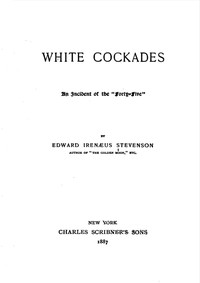
White Cockades: An Incident of the "Forty-Five"
Language: en398 downloads on Project Gutenberg
Subjects
In: Historical Novels·Adventure·British Literature
Public-domain ebook sourced from Project Gutenberg #67658.
Public-domain ebook
Language: en398 downloads on Project Gutenberg
Subjects
In: Historical Novels·Adventure·British Literature
Public-domain ebook sourced from Project Gutenberg #67658.
The opening · free to read
IN A HIGHLAND GLADE.
Just as the brilliancy of a singularly clear July afternoon, in the year above named, was diminishing into that clear, white light which, in as high a Scotch latitude as Loch Arkaig, lasts long past actual sunset, Andrew Boyd, a Highland lad of sixteen, was putting the finishing strokes to the notch in the trunk of a good-sized oak he was felling. Its thick foliage waved rather mournfully, as if in expectancy of near doom, over the boy's head. That oak had engaged Andrew's attention pretty much all the afternoon. He was glad to be so well on toward his work's close.
Around the young wood-cutter soughed the dense forest. It clothed the mountain side, straight from the margin of the loch below. Andrew's blows rang quick and true against the trunk. His springy back, his well-developed legs and arms, came handsomely into play. On the moss lay his plaid and bonnet. The sweat dripped from his forehead, not much cooled by the breeze that tossed his yellow hair and the folds of his kilt.
Young Boyd did not cut down oak-trees for a livelihood, though he just now worked as if fortune had mapped a no less arduous career for him. He was the only son of a wealthy landholder of the vicinity, a man of English descent and English thrift. Andrew's grandfather came north into Scotland from Shrewsbury, in a sort of angry freak after a local quarrel. He bought and developed a valuable farm near Loch Arkaig, and then suddenly died upon it, leaving the newly acquired estate to Gilbert Boyd, the father of young Andrew. All of which had happened some forty years before this tale's beginning.
One, two--one, two--rang the axe upon the tough wood which Andrew wished for the boat he was building, down at the loch side. His thoughts ran an accompaniment. We spare the reader their translation from the Scotch dash in which they were couched, the result of Andrew's schooling and intimacies round about him.
"There! Have at you again, old tree! How I wish you were a dragon, and I some Saint George busy at carving you!" One, two--one, two--quoth the axe, approvingly. "No, I don't! Away with any wish that meddles with saint or man that the Lowlanders love!" One, two--one, two--assented the axe. "Better wish that you were the little English King George himself! and I a stout headsman, ready to knock his crown off, head and all!"
The chopper's brows knit. His eyes flashed at a notion that struck a specially sensitive chord. "Ah, you stockish trunk, if you only were George, the Dutchman! Tyrant! Monster! Will you withdraw your troops from our harried counties? Will you end now, at once, your bloodthirsty hunt for the Prince?--God bless him! Will you empty out that horrid Tower, full of our noble gentlemen and lords who fought for the Lost Cause? Will you pardon my father's friend, the Earl of Arkaig, and send him home straightway to us? What, you won't? Take that, then!--and that!"
Here the axe-strokes descended with such vim and amid such a meteoric shower of chips that no clear-headed listener could entertain for a moment doubt as to hot-headed young Boyd's politics. The oak sighed, and rather unexpectedly crackled and snapped, and came crashing down most magnificently.
But halloa! At the instant that its mighty top smashed into the underbrush and saplings, a single sharp, piercing cry of pain and terror rang out above the crackle and splinterings.
Andrew dropped the axe. He rested rigid as stone, open-mouthed, in sudden alarm and consternation. "What!" he exclaimed. "Great Heaven! Can it be that--that a human creature--a man--was hid in the thicket, and that when the oak fell----"
"Help! help! for the love of mercy!" The appeal, fainter than the first cry, rose from the densest crush of the shattered oak branches. There could be no mistake. Some one had been slinking in the bushes near young Boyd; possibly a Hanoverian spy! Through his own unaccountable carelessness the unseen person had allowed himself to be suddenly trapped by the boughs of the falling tree. He was pinned in a torturing, if not a fatal trap.
Andrew's sharp eyes could not penetrate the barricade of dark green. "Hi, there! Halloa!" he shouted. "Are ye under the oak? What has befallen ye, man, or whatever ye be?"
No answer. To catch up his axe and plunge boldly into the tangle was his next impulse. He hewed and trampled a path toward the centre of the felled tree, which had been young but very vigorous and leafy. No trace of any unusual object imprisoned beneath the knitted boughs, no new cry for help guided him.
He began to doubt whether to press to right or left, or to go round about and continue his examination from another point of the oak's circumference, when a low but distinct groan spurred him to more active work in the same direction. Forcing aside the strong branches by his knees, he caught sight of a dark object just beyond. He next discerned a cloth garment, covering a man's back. The yet invisible wearer had been all this time in a faint, and was now able to betray but small sign of interest in his own deliverance.
"This way, this way," Andrew heard him moan, as if articulating with real anguish; "I am hurt badly, I fear. I cannot stir."
The accent, not so Scotch as Andrew's, seemed gentle. The mysterious interloper might then be some well-bred prowler. Andrew thrust away the last intervening twigs. There lay on the turf a man, at full length, and face downward, with one arm and a part of his right shoulder held as if in a vice by the oak's grasp. His well-turned neck and figure implied to Andrew's hasty survey that he was young and comely.
"Whatever you do, man, don't try to move!" exclaimed Andrew; "leave your outgetting to me. I'll set you free in a trice."
He went to work cautiously but swiftly to do it.
"And my ankle is fast too"--came the smothered complaint. "Look--you will see how--my leg--is held!"
Andrew looked. "'Twill be free speedily, sir!" he answered cheerfully, already impressed by the fortitude of the tormented man. "Be but a bit patient, sir. That's it; now you can roll to the left, please." He employed axe and helve adroitly as he spoke. "Now, to the right; up, up--that's it, sir. What a miracle your skull 'scaped the fork."
The victim rolled over, displaying the countenance of an entire stranger, eight or ten years Andrew's senior, and with strikingly handsome features. "Thank you, thank you, my good friend!" he gasped, pulling himself to his feet; "that was the torture of a fiend, I assure you! Your hand, one instant, please."
By dint of leaning on Andrew's arm, and after several battles with successive tough boughs, in which the new-comer showed that he possessed strength and dexterity, the two finally scrambled out of all the labyrinth of foliage and into clear space. Andrew flung down the axe and assisted his new acquaintance to a seat upon the prostrate trunk.
"The next matter is to examine your hurts, sir!" Boyd exclaimed, taking a sharp look at his dignified protégé. The latter returned this scrutiny as keenly, however.
"I begin to suspect that such hurts amount to little or naught," returned the stranger, dropping Andrew's hand which he had held in a grateful pressure. "I have nothing worse than a bruised shin, a scraped shoulder and back, I fancy. Heaven be blessed, nothing is broken in my anatomy!"
Andrew laughed, although he knelt down all the same and began a rigid inspection of the bruises. He remarked how spare and muscular were the stranger's legs and arms, as if from much exertion and little food. His costume was odd: a faded Highland suit, rent and stained, ill-fitting brogans, agape with holes cut by mountain flints; his throat and face were surprisingly sunburnt, though his natural complexion seemed to be fair. But what of his clothing or his tan? As the man leaned against the prostrate trunk, with one leg boldly out before the other for Andrew's care, there was something commanding, fascinating to Boyd in his whole bearing. Andrew had not read Shakespeare, but if he had he might well have recalled the lines in "Coriolanus":
"----though thy tackle's torn Thou showest a noble vessel."
While the hurried surgery progressed the object of it aided therein with no small skill, venting now and then an ejaculation of pain. He stealthily studied Andrew. It was a question which should first act on the opinions shaped by this mutual caution. But in those gray blue eyes sparkled a quizzical light that made Andrew smile, as he suddenly observed it, when rising from his bowed attitude.
"Name for name, it must be, I see; and faction for faction, eh? Well, I don't wonder that you and I have eyed each other askance. These be days when honest men can ill be known as such. It would be strange, too, if loyal subjects of Hanover, like you and your axe, should not remember spies and renegades when you pluck strangers out of tree-tops."
"You--you overheard my thoughts while I hewed!" returned Andrew, first red, then pale. "I--I knew not that I ran them so heedlessly into speech. Evil speech to be overheard, sir."
"Your tongue has a Lowland twang to it, whatever little to please a Lowlander it spoke," said the stranger. "You are right my lad; what you prattled there, by yourself, as you thought, was treason--with a vengeance. Know you not that these mountains are filled with those who would gladly tie your arms behind your back and gallop you off to Neith jail, for half such sentiments. Or"--and here the voice became tinged with a profound sadness, "or, have you been, young as you seem, like myself, a defender of that most unlucky young soldier, my master, Charles Stewart, who, a hunted refugee, with an army cut to pieces and a realm lost, is skulking to-day in some corner of the country with death at his heels and a price upon his head--instead of a crown-royal."
Andrew drew himself back proudly and stared into his questioner's face. "Sir," he exclaimed, "I see you are a soldier! You may be a Southerner as well. I care not. God save the Prince! I love him! God defend him! So will say my father and every man and woman at Windlestrae! I was too young--so they pleased to think--to fight at Culloden Moor, and my father has just tided over a long sickness. But for these things we had both been there--and dead, by now, 'tis very likely."
The stranger fairly leaped from his resting-place. "Your hand, your hand, young sir!" he demanded, his face suffused with color. "Rash as you are loyal, let me press it! I, too, love the Prince, our master; and I, too, hope yet to see him make a footstool of his enemies. My name is Geoffry Armitage--Lord Armitage I am oftenest called. Windlestrae, said you? Then I speak to one of those to whom I am sent on an errand from which yonder villainous tree did its best to let me. Are you Peter--no, Andrew Boyd, the son of Gilbert Boyd, who owns the manor of Windlestrae?"
"I am, sir," replied Andrew, in deepening surprise: "this very nook of the woodland we stand in belongs to my father and is within our farm. The manor house and fields are but half-an-hour from this spot; below the hill-foot yonder."
The book keeps going
Reading is free forever. Sign up and watch scenes appear while you read.



Scenes Storieta drew for other classics.
New illustrated classics
Once or twice a month: the latest books to get full character casts, scene art, and free comic editions. No account needed.