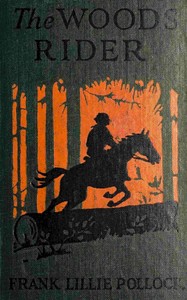
Leaning from his saddle, Joe Marshall looked into the cup that hung on the turpentine-tree. One side of the great long-leaf pine had been stripped of its bark to a height of three feet, leaving a tall, livid scar, sticky with resinous exudation. A thick layer of hardened gum crusted over its lower edge, and two tin gutters near the top carried the gummy oozings into the two-quart tin cup suspended from a hook driven into the tree. It was only March, but the weather had been unusually warm, and the gum was running in thin viscous threads imperceptibly slow, but the cup was half full of the sticky whitish mass.
“I declare, we can begin dipping soon!” Joe said to himself, glancing around at the other pines, which were all similarly blazed and tapped.
This was the best corner of the Burnam turpentine “orchard.” The trees that grew here were splendid long-leaf pines, shooting up straight as arrows almost a hundred feet before they broke into palm-like branches; and many of them were so large that the turpentine gatherers had been able to chip them on both sides, and hang two cups on them.
For about two hundred yards this park-like growth lasted, where his horse’s feet trod silently on the thick layer of pine-needles; then a slight descent took him out into the open ground. The sunlight seemed blinding after the shade of the woods. The sky was hazily blue, radiating an intense heat. High overhead two buzzards soared in circles. The ground was a tangle of gallberry-bushes, and Joe rode through them by a trail that he followed daily on his rounds. From the gallberry flat it led down to a creek swamp, dense with titi and bay-trees and tangled with bamboo-vine, and it wound through this jungle across the creek itself.
“Want to drink, Snowball?” said Joe, as the black horse showed an inclination to pause at the clear water; and while Snowball drank Joe dismounted and dashed water over his face and arms. It was unusually hot for March, even in southern Alabama, and from the look of the sky he judged that there might be thunder before night.
Joe was one of Burnam’s three woods-riders, and it was his duty to keep his eye on the run of gum and the work of the negroes on a third of the big tract. As he rode on he encountered several of the “chippers” at work, making the regular enlargement of the blaze on the pine-bark; occasionally he found a tree neglected, and had to find the man in whose “furrow” it lay, reprimand him, and send him back; now and then he had to stop and readjust a cup that had become displaced. Once he found two negroes idling and swapping stories behind a thicket, and he sent them back to work with good-natured bullying, which they took with equal good nature. They understood Joe Marshall, and he understood them.
He swung through the woods in a wide circle that would at last take him back to the camp. It was growing late in the afternoon, and most of the negroes were also straggling out of the woods. Provided they finished their furrow, they could leave when they pleased; but from the top of a ridge Joe caught sight of a chipper still at work, going at a fast trot from tree to tree. His clothes were ragged and there were not many of them; his arms were bare, and his black face streamed with perspiration. He carried a “turpentine-hack,” a tool very like a small pick with a keen, gouging end, and at each tree he ripped away with a skilful stroke another inch of the gummy bark at the top of the slash.
“Seems to me you’re working mighty hard for a hot day, Sam,” Joe remarked as he rode up.
The chipper threw back his head and laughed loudly. Sam was one of the “Marshall negroes.” His father had been a slave, owned by Joe’s grandfather, and Joe and Sam had both been born on the Marshall estate, before the place was broken up. They were about the same age and had played together as white and negro children will. Sam had been Joe’s lieutenant in many a hunting and fishing expedition, and when Joe had taken this place as woods-rider Sam had come as chipper in order to work in the woods with him.
“Yes-suh, Mr. Joe!” he cried, “I shorely is hot, but I reckon de weather goin’ change, an’ I wants to finish my furrow. Jus’ you look down yander in de souf. What you reckon comin’ up dere, Mr. Joe?”
“Thunderstorm, maybe,” said Joe, looking at the haze over the sky, and the coppery clouds low in the south, rising out of the Mexican Gulf. Sam looked too, intent, seeming to sniff the air, and his eyes looked suddenly wise and far-seeing, like a wild animal’s.
“I dunno, suh. Some kind o’ storm, shore. Anyhow, I’s goin’ mek for camp soon’s I finish my few mo’ trees. Mr. Joe, you better ride back home.”
“Oh, a thunderstorm won’t hurt us,” said Joe, laughing, and he rode on, intending to finish his usual round. He was anxious to give especial attention to his tract that day, for the next three days were to be a vacation. The other two wood-riders had agreed to look after his duties, and he was going to ride over to Uncle Louis’s plantation, ten miles south, to meet his cousins from Canada.
He had never seen these cousins—Carl, Bob, and Alice Harman—children of his father’s sister who had married a Canadian, for they had never been south before, and he had never been north of Tennessee. Both their parents had been dead for some years. The three lived together, and, Joe understood, were in bee-keeping. It seemed to Joe an odd and shiftless sort of pursuit, especially in the land of snow and ice which he dimly conceived Canada to be. They had been in Alabama now for several weeks, and had been ten days at Uncle Louis’s place, where they were to remain till spring. Joe understood that they were looking for more bees, and he chuckled at the idea. He knew where there were at least a dozen bee-trees. “Reckon I can show ’em all the bees they want!” he reflected. He had planned great entertainments for them. He would take them fishing for the giant Alabama catfish, take them ’possum hunting, show them the turpentine woods.
He rode on his wide curve through the pines, looking after the turpentine-cups, thinking of the Canadian visitors, when he suddenly became aware that the sun had disappeared. Glancing up through the feathery pine crests he saw a huge bank of tumbled, coppery-black clouds rolling up fast from the south. The air seemed dead still, but a chill had come into it. Far away he heard a growl of thunder, still faint and distant, and Snowball tossed his head, snorted, and stamped, looking back nervously at his master.
It was not the usual time of the year for tornadoes, but he knew how terrific these Gulf thunderstorms sometimes are, and he did not want to be caught in the pine woods where any tall tree might draw the flash. But he remembered a bare, open flat not half a mile away, and, kicking Snowball in the ribs, he started through the woods at a reckless gallop, over logs and brush without ever swerving.
A wind rushed heavily over the trees, carrying a curtain of black cloud. Twilight seemed to fall in a single instant. Snowball was almost uncontrollable with fright, but he saw the open space ahead. As he tore out of the woods, Joe saw behind them a wall of blackness sweeping up the sky with an appalling roar. He jumped from the horse, scared, uncertain what to do, knowing well now that this was no mere thunderstorm. Snowball reared, jerking the bridle from Joe’s hand, and bolted. The next moment the storm burst.
The sheer force of the wind swept Joe off his feet and rolled him over and over. The air was thick with torn pine-needles, flying branches, and strips of bark; trees were crashing and rending, and there was an uproar as if a giant were treading down the forest like grass. Rain suddenly came down in a blinding torrent. Half dazed, Joe tried to get to his feet, made a staggering run without knowing where he went.
A sheet of bluish lightning seemed to explode just over the tree-tops. In the midst of the deafening thunder a great pine snapped at the butt, not a hundred feet away. Joe heard the roaring swish as it came down through the air, straight towards him. He made a plunge to get away, but stumbled; and the next instant he was struck down in a whirl of snapping branches.
That was the last he knew for several minutes at least. When he came to his senses, rain was still pouring down upon him. The ground was streaming with water; a cold river seemed running under his back. The wind still blew fiercely but the lightning was more distant, and the worst of the storm seemed to have passed. He had no idea how long he had lain there, but the darkness now seemed to be, not of the storm, but of night.
He endeavored to raise himself, and found that something held him down with apparently enormous weight. It hurt, too; there was a pain in his chest, a sharp pain in his head. Dimly Joe imagined that the tree had fallen on him, and that he must be seriously wounded; but by groping with his hands he found that the trunk of the big pine had missed his body by a scant yard. His last jump had just saved his life, but one of the smaller branches had caught him across the body and pinned him down, though the mass of twigs had saved him from being crushed. Something had hit him on the head, too, but as he gradually came to himself he decided that he was not as badly broken to pieces as he had imagined. But for all his efforts, he could not work his way out from under the branch that pinned him fast down.
He wormed himself this way and that; he tried to hollow out the earth under him, until he had exhausted his strength. Then he shouted at the top of his voice, but in that roar of wind and splash of rain he knew that there was scarcely a chance of any one’s hearing him. Nearly all the men had left the woods.
The rain ceased to fall in torrents, slackening to a drizzle. The thunder already sounded far away. The storm was passing over as swiftly as it had come up. It had grown almost completely dark when at last Joe heard the far-away voice of a negro calling, echoing strangely through the woods. He yelled in answer; the voice approached; and presently he heard some one crashing through the bushes.
“Who dat a-callin’?” he heard a well-known voice. “Where is you?”
“Sam!” shouted Joe in delight. “Here—this way! I’m down under a tree.”
Sam appeared, a vague black shape in the blackness.
“Fo’ de land’s sake, Mr. Joe!” he exclaimed. “How you git dere? Is you hurted bad? Wait—I git you out!”
Sam pulled and hauled, aiding Joe’s fresh efforts. He tried to shift the branch in vain, and it was too dark to see what he was about. Presently he stopped, groped about in the dark for some time, and then, squatting in a sheltered spot, began to scratch matches.
They were damp, and it was some time before he produced a flame. Then there was a sizzle, a flash, and a brilliant flare sprang up. Sam had found a cup half full of gum, and stuck the match down into the resinous stuff. It flamed up like a huge torch, blown in the wind, casting a lurid light on the chaos of the fallen timber, and Sam elevated it on a stick where it would illuminate his proceedings.