Public-domain ebook
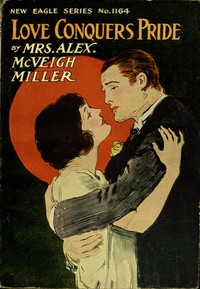
Love conquers pride; or, Where peace dwelt
English401 downloads on Project GutenbergDownload EPUB
Public-domain ebook sourced from Project Gutenberg #67869.
Public-domain ebook
English401 downloads on Project GutenbergDownload EPUB
Public-domain ebook sourced from Project Gutenberg #67869.
The opening · free to read
“Norman Wylde!”
At the top of the green, sloping lawn stood a big white farmhouse, with long porches shaded by rose vines and honeysuckles. Pansy’s uncle and aunt lived there, and she had come on a month’s visit to them. The month was slipping away very fast now, and she must soon return to her work in Richmond, for Pansy Laurens was no pampered favorite of fortune, but an employee of one of the great tobacco factories.
Pansy was only fifteen when her father, a machinist at the Tredegar Works, had died and left his wife and five children penniless, save for what they could earn by the labor of their own hands. Pansy was the eldest, and her mother had to take her from school that the labor of her little white hands might help to earn the family support.
Nothing offered but the tobacco factories, and Pansy went there, while her brother Willie found work as a cash boy in a dry-goods store on Broad Street. The three younger ones, being too small to work, were continued at school, while the mother took in sewing to help eke out the family income.
It was hard on them all, most especially on Pansy, who was so intelligent and refined, and who hated to leave school and toil at repulsive tasks among companions who were mostly uncongenial, for, although some of the girls were sweet and pretty as herself, others were coarse and rude, and sneered at her, calling her proud and ambitious, although they knew at heart that they were only jealous of the lovely face, so round and dimpled, with its big purplish-blue eyes, shaded by such a beautiful fringe of long black curling lashes.
They all envied her that fair face and those silky masses of wavy dark hair that made such a becoming frame for the transparent white skin, with its wild-rose tints and delicate tracery of blue veins.
But, pretty or ugly, it did not matter, the girl said to herself sometimes, with bitter discontent, as she looked at her fair reflection in the mirror. She was nothing but a factory girl, after all, and there were people who looked down on her for that act as if the very sound were the essence of vulgarity. To have been a shopgirl even, or a dressmaker, or milliner, would have been far more genteel, she said to herself.
This was the first time in three years that she had got away from the factory, and she would not have done so then if she had not been given a furlough from work because there was a temporary dullness in trade.
Then Uncle Robbins had come to Richmond from his country home on a little business, and, struck by her pale cheeks and air of languor, invited her to go home with him. Mother urged her to accept the invitation, declaring that she could get along without her, and Pansy went gladly away on her little summer holiday, which was now drawing to an end.
Her heart was full of this as she swung to and fro in the hammock beneath the trees, and listened to the wind rustling the leaves so musically, seeming to murmur over and over that name so dear to her heart:
“Norman Wylde!”
He was a summer boarder at her aunt’s, and he had been kind to her, not cool and supercilious like the others, who looked down upon her because she was a working girl.
Pansy thought him the handsomest man she had ever seen, and she was grateful to him for the courteous way in which he treated her, never seeming to realize any difference in the social position of herself and Miss Ives, the Richmond belle, who was here with her mother because the doctors had tabooed any gayety for the elderly lady this summer on account of a serious heart trouble.
Juliette Ives was as much in love with the handsome young gentleman as Pansy herself, and she sneered at the factory girl in her cheap lawns and ginghams.
“Actually setting herself up as an equal among her aunt’s boarders,” she said disdainfully. “I mean to put her down at once, and let her know that we do not desire her company.”
So she boldly asked Pansy if she could hire her to do the washing for her mother and herself.
“I am not a servant,” Pansy answered, flushing angrily.
“You are a factory girl, aren’t you?” disdainfully.
“Yes, but not a servant.”
“I don’t see much difference,” said the rich girl insolently; and from that moment the two were open enemies.
Juliette Ives knew in her own heart that her spiteful actions had been the outcome of jealousy because Norman Wylde had looked so admiringly at Pansy when he first met her, and Pansy was quick enough to understand the truth.
“She is in love with him, and is jealous of me, in spite of my poverty and my lonely position. Very well, I’ll pay her back for her scorn, if I can,” she resolved, with girlish pique.
And as she possessed beauty equal to, if not greater than, Juliette’s blond charms, and was fairly well educated and intelligent, she had some advantages, at least, with which to enter the lists with the aristocratic belle who scorned her so openly.
And Norman Wylde, who had a noble, chivalrous nature, could not help taking Pansy’s part when he saw how the boarders tried to put her down.
“Poor little thing! It’s a shame, for she is as sweet and pretty as a wild rose, and they ought to be friendly with her and help to brighten her hard lot,” he thought, with indignation.
CHAPTER II. LOVE ALL HIS OWN.
The boarders had organized a fishing party, and everybody had gone, even Mr. Wylde, so it was very quiet at the farmhouse. Aunt Robbins and her servants were busy making preserves, and Uncle Robbins was in the meadow, hauling and stacking the wheat he had cut a few days before. Pansy had helped to peel apples for the preserves until her back ached and her hands smarted, so at last Aunt Robbins sent her out to rest.
“I shan’t need you any more to-day, so you had better go and take a nap in the hammock before that stuck-up Jule Ives comes to turn you out of it,” said the good woman.
Pansy went out, but she took off her calico dress and gingham apron first, and donned her prettiest dress, an organdie lawn with a white ground sprigged with blue flowers. A pretty bow of blue ribbon fastened the white lace at her throat, and another one tied back the mass of rippling dark hair from the white temples, leaving just a few bewitching love locks to curl over the white brow. Thus attired, she looked exquisitely fair, cool, and charming, and she knew well that when the boarders returned, tired and hot from the day’s amusements, they would envy her sweet, comfortable appearance.
She was not disappointed, for by and by, when they came trooping through the big white gate close by her, every one stopped and stared, and Miss Ives exclaimed, in a loud, sarcastic voice:
“Good gracious, is it Sunday?”
“Why, no, of course not, Juliette,” said Chattie Norwood. “Why, what made you think of such a funny thing?”
“Why, Pansy Laurens has on her Sunday dress, that’s all,” with a loud laugh.
“Oh, pshaw! Her other one is in the washtub,” tittered Miss Norwood, and every word came distinctly to Pansy’s ears. An angry impulse prompted her to make some scathing reply, but an innate delicacy restrained her, and she would not lift her beautiful, drooping lashes from the book she pretended to be reading, although the angry color deepened to crimson on her cheeks.
The tittering party passed on toward the house, but, although Pansy did not look up, she was conscious that one had lingered and stopped. It was Norman Wylde, and he came up to the hammock, and said gently:
“Poor little Pansy!”
Her sweet lips quivered, and she looked up, meeting the tender, sympathetic gaze of his splendid dark eyes.
“You are a brave little girl,” he continued warmly. “I was glad that you proved yourself too much of a lady to reply to their coarse sneers. Your sweet dignity makes me love you all the more.”
Pansy gave a little start of surprise and rapture. Did he indeed love her? The color flamed up brightly on her delicate cheeks, and the lashes drooped bashfully over her eyes.
“Look at me, Pansy,” said the young man, in a tone made up of tender command and fond entreaty. “You are not surprised. You guessed that I loved you, didn’t you?”
The book keeps going
Reading is free forever. Sign up and watch scenes appear while you read.



Scenes Storieta drew for other classics.
New illustrated classics
Once or twice a month: the latest books to get full character casts, scene art, and free comic editions. No account needed.