Public-domain ebook
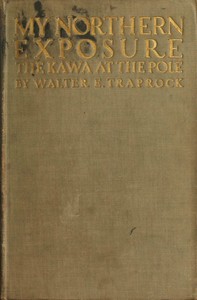
My Northern Exposure: The Kawa at the Pole
Language: en613 downloads on Project Gutenberg
Subjects
Public-domain ebook sourced from Project Gutenberg #67913.
Public-domain ebook
Language: en613 downloads on Project Gutenberg
Subjects
Public-domain ebook sourced from Project Gutenberg #67913.
The opening · free to read
Irving T. Grosbeak, R.O.T.C.
AT DURFEE COLLEGE, XENIA, O.
For hundreds of years men have struggled amid snow and ice to reach one or the other of the earth's poles. Why? What has attracted them? What has been the lure which has led them from warm firesides and comfortable radiators to suffer the rigors of a most annoying climate?
We search in vain among the writings of modern polar explorers for a satisfactory answer to this question.
In earlier days we find credible reasons for this fanatical zeal, reasons which were material and commercial. In the dark ages we know that hardy Norsemen sought an Ultima Thule beyond the Arctic Circle. The Irish also claim credit for the earliest discoveries. They would. These voyages were mere forays undertaken with the hope of advantages in barter and exchange. Following the establishment by Columbus of the globular theory of earth formation we read, likewise, of many futile attempts to reach the fabled wealth of India by short cuts and northwest passages. The adventurous Cabots, fearless Frobisher and gallant Gilbert were mainly occupied with material aims, the securing of additional colonies for the crown, additional gold for the royal treasury. They were out for the cush.
But when we turn to modern days in which the forbidding character of the northland has been well understood we are more puzzled to find a reasonable explanation for its fascination. We meet frequently that strange phrase, "the lure of the North," which is later described in terms of unspeakable hardships. We are told that this or that expedition was undertaken in order "to add to the sum of human knowledge" though that addition proves to be a series of tidal observations and barometric readings which could have been arrived at with sufficient exactness by scientific computations.
Moreover, without belittling the courage and determination of our gallant Peary, it is evident that his exploit was not discovery in its strictest sense. The pole had been located for centuries as being the exact point of convergence of the meridional lines. Its precise position was known. To reach it, then, was a problem in transportation rather than one of actual discovery. This problem Peary solved magnificently and since that memorable April 6th, 1909, the flags of the United States, Delta Kappa Epsilon (Gnu Chapter), the world's Ensign of Peace, the Navy League and the Red Cross have flapped concertedly at the top of the world.
And yet the mystery has remained. We can not read the stories of these brave men, from the most successful to the least, without wondering what it was which actually drew them into the regions of eternal ice and snow. We can but suspect some great, unrevealed truth, some untold secret lying back of the veil of fog, shrouded in the darkness of the long Arctic night.
May we not well ask, "Has the entire truth been told? has the last word been spoken which will forever answer the natural question, why go there?"
It has remained for Walter E. Traprock to answer that question in no uncertain terms. The writer has no hesitation in saying that since the perusal of Dr. Traprock's log the entire northern question has been illuminated with perpetual sunshine.
It is not within the province of this foreword to go into details. The reader can, at the close of this book, lay it down with the thought that he knows the whole story of the North, the truth, the whole truth, and a lot else.
But it would be wrong for us to lay our pen aside without a word of explanation as to how the Traprock Polar Expedition came to be undertaken, for the circumstances were at once so dramatic and unusual as to warrant their preservation in definite form. In the spring of 1921, following Traprock's amazing discovery of the Filbert Islands, a meeting of the Explorers Union of the United States was held in the Federation Rotunda in Cambridge, Mass. The name of Traprock was in every mouth and to many it was distinctly unpalatable. A three days meeting resulted in the formation of the Traprock Polar Expedition. One half of the necessary funds was supplied by the Federation, the remainder being pledges by individuals.[1] But here is the dramatic truth which has never before been stated.
THE FEDERATED EXPLORERS NEVER EXPECTED DR. TRAPROCK TO RETURN!
The entire expedition was a deliberate plot on the part of jealous scientific men to forever remove from the field of action their most brilliantly successful rival. How this dastardly effort failed is told in the succeeding pages, which add fresh lustre to the crown, fresh laurel to the brows of America's intrepid son, Walter E. Traprock.
A mere statement of the fact that the first condition of Traprock's contract was that he should not only reach the Pole himself but that he should take his ship there will indicate the handicaps which were imposed from the start.
Did Traprock flinch or evade? Did he hesitate or shilly-shally?
Let the ice-bergs answer! Let the seals bark reply! Let the north wind howl its answer.
Better still, let the testimony of Traprock be graved on the Palisades of Time, that the world may know forever just exactly "Why Explorers Leave Home!"
Irving T. Grosbeak. Hall of Applied Ceramics, Durfee College, Xenia, O.
The book keeps going
Reading is free forever. Sign up and watch scenes appear while you read.



Scenes Storieta drew for other classics.
New illustrated classics
Once or twice a month: the latest books to get full character casts, scene art, and free comic editions. No account needed.