Public-domain ebook
QRM-Interplanetary
Language: en374 downloads on Project Gutenberg
Subjects
In: Science-Fiction & Fantasy·Novels·American Literature
Public-domain ebook sourced from Project Gutenberg #68005.
Public-domain ebook
Language: en374 downloads on Project Gutenberg
Subjects
In: Science-Fiction & Fantasy·Novels·American Literature
Public-domain ebook sourced from Project Gutenberg #68005.
The opening · free to read
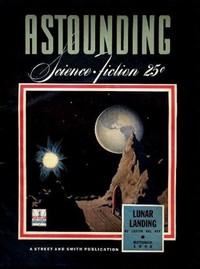
[Transcriber's Note: This etext was produced from Astounding Science-Fiction October 1942. Extensive research did not uncover any evidence that the U.S. copyright on this publication was renewed.]
QRM--International code signal meaning "Interference" of controllable nature, such as man-made static, cross modulation from another channel adjoining or willful obliteration of signals by an interfering source.
Interference not of natural sources (designated by International code as QRN), such as electrical storms, common static, et cetera.
--_Handbook, Interplanetary Amateur Radio League.
Korvus, the Magnificent, Nilamo of Yoralen, picked up the telephone in his palace and said: "I want to talk to Wilneda. He is at the International Hotel in Detroit, Michigan."
"I'm sorry, sir," came the voice of the operator. "Talking is not possible, due to the fifteen-minute transmission lag between here and Terra. Interplanetary Communications will not permit audio. However, teletype messages are welcome."
Her voice originated fifteen hundred miles north of Yoralen, but it sounded as though she might be in the next room. Korvus thought for a moment and then said: "Take this message: 'Wilneda: Add to order for mining machinery one type 56-XXD flier to replace washed-out model. And remember, tobacco and sublevel energy will not mix!' Sign that Korvus."
"Yes, Mr. Korvus."
"Not mister!" yelled the monarch. "I am Korvus, the Magnificent! I am Nilamo of Yoralen!"
"Yes, your magnificence," said the operator humbly. It was more than possible that she was stifling a laugh, which knowledge made the little man of Venus squirm in wrath. But there was nothing that he could do about it, television still being distant by the same five years that it was behind in 1929.
To give Korvus credit, he was not a pompous little man. He was large--for a Venusian--which made him small according to the standards set up by Terrestrians. He, as Nilamo of Yoralen, had extended the once-small kingdom outward to include most of the Palanortis Country which extended from about 23.0 degrees North Latitude to 61.7 degrees, and almost across the whole, single continent that was the dry land of Venus. He was a wily monarch, making his conquest of the wild and lawless country by treaty, and by double-double-crossing those who might have tried to double-cross him. Armed conquest was scorned, but armed defense was desirable in the Palanortis Country--and Korvus had defended himself up and down the inhabitable Northern portion of the planet. His conquest had been a blessing to civilization, and though publicly denounced, it was privately commended. Those who could have stopped it did all they could to delay and intercept any proceedings that would have caused the conquest of Korvus' intended country any trouble.
Korvus' message to Terra zoomed across the fifteen hundred rocky miles of Palanortis to Northern Landing. It passed high across the thousand-foot-high trees and over the mountain ranges. It swept over open patches of water, and across intervening cities and towns. It went with the speed of light and in a tight beam from Yoralen to Northern Landing, straight as a die and with person-to-person clarity. The operator in the city that lay across the North Pole of Venus clicked on a teletype, reading back the message as it was written.
Korvus told him: "That is correct."
"The message will be in the hands of your representative Wilneda within the hour!"
The punched tape from Operator No. 7's machine slid along the line. It entered a coupling machine and was stripped from the tape and repunched upon a tape that was operating at better than a thousand words per minute. Operator 7's tape then left the machine to be rolled into a file roll and placed in the vaults below the city. It was of no use save as a reference from now on.
The coupling machine worked furiously. It accepted the tapes from seventy operators as fast as they could write them. It selected the messages as they entered the machine, placing a mechanical preference upon whichever message happened to be ahead of the others on the moving tapes. The master tape moved continuously at eleven hundred words per minute, taking teletype messages from everywhere in the Northern Hemisphere of Venus to any of the other planets in the Solar System. It was a busy machine, for even at eleven hundred words per minute, it often got hours behind.
The synchronous-keyed signal from the coupling machine left the operating room and went to the transmission room. It was amplified and hurled out of the city to a small, squat building at the outskirts of Northern Landing.
Here it was impressed upon a carrier wave and flung at the sky.
But not alone. Not unguarded. The upper half of the building carried a monstrous parabolic reflector, mounted on gimbals. The signal was focused into a beam. The beam was made of two components. The center component was a circularly polarized, ultra-high frequency wave of five centimeter waves, modulated with the keying signals of the teletype coupling machine. The outer component was a radially polarized wave of one centimeter waves. A radio frequency armor.
It was hurled at the sky, a concentric wave, out of a reflector, by a thousand kilowatt transmitter. The wave seared against the Venusian Heaviside Layer. The outer component bored at the ionization. It chewed and it bit. It fought and it struggled. It destroyed ionization by electronically shorting the ionization. And, as is the case with strife, it lost heavily in the encounter. The beam was resisted fiercely. Infiltrations of ionization tore at the central component, stripping and trying to beat it down.
But man triumphed over nature! The megawatt of energy that came in a tight beam from the building at Northern Landing emerged from the Heaviside Layer as a weak, piffling signal. It wavered and it crackled. It wanted desperately to lie down and sleep. Its directional qualities were impaired, and it wabbled badly. It arrived at the relay station tired and worn.
One million watts of ultra-high frequency energy at the start, it was measurable in microvolts when it reached the relay station, only five hundred miles above the city of Northern Landing.
The signal, as weak and as wabbly as it was, was taken in by eager receptors. It was amplified. It was dehashed, de-staticked, and deloused. And once again, one hundred decibels stronger and infinitely cleaner, the signal was hurled out on a tight beam from a gigantic parabolic reflector.
Across sixty-seven million miles of space went the signal. Across the orbit of Venus it went in a vast chord. It arrived at the Venus Equilateral Station with less trouble than the original transmission through the Heaviside Layer. The signal was amplified and demodulated. It went into a decoupler machine where the messages were sorted mechanically and sent, each to the proper channel, into other coupler machines. Beams from Venus Equilateral were directed at Mars and at Terra.
The Terra beam ended at Luna. Here it again was placed in the two-component beam and from Luna it punched down at Terra's Layer. It emerged into the atmosphere of Terra, as weak and as tired as it had been when it had come out of the Venus Layer. It entered a station in the Bahamas, was stripped of the interference, and put upon the land beams. It entered decoupling machines that sorted the messages as to destination. These various beams spread out across the face of Terra, the one carrying Korvus' message finally coming into a station at Ten Mile Road and Woodward. From this station at the outskirts of Detroit, it went upon land wires downtown to the International Hotel.
The teletype machine in the office of the hotel began to click rapidly. The message to Wilneda was arriving.
And fifty-five minutes after the operator told Korvus that less than an hour would ensue, Wilneda was saying, humorously, "So, Korvus was drunk again last night--"
Completion of Korvus' message to Wilneda completes also one phase of the tale at hand. It is not important. There were a hundred and fifty other messages that might have been accompanied in the same manner, each as interesting to the person who likes the explanation of the interplanetary communication service. But this is not a technical journal. A more complete explanation of the various phases that a message goes through in leaving a city on Venus to go to Terra may be found in the Communications Technical Review, Volume XXVII, Number 8, pages 411 to 716. Readers more interested in the technical aspects are referred to the article.
But it so happens that Korvus' message was picked out of a hundred-odd messages because of one thing only. At the time that Korvus' message was in transit through the decoupler machines at Venus Equilateral Relay Station, something of a material nature was entering the air lock of the station.
It was an unexpected visit.
Don Channing looked up at the indicator panel in his office and frowned in puzzlement. He punched a buzzer and spoke into the communicator on his desk.
"Find out who that is, will you, Arden?"
"He isn't expected," came back the voice of Arden Westland.
"I know that. But I've been expecting someone ever since John Walters retired last week. You know why."
"You hope to get his job," said the girl in an amused voice. "I hope you do. So that someone else will sit around all day trying to make you retire so that he can have your job!"
"Now look, Arden, I've never tried to make Walters retire."
"No, but when the word came that he was thinking of it, you began to think about taking over. Don't worry, I don't blame you." There was quite a protracted silence, and then her voice returned. "The visitor is a gentleman by the name of Francis Burbank. He came out in a flitter with a chauffeur and all."
"Big shot, hey?"
"Take it easy. He's coming up the office now."
"I gather that he desires audience with me?" asked Don.
The book keeps going
Reading is free forever. Sign up and watch scenes appear while you read.



Scenes Storieta drew for other classics.
New illustrated classics
Once or twice a month: the latest books to get full character casts, scene art, and free comic editions. No account needed.