Public-domain ebook
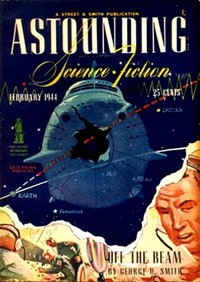
Off the Beam
Language: en532 downloads on Project Gutenberg
Subjects
In: Science-Fiction & Fantasy·Novels
Public-domain ebook sourced from Project Gutenberg #68047.
Public-domain ebook
Language: en532 downloads on Project Gutenberg
Subjects
In: Science-Fiction & Fantasy·Novels
Public-domain ebook sourced from Project Gutenberg #68047.
The opening · free to read
[Transcriber's Note: This etext was produced from Astounding Science-Fiction, February 1944. Extensive research did not uncover any evidence that the U.S. copyright on this publication was renewed.]
Thirty hours out of Mars for Terra, the Solar Queen sped along her silent, invisible course. No longer was she completely severed from all connection with the planets of the inner system; the trick cams that controlled the beams at Venus Equilateral kept the ship centered by sheer mathematics. It was a poor communications system, however, since it was but a one-way job. Any message-answering would have to be done thirty hours later when the ship made planetfall, and the regular terminal office of Interplanetary Communications could be employed.
In spite of her thirty hours at 2-G, which brought her velocity to eleven hundred miles per second, the beam-director cams did their job well enough. It was only in extreme cases of course-changing to dodge meteors that the beams lost the ship; since the cams were not clairvoyant, there was no way to know when the autopilot juggled the controls to miss a bit of cosmic dust. The cams continued to spear the space through which the ship was supposed to pass according to the course constants.
What made this trip ironic was the fact that Don Channing was aboard. The beams had been bombarding the Solar Queen continually ever since she left Mars with messages for the Director of Communications. In one sense, it seemed funny that Channing was for once on the end of a communications line where people could talk to him but upon which he could not talk back. On the other hand it was a blessing in disguise, for the Director of Communications was beginning to paper-talk himself into some means of contacting the Relay Station from a spaceship.
A steward found Channing in the salon and handed him a 'gram. Channing smiled, and the steward returned the smile and added: "You'll fix these ships to talk back one day. Wait until you read that one--you'll burn from here to Terra!"
"Reading my mail?" asked Channing cheerfully. The average spacegram was about as secret as a postcard, so Channing didn't mind. He turned the page over and read:
HOPE YOU'RE WELL FILLED WITH GRAVANOL AND ADHESIVE TAPE FOR YOUR JUMP FROM TERRA TO STATION. SHALL TAKE GREAT DELIGHT IN RIPPING ADHESIVE TAPE OFF YOUR MEASLY BODY. LOVE.
"She will, too," grinned Don. "Well, I'd like to toss her one back, but she's got me there. I'll just fortify myself at the bar and think up a few choice ones for when we hit Mojave."
"Some day you'll be able to answer those," promised the steward. "Mind telling me why it's so tough?"
"Not at all," smiled Channing. "The problem is about the same as encountered by the old-time cowboy. It's a lot easier to hit a man on a moving horse from a nice, solid rock than it is to hit a man on a nice, solid rock from a moving horse. Venus Equilateral is quite solid as things go. But a spaceship's course is fierce. We're wobbling a few milliseconds here and a few there, and by the time you use that arc to swing a line of a hundred million miles, you're squirting quite a bit of sky. We're tinkering with it right now, but so far we have come up with nothing. Ah, well, since the human race got along without electric lights for a few million years, we can afford to tinker with an idea for a few months. Nobody is losing lives or sleep because we can't talk to the boys back home."
"We've been hopping from planet to planet for quite a number of years too," said the steward. "Quite a lot of them went by before it was even possible to contact a ship in space."
"And that was done because of an emergency. Probably this other thing will go on until we hit an emergency; then we shall prove that old statement about a loaf of bread being the maternal parent of a locomotive." Channing lit a cigarette, and puffed deeply. "Where do we stand?"
"Thirty hours out," answered the steward. "About ready for turnover. I imagine that the poor engineer's gang is changing cathodes about now."
"It's a long drag," said Channing. He addressed himself to his glass and began to think of a suitable answer for his wife's latest thrust.
Bill Hadley, of the power engineer's gang, spoke to the pilot's greenhouse below the ship. "Hadley to pilot room: Cathodes 1 and 3 ready."
"Pilot Greenland to Engineer Hadley: Power fade-over from even to odd now under way. Tubes 2 and 4 now dead; load on 1 and 3. You may enter 2 and 4."
"Check!"
Hadley cracked an air valve beside a circular air door. The hiss of entering air crescendoed and died, and then Hadley cracked the door that opened in upon the huge driver tube. With casual disregard for the annular electrodes that filled the tube and the sudden death that would come if the pilot sent the driving voltages surging into the electrodes, Hadley climbed to the top of the tube and used a spanner to remove four huge bolts. A handy differential pulley permitted him to lower the near-exhausted cathode from the girders to the air door where it was hauled to the deck. A fresh cathode was slung to the pulley and hoisted to place. Hadley bolted it tight and clambered back into the ship. He closed the air door and the valve, and then opened the valve that led from the tube to outer space. The tube evacuated and Hadley spoke once more to the pilot room.
"Hadley to Greenland: Tube 4 ready."
"Check."
The operation was repeated on Tube 2, and then Pilot Greenland said: "Fade-back beginning. Power diminishing on 1 and 3, increasing on 2 and 4. Power equalized, acceleration 2-G as before. Deviation from norm: two-tenths-G."
Hadley grinned at the crew. "You'd think that Greenland did all that himself, the way he talks. If it weren't for autopilots, we'd have been all over the sky."
Tom Bennington laughed. He was an old-timer, and he said in a reminiscent tone: "I remember when we used to do that on manual. There were as many cases of mal de void during cathode change as during turnover. Autopilots are the nuts--look! We're about to swing right now, and I'll bet a fiver that the folks below won't know a thing about it."
A coincidence of mammoth proportions occurred at precisely that instant. It was a probability that made the chance of drawing a royal flush look like the chances of tomorrow coming on time. It was, in fact, one of those things that they said couldn't possibly happen, which went to prove only how wrong they were. It hadn't happened yet and probably wouldn't happen again for a million million years, but it did happen once.
Turnover was about to start. A relay circuit that coupled the meteor-spotter to the autopilot froze for a bare instant, and the coincidence happened between the freezing of the relay contacts and the closing of another relay whose purpose it was to shunt the coupler circuits through another line in case of relay failure. In the inconceivable short time between the failure and the device that corrected failure, the Solar Queen hit a meteor head on.
It is of such coincidences that great tragedies and great victories are born.
The meteor, a small one as cosmic objects go, passed in through the broad observation dome at the top of the ship. Unhampered, it zipped through the central well of the Solar Queen and passed out through the pilot's greenhouse at the bottom of the ship. Its speed was nothing worth noting; a scant twenty miles per second almost sunward. But the eleven hundred miles per second of the Solar Queen made the passage of the meteor through the six hundred feet of the ship's length of less duration than the fastest camera shutter.
In those microseconds, the meteor did much damage.
It passed through the main pilotroom cable and scrambled those circuits which it did not break entirely. It tore the elevator system from its moorings. It entered as a small hole in the observation dome and left taking the entire pilot's greenhouse and all of the complex paraphernalia with it.
The lines to the driver tubes were scrambled, and the ship shuddered and drove forward at 10-G. An inertia switch tried to function, but the resetting solenoid had become shorted across the main battery and the weight could not drop.
Air doors clanged shut, closing the central well from the rest of the ship and effectively sealing the well from the crew.
The lights in the ship flickered and died. The cable's shorted lines grew hot and fire crept along its length and threatened the continuity. The heat opened fire-quenching vents and a cloud of CO_{2}, emerged together with some of the liquid gas itself. The gas quenched the fire and the cold liquid cooled the cable. Fuses blew in the shorted circuits--
And the Solar Queen continued to plunge on and on at 10-G; the maximum possible out of her driving system.
The only man who remained aware of himself aboard the Solar Queen was the man who was filled with gravanol and adhesive tape. No other person expected to be hammered down by high acceleration. Only Channing, who was planning to leave Terra in his own little scooter, was prepared to withstand high G. He, with his characteristic hate of doing anything slowly, was ready to make the Terra to Venus Equilateral passage at 5- or 6-G.
It might as well have caught him, too. With all of the rest unconscious, hurt, or dead, he was alone and firmly fastened to the floor of the salon under eighteen hundred pounds of his own, helpless weight.
And as the hours passed, the Solar Queen was driving farther and farther from the imaginary spot that was the focus of the communicator beams from Venus Equilateral.
The newly-replaced cathodes in the driving tubes were capable of driving the ship for about two hundred G-hours at 1-G, before exhaustion to the point of necessary replacement for safety purposes. The proportion is not linear, nor is it a square-law, but roughly it lies in the region just above linear, so that the Solar Queen drove on and on through space for ten hours at 10-G before the cathodes died for want of emitting surface. They died, not at once, but in irregular succession so that when the last erg of power was gone from the ship it was zooming on a straight line tangent from its point of collision but rolling in a wild gyration through the void.
And twenty-five hundred miles per second added to her initial velocity of eleven hundred miles per second added up to thirty-six hundred miles per second. She should have had about seventy-five million miles to go at 2-G, to reach Terra in thirty hours from the halfway point where she turned ends to go into deceleration. Instead, the Solar Queen after ten hours of misdirected 10-G acceleration was thirty million miles on her way, or about halfway to Terra. Three hours later, driving free, the Solar Queen was passing Terra, having missed the planet by a few million miles.
Back in space, at an imaginary junction between the beams from Venus Equilateral and the course registered for the Solar Queen, Arden Channing's latest message was indicating all sorts of mild punishment for her husband when she got him home.
The book keeps going
Reading is free forever. Sign up and watch scenes appear while you read.



Scenes Storieta drew for other classics.
New illustrated classics
Once or twice a month: the latest books to get full character casts, scene art, and free comic editions. No account needed.