Public-domain ebook
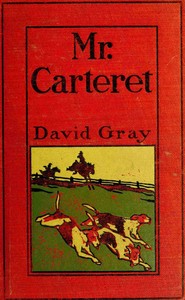
Mr. Carteret and Others
by David Gray
Language: en429 downloads on Project Gutenberg
Subjects
In: Short Stories·Humour·British Literature
Public-domain ebook sourced from Project Gutenberg #68051.
Public-domain ebook
by David Gray
Language: en429 downloads on Project Gutenberg
Subjects
In: Short Stories·Humour·British Literature
Public-domain ebook sourced from Project Gutenberg #68051.
The opening · free to read
“It must have been highly interesting,” observed Mrs. Archie Brawle; “so much pleasanter than a concert.”
“Rather!” replied Lord Frederic. “It was ripping!”
Mrs. Ascott-Smith turned to Mr. Carteret. She had been listening to Lord Frederic Westcote, who had just come down from town where he had seen the Wild West show. “Is it so?” she asked. “Have you ever seen them?” By “them” she meant the Indians.
Mr. Carteret nodded.
“It seems so odd,” continued Mrs. Archie Brawle, “that they should ride without saddles. Is it a pose?”
“No, I fancy not,” replied Lord Frederic.
“They must get very tired without stirrups,” insisted Mrs. Archie. “But perhaps they never ride very long at a time.”
“That is possible,” said Lord Frederic doubtfully. “They are only on about twenty minutes in the show.”
Mr. Pringle, the curate, who had happened in to pay his monthly call upon Mrs. Ascott-Smith, took advantage of the pause. “Of course, I am no horseman,” he began apprehensively, “and I have never seen the red Indians, either in their native wilds or in a show, but I have read not a little about them, and I have gathered that they almost live on horseback.”
Major Hammerslea reached toward the tea table for another muffin and hemmed. “It is a very different thing,” he said with heavy impressiveness. “It is a very different thing.”
The curate looked expectant, as if believing that his remarks were going to be noticed. But nothing was farther from the Major’s mind.
“What is so very different?” inquired Mrs. Ascott-Smith, after a pause had made it clear that the Major had ignored Pringle.
“It is one thing, my dear Madame, to ride a stunted, half-starved pony, as you say, ‘bareback,’ and another thing to ride a conditioned British hunter (he pronounced it huntaw) without a saddle. I must say that the latter is an impossibility.” The oracle came to an end and the material Major began on the muffin.
There was an approving murmur of assent. The Major was the author of “Schooling and Riding British Hunters”; however, it was not only his authority which swayed the company, but individual conviction. Of the dozen people in the room, excepting Pringle, all rode to hounds with more or less enthusiasm, and no one had ever seen any one hunting without a saddle and no one had ever experienced any desire to try the experiment. Obviously it was an absurdity.
“Nevertheless,” observed Lord Frederic, “I must say their riding was very creditable--quite as good as one sees on any polo field in England.”
Major Hammerslea looked at him severely, as if his youth were not wholly an excuse. “It is, as I said,” he observed. “It is one thing to ride an American pony and another to ride a British hunter. One requires horsemanship, the other does not. And horsemanship,” he continued, “which properly is the guiding of a horse across country, requires years of study and experience.”
Lord Frederic looked somewhat unconvinced but he said nothing.
“Of course the dear Major (she called it deah Majaw) is unquestionably right,” said Mrs. Ascott-Smith.
“Undoubtedly,” said Mr. Carteret. “I suppose that he has often seen Indians ride?”
“Have you often seen these Indians ride?” inquired Mrs. Ascott-Smith of the Major.
“Do you mean Indians or the Red Men of North America?” replied the Major. “And do you mean upon ponies in a show or upon British hunters?”
“Which do you mean?” asked Mrs. Ascott-Smith.
“I suppose that I mean American Indians,” said Mr. Carteret, “and either upon ponies or upon British hunters.”
“No,” said the Major, “I have not. Have you?”
“Not upon British hunters,” said Mr. Carteret.
“But do you think that they could?” inquired Lord Frederic.
“It would be foolish of me to express an opinion,” replied Mr. Carteret, “because, in the first place, I have never seen them ride British hunters over fences--”
“They would come off at the first obstacle,” observed the Major, more in sorrow than in anger.
“And in the second place,” continued Mr. Carteret, “I am perhaps naturally prejudiced in behalf of my fellow countrymen.”
Mrs. Ascott-Smith looked at him anxiously. His sister had married a British peer. “But you Americans are quite distinct from the red Indians,” she said. “We quite understand that nowadays. To be sure, my dear Aunt--” She stopped.
“Rather!” said Mrs. Archie Brawle. “You don’t even intermarry with them, do you?”
“That is a matter of personal taste,” said Mr. Carteret. “There is no law against it.”
“But nobody that one knows--” began Mrs. Ascott-Smith.
“There was John Rolfe,” said Mr. Carteret; “he was a very well known chap.”
“Do you know him?” asked Mrs. Brawle.
The curate sniggered. His hour of triumph had come. “Rolfe is dead,” he said.
“Really!” said Mrs. Brawle, coldly. “It had quite slipped my mind. You see I never read the papers during the hunting. But is his wife received?”
“I believe that she was,” said Mr. Carteret.
The curate was still sniggering and Mrs. Brawle put her glass in her eye and looked at him. Then she turned to Mr. Carteret. “But all this,” she said, “of course, has nothing to do with the question. Do you think that these red Indians could ride bareback across our country?”
“As I said before,” replied Mr. Carteret, “it would be silly of me to express an opinion, but I should be interested in seeing them try it.”
The book keeps going
Reading is free forever. Sign up and watch scenes appear while you read.



Scenes Storieta drew for other classics.
New illustrated classics
Once or twice a month: the latest books to get full character casts, scene art, and free comic editions. No account needed.