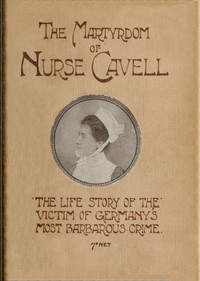
In the early seventies there were living at the country rectory of Swardeston, near Norwich, a clergyman and his wife and little family. There was a “New” and an “Old” Rectory. Both are still standing, much as they were then, except that the trees are older, and the “New” Rectory has long ago lost any signs of newness. It is one of the ways of Old England to call some of its most ancient things New, as if it could never learn to tolerate change kindly, even after centuries of wont.
There is a Newtimber Place in Sussex whose walls were built before the Armada. There is a New Building in Peterborough Cathedral which was completed before the Reformation. New Shoreham took the place of Old Shoreham before Magna Charta was signed.
The Rector, the Rev. Frederick Cavell, lived with his family at the New Rectory. It is a pleasant sunny house with a large garden. Such parsonages are common in all the unspoiled rural parts of England. A little gate leads to the churchyard close by.
In a great city no man would live willingly close by a cemetery. In such a village as Swardeston the nearness of the graveyard is a consecration. New graves appear among the old ones from time to time. The oldest of these others have faded gently into the grass. Nobody is left to tend them or to remember whose bones they cover. Yet the history of many a family can be traced back for three centuries on the lichen-covered stones.
Some day, when the war is over, another grave may be dug in this quiet spot. If the poor mutilated frame of Edith Cavell is ever permitted to be brought back home, her countrymen will come here to look upon the place where she lies. In this October of 1915 she sleeps in a land ravaged by war, and those who killed her will not stoop even to the tardy pity of giving back her body.
But in those early seventies the village churchyard was not a place of sadness to the Rectory children. They played hide-and-seek among the sloping tombstones. The church and churchyard were, as they still are, the centre of the village life. Gay doings, such as a wedding, took place under the shadows of the elms and yews.
The whole community assembled there on any day of special interest. The churchyard was the Trafalgar Square of Swardeston. For it was not remote from the houses, as many village churchyards are. Norfolk labourers swung their heels on the wall in the long evenings of the days before village institutes and reading rooms were invented.
In these early seventies the village talk still harked back sometimes to the War of the French and Prussians. Its politics dealt with such names as “Dizzy” and Gladstone and Joseph Arch, the agricultural reformer--and, what was more to the point, a Norfolk man. In later years the village church saw the celebrations of Queen Victoria’s two Jubilees and King Edward’s Coronation--“a Norfolk landlord, and a rare good ’un,” as they liked to say in Swardeston.
Home life in the Rectory was tinged, as was that of most English homes at the time, with Evangelical strictness. On Sunday all books, needlework, and toys were put away. The day began with the learning of collect or Catechism. As soon as the children were big enough they attended services in the morning and afternoon.
Evening services were not yet introduced in Swardeston. Light was not cheap, and the way across the country fields to church was no adventure for Sabbath clothes on dark winter nights. Thus the closing hours on Sunday were home hours for Rectory and village. Let those who have no memories of such times scoff if they think fit. A memory is better than a jest.
Edith Cavell’s father was Rector of this parish for more than fifty years. He is dead now, but the villagers remember him well. His portrait shows him with a mouth and chin of unusual firmness. His eyes are kindly, but there is little sense of humour about them. It is notably the face of an upright man. Surely capable of sternness, he would be just to the point of inexorableness unless his face belies him. A sense of duty is implicit in every line; and we have the best of reasons for knowing that he transmitted this part of his character to his daughter Edith.
“The clever Miss Cavell” she was called in later years when she worked at a London hospital; but a more dominant characteristic was a rigid insistence upon what she deemed to be right. This was the constant theme of the father’s sermons to his village flock. He would not hesitate to reproach from the pulpit any member of the congregation, whatever his station, whom he considered guilty of grave fault.
The mother (who is now eighty years old, and lives very quietly at Norwich) brought a gentler influence to bear upon the Rectory life. There is a picture of her with two of her little girls. The mother wears the wide flounces which to-day are among the earliest memories of the “Men of Forty.” Flounces that were a protection and a promise. Something for little hands to cling to when the legs were not yet sure of their way. These flounces made a royal road from earth to the children’s heaven. The grown-up world far out of reach was always within call of a pull at the ample skirts.
Mrs. Cavell was a happy mother, and her children were happy too. So early as the days we are speaking of her eyes had something wistful in them. It was almost as if some inner consciousness had told her then of the distant, poignant future.
So the family grew up in a contented, well-ordered home, with plenty of outdoor games and sunshine, such as country children have. Long afterwards, in the midst of London slums, Edith Cavell would talk of the ripening blackberries far away in the Norfolk lanes, and of the great jam-making times which followed.
Like Charlotte Brontë, another vicar’s daughter, Edith Cavell first learned something of the wider world in a Brussels school. It was commoner then than now--meaning by “now” before the war--for English girls to be sent to Belgium to school. Charlotte Brontë’s Brussels life has left us at least one imperishable book. Edith Cavell has left no written memorials of those times; but if we would reconstruct her life we may imagine some such background as that of “Villette”: the strangeness of a foreign city, fascinating by its novelty yet repelling by alien atmosphere.
The lot of a school-girl is not too happy at the best among new companions. When their language and ways are those of a foreign country they can become a source of torture to a sensitive child. Some of these school-girl irritations Edith Cavell had to bear; yet such early annoyances evidently left little mark on her, for she returned many years later to Brussels of her own free will, and conquered the affections of the Belgians a second time.
Edith Cavell’s early womanhood was spent in London--at the London Hospital, the St. Pancras Infirmary, and the Shoreditch Infirmary in Hoxton. Her training was obtained at the London Hospital, the great institution in the Whitechapel Road which is now nursing many wounded soldiers. The women who train in this hospital pass through a hard school. All hospital nurses work hard, but the nurses who come from “The London” think they know more of the strain of their calling than any others.
“The London” proposes to raise a memorial to Nurse Cavell. It is their right and hers that this should be done. For “The London” gave her the thorough training which enabled her to become the skilful teacher of others, and to instruct the nurses who should succour with equal care the wounded of all nations.
At the end of her arduous training at the London Hospital in 1896, Miss Cavell went to St. Pancras Infirmary as Night Superintendent. She stayed there for a little more than three years. Then she became Assistant Matron at the Shoreditch Infirmary in Hoxton. She left Hoxton in 1906 to start the work in Brussels which ended only with her cruel death.
Including the training years at the London Hospital, Edith Cavell had given twenty-two years to nursing the sick. She was twenty-one years old when she began this work. She was forty-three when she met her death. Thus she had given up the best years of a woman’s life without a break, save for the occasional precious holidays, of which we shall say a word presently.
The work in London was one of unvarying routine in the most dismal surroundings. Nothing but a real devotion to the task could have made the monotony tolerable.
The writer asked one of those who worked with her for part of this time what was the reason that decided Edith Cavell to become a nurse. “She felt it was her vocation,” was the simple answer; “isn’t that enough?” The vocation, in these great London infirmaries, consisted in preserving a cheerful face day in and day out; in ruling, with kindness but also with firmness and an unfaltering tact, old men and women, children from the poorest slums; in being constantly in contact with pain and suffering and in the near presence of death. Those who remember her work in London--and they are very many--speak of her unselfishness and of a shy pride about the details of her labours.
What she did for her patients she liked to be a secret between herself and them. She would follow up the “cases” to their homes. The Matron and her fellow-nurses guessed some of these acts of week-day holiness; but Nurse Cavell never spoke of them. She went about doing good among the neat beds of the wards and in the unlovely surroundings of the neighbouring streets, doubtless thinking sometimes of the Norfolk village where the sun was shining beyond the fog, yet never letting the patients see that she had any thoughts except for them.
But with this sympathy went a rare strength of mind. Her name “Clever Miss Cavell” was not used in envy. It was a simple recognition of the fact that she had what is called a capable brain. She always knew what to do in a difficult situation. A fellow-nurse in trouble was always advised to consult Miss Cavell.
Edith Cavell needed all her strength of character in her first years in Brussels. When she went there nine years ago as Matron of a Surgical and Medical Home, English nursing methods were not appreciated on the Continent as they are now. Nursing was regarded as one of the functions of the Church. Miss Cavell was a Protestant as well as a foreigner. She was felt to be a rival of the nuns and sisters working under religious vows.
The authorities of the Catholic Church looked coldly upon an enterprise which, from their point of view, had an aspect of irreligion and freethinking. But it was not long before the Matron’s efficiency and tact carried the day. A well-known priest trusted himself to the English lady. His tribute to her devotion and skill brought public opinion to her side. In 1909 she established a training home for nurses. The authorities recognised and encouraged her; and shortly before the outbreak of war she was provided with a modern and well-equipped building.
The first warning of the war came when she was spending a holiday at home with her mother at Norwich. During these years in Brussels two holidays a year had been spent in England. They were happy halting places in a rough journey. What made them so pleasant to Edith Cavell was that she could spend them with her mother.