Public-domain ebook
Trouble Times Two
English398 downloads on Project GutenbergDownload EPUB
Public-domain ebook sourced from Project Gutenberg #68161.
Public-domain ebook
English398 downloads on Project GutenbergDownload EPUB
Public-domain ebook sourced from Project Gutenberg #68161.
The opening · free to read
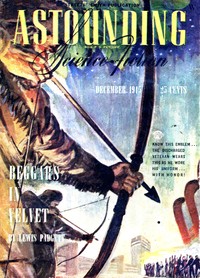
[Transcriber's Note: This etext was produced from Astounding Science-Fiction December 1945. Extensive research did not uncover any evidence that the U.S. copyright on this publication was renewed.]
Thomas Lionel Ph.D., M.M. bounded out of bed with a cheerful bit of off-tune song. He glanced at the calendar and then the clock and he grinned because life was just too good to be true.
Everything was according to plan. He'd won his first battle. Up to now it had been touch and go; at last he had established his right to co-occupy the mind along with the engineer. No longer could the engineer claim that he was an expensive detriment. He had forced the engineer into agreeing that his offering, though not directly productive, was a causative factor in the development of success. Then to top it all, he retained enough technology to be a necessary item. He must be permitted to remain if only for a source of information.
The engineer's trap had been excellent. But the trap had turned and caught the engineer. Those reams of data on the poltergeist effect had been the basis for an entirely new science that only a real physicist could appreciate--and no engineer could hope to thread his way through them without a research physicist's assistance.
He stood over the chessboard in the living room for a few minutes. The engineer was not making any great moves. Therefore the physicist thought that he might best consolidate his position. He castled to the queen's side, burying his king behind a bulwark of defenses that would defy a master chess player to penetrate in less than ten or fifteen moves.
During breakfast, he perused a thin volume of recent publication. He did not entirely agree with the theories presented; after all, the book had been written for the express purpose of getting reader's viewpoints and Thomas knew it. In fact, the book was not too interesting to Thomas but he knew that the engineer would fume, fret, and howl at the idea of having a well-thumbed volume of "_Theory of Multi-Resonant Wave Guides_" in the library.
Thomas wouldn't look at the engineer's volume, laying on the table opposite. It was too un-physical. It was un-erudite. It was "_Basic Theory in Micro-Wave Transmission_" and the edges of the pages were loaded with application formulas, diagrams, and working sketches.
He was near the end of breakfast when the glint of reflected sunshine arrowed through the window and caught his eye. He looked, and wondered who was landing on his lawn in a helicopter.
Then he did a double take.
"Helicopter" stemmed from Greek, the "helix" or screw plus the "opter" a machine. This contrivance did not. It was not operated with air screws.
It looked like a three-wheeled coupé. It looked like the industrial designer's dream of the Plan For Tomorrow, excepting those three wheels. The Plan For Tomorrow should, by all rights, have four wheels. And, if the thing is going to fly, it should have some sort of overhead vanes, or wings, or engines, or jets, or even a skyhook. But there it was, coming down as light as a feather to make a neat landing on the back lawn.
By the time the door was open, and the passenger stepped to the ground, Thomas was standing before the little sky car, looking somewhat dazed at the name:
"I wish you would. We've got the jump on the whole world with this. We'd like to keep it. But the thing doesn't answer to the wheel too solidly."
"Uh-huh."
"The chief engineer said, 'Jim, take that crate over to Lionel and see if he will beef up the control force a bit.' So here I am."
"O.K., Jim," said Thomas, offering a prayer for the name that had been given unwittingly. The engineer must have been a busy boy! "How are you going to get back?"
Jim looked up into the sky. "Jerry is following in the pilot model. He'll pick me up and we'll go on back thataway."
Jim nodded skyward, and Thomas looked at the growing speck that must have been the pilot model.
Thomas forgot about the pilot model. What he wanted to know was the whereabouts of the five tons of equipment that had been an integral part of this idea. He looked at the model. He wondered whether the engineer had installed the whole thing, stepping up the power and using the main part of the power to support the equipment. That did not seem possible. Any failure would cause the little sky car to collapse of its own dead weight. Besides there was not enough room in the little crate to pack all that equipment-tonnage.
The engineer had achieved the impossible. He had done away with the main part while retaining the effect.
The pilot model landed. It was not the finished job of the prototype. The cabin was squarely functional and the landing wheels were not faired into the hull. The rear end, instead of tapering gently into a narrow paraboloid of revolution, was a truncated four-sided pyramid.
Jerry did not emerge. He merely tossed the door open and shouted: "Come on--we ain't got all day!"
Thomas nodded. "I'll call you when I get it fixed."
Call who? the physicist wondered, and then forgot about it. He wanted desperately to dig into the sky car. He wanted to find out where the engineer had packed five tons of equipment. He wanted to see what made the wheels go around. No doubt the thing could be returned to its owners without calling in the police. The thing was probably recorded in the precisely kept engineering notebook of the physicist's alter ego.
The pilot model was not completely out of sight before Thomas had the power cowls off, and the whole model stripped of its servicing doors. They had done an excellent job of design; the sky car without its servicing panels was but a skeleton frame, with every line, every connection, and every control rod open for easy servicing.
And it was then and there that the physicist understood what the engineer had been doing.
Instead of the low-voltage high-current supply lines, with their attendant heavy busbars, thin pipes ran about the sky car. Seamless aluminum tubing carried the energizing current. Or, rather the space inside of the tubing carried it. At the generator end, a ten megawatt microwave generator supplied high power at ultra high frequency. At the terminus, rectifiers brought the ultra high frequency down to direct current for operation of the force-field generators.
Thomas nodded. It was not the final tenth of one percent job. It was not direct current. The diagravitic force was not constant. It operated only seven tenths of the time, and was turned off and on fifteen or twenty million million times per second. Nothing short of high-definition test equipment would ever tell the difference, however.
Gone were the massive electromagnetic deflection field coils. In their place was a set of seventy kilovolt electrostatic plates.
Missing entirely were the variable-speed motor generators. In their place was a simple crystalline formation under permanent magnetic stress. "Artificial radio-activated crystals," muttered Thomas. "Good for a couple of years."
But the feed lines. The feed lines. The current carrying ability of space itself--not the metallic conductor--did the trick. Using the ultra high frequency bands, the busbars had been replaced with cylindrical wave guides. The depth of penetration was measured in microns at those frequencies--and as long as the guides were properly designed, they offered little loss in power. The current went down the wave guides by virtue of the magnetic fields created throughout the guides--magnetic fields generated in the space inside of the tubular guides.
The generator itself was one of the new crystal microwave generators and the rectifiers at the receiving end were of the same ilk.
And the five tons of equipment had vanished in a puff of tubular guides, electrostatic plates, and intermittent operation.
Thomas hit a snag for a moment. The engineer had answered his challenge. So he'd come up with the answer to the five-ton-per-fifty-pound answer--and had gone further. Thomas knew that there was no apparent limit to the maximum power or lift. It merely set a fifty pound minimum--actually it was 49.87 pounds by measurement--under which limit no amount of tinkering would produce the effect.
He smiled. There must be something beyond. After all, small stones moved quietly in natural poltergeist manifestation; they would be able to reproduce that eventually. But for now, the engineer was willing to accept the limitation whereas the physicist would not.
He knew now. And he'd leave the sky car until the engineer returned. Let him beef up the control force. It was his baby.
Thomas put the panels back on the sky car and stood off to admire it. It was a neat job, just what the public wanted. The urge to get in and drive was a most compelling one, and Thomas succumbed. He sat for a moment, inspecting the dashboard until he had the pattern well set. Then he snapped on the power, took the wheel and pulled back gently. The sky car lifted its nose slightly, and as Thomas pressed the foot pedal, it took off on a side-line straight into the sky. He leveled off at a thousand feet and he did some scurrying back and forth in midair. It did handle a little sloppy but not enough to make the physicist uncomfortable. Yet it wouldn't stand any hedge-hopping or bridge-undercutting without a prayer on the part of the driver. Butter the controls a bit and you could thread a needle with it on the first try.
Yes, the engineer had done it again--all of which made Thomas chuckle. A bit more of this and the engineer would have such an income that he'd no longer worry himself into engineering. Then--
Thomas turned the sky car and drove across the city toward Dr. Hamilton's place. He landed on the psychiatrist's lawn and startled the doctor out of a week's growth.
"I've won," he told the doctor.
The book keeps going
Reading is free forever. Sign up and watch scenes appear while you read.



Scenes Storieta drew for other classics.
New illustrated classics
Once or twice a month: the latest books to get full character casts, scene art, and free comic editions. No account needed.