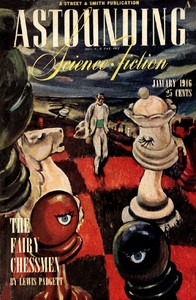
Public-domain ebook
Fine Feathers
Language: en418 downloads on Project Gutenberg
Subjects
In: Science-Fiction & Fantasy·Novels
Public-domain ebook sourced from Project Gutenberg #68218.
Public-domain ebook
Language: en418 downloads on Project Gutenberg
Subjects
In: Science-Fiction & Fantasy·Novels
Public-domain ebook sourced from Project Gutenberg #68218.
The opening · free to read
Wanniston fixed the other man with a piercing gaze. "Sorry," he said. "Quite sorry. But it can not be done that way, you know. The whole proposition was your idea."
"I know," said the other man. He inspected Wanniston's large, well-proportioned frame, his strong features, and his absolute poise and wondered how any man, with all to recommend him, could be so utterly unsympathetic. The coldness in his face set him apart from one of the Galactic Ones. "The proposition was sensible enough--yet I failed. Even though I failed, my manipulations were properly done, you will agree."
Wanniston nodded.
"Where did I fail?"
"You struck a snag."
"It was not my fault."
"Are you crawling?" snapped Wanniston.
"Perhaps," said the other man bitterly. "I want to know how I failed."
Wanniston smiled deprecatorily. "Lincoln, you failed because you neglected to take everything into account. Before you succeed--before you can hope to plan without failure, you must learn to take everything into account."
"One cannot take everything into account."
"Yes, one can. It is quite possible--if you know how."
"Everything's easy," said Lincoln sourly, "once you know how."
"Certainly," laughed Wanniston.
"And because I made a mistake, I failed."
"Had you taken everything into account, you would have known that you could never succeed. You wouldn't have started, and now you wouldn't be a complete and broken failure."
"You may well gloat."
"I'm not gloating."
"I believe that," admitted Lincoln. "But that changes nothing."
"You understand our position, Lincoln. If we prevented you from trying, well, you might have succeeded, and we'd never know the benefits of your success. It was your idea, and you wanted to try. But don't feel too broken. Others have tried."
"Small consolation. Knowing that another man is starving will not put food in my belly." Lincoln stood up, dusted off his jacket, and left the office.
The report of a pistol echoed and re-echoed up and down the corridor, reverberating and hushing until it could be mistaken for a wild cackle of laughter.
Wanniston went into the small office beside his own, through an interconnecting door. The key to the outer door hung in the lock by the tongue, and the office was a sharp contrast to his spotless business office. Here was no clean desk, no bookcase bulging with erudition, no deep-pile carpet. Instead, the place was a litter of complicated equipment. Not messy, in the dirty sense of the word, but the standard neglect of any laboratory. Delicate instruments stood on the floor, a box was partly filled with discarded parts, and several pieces of partly disassembled apparatus lined the walls. On the desk, which was the cleanest spot in the room, there stood a small cabinet. It was not the precisely finished cabinet that comes with commercial equipment, but strictly functional. There was no pattern to the dials--at least there had been no attempt to arrange the controls in sensible pattern. They stuck out wherever they were needed--and the sides and top each had a knob or two.
Wanniston slid the headpiece over his temples and snapped the main switch. A split-second timer kicked in for less than one-tenth of a second, waited for ten seconds, and then repeated the dose. Four times it followed the sequence of keying the machine for a period of less than a tenth of a second, following with a ten-second pause. Finally it gave Wanniston a full one-second charge and then ceased.
The financier removed the temple set and sat thinking for a moment. There was a bit of resentment at the machine--not resentment, exactly, but a slight feeling of annoyance that he must take such microscopic doses of the machine.
He knew the story of Andrew Tremaine and how the publisher's attempts to use the machine had resulted in self-destruction because it had been too good. But, smiled Wanniston, he really had no intention of trying to lift the whole race to the level of the Ambassador of the Galactic Ones, the emissary Gerd Lel Rayne. Rayne had told him.
Not the complete story, of course. Rayne could never tell that. Nor if he did, Wanniston could not have understood it. But he did know that Tremaine had developed such a machine and had energized his mind with disastrous results.
Obviously, Tremaine could not have gone on living after that. Tremaine was pretty much of an extrovert who loved people and wanted them all to advance rapidly. Wanniston was self-centered and introverted and wanted nothing more than to run the show himself. Tremaine could not live in a world alone--and with his energized brain, he was in a world alone. Gerd Lel Rayne could be his only friend, he and Gaya, and their friendship must necessarily be one kept under cover. But Wanniston could, did, and liked a world alone. He had no intention of letting the world know.
That would be disastrous.
The world would rush to the machine, to partake of its offerings, in order to gain the benefit of the increased intelligence. They would not count the cost--and the cost was great.
The machine produced sterility.
So much for general usage.
But for individual usage? That was another matter. He would use it for himself alone and forget progeny. Wanniston wanted to run the show. He felt entitled to have a hand in it, for he knew that he was better equipped, mentally, to handle the complex problems of running the world than many others. He was aware of man's weaknesses. They were all glad to be just human, but it took a higher intellect to understand that there was something better than just being human.
Wanniston knew that, and Wanniston was going to do something about it. Wanniston, by knowing that there was something higher, and by being just that slight bit higher himself, was going to go all the way and make himself Gerd Lel Rayne's mental equal. He believed that he might even surpass the 260-odd I.Q. possessed by the emissary of the Galactic Ones, for he knew that Rayne was merely the lowest link in a long chain that led right up to the Grand Galactic Council.
"Wait until you see me kid brudder," grinned Wanniston. His lips were thin as he grinned, and there was more sardonicism than genuine humor in the situation.
Gerd Lel Rayne smiled amicably as Wanniston entered. "Good morning," he said with a booming, easy voice. The emissary was a large man, a living embodiment of poise and good will. "I sent for you, John. You're heading for trouble."
"It's my trouble," answered Wanniston.
Rayne shook his massive head slowly. "Not entirely. I'm concerned."
"It's my trouble and, if it blows up in my face, it's my grief."
Again there came that shake of the head. "No, Wanniston, you cannot shake yourself loose like that. You are not alone. I failed my superiors when I told you the tale of Andy Tremaine. I thought that the knowledge of what had happened to another who tried the same thing would deter you. Remember?"
"Yes, I remember. I asked you why it wouldn't be possible to energize the human brain so that it could use the whole thing instead of the usual ten percent. You countered with the yarn about Tremaine."
The book keeps going
Reading is free forever. Sign up and watch scenes appear while you read.



Scenes Storieta drew for other classics.
New illustrated classics
Once or twice a month: the latest books to get full character casts, scene art, and free comic editions. No account needed.