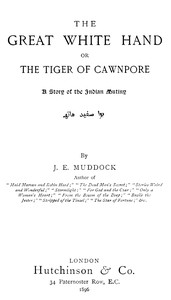
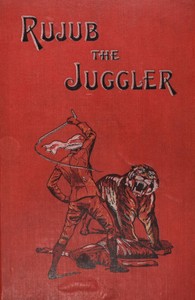
In the year 1894, I published in two volumes a romance of the Indian Mutiny, under the title of “The Star of Fortune.” A short prefatory note intimated that it was my lot to be in India during the terrible time of the Sepoy Rebellion. From this it may be inferred that I not only wrote with feeling, but with some personal knowledge of my subject. “The Star of Fortune” was exceedingly well received by the public, and last year a cheaper edition was called for. That edition has been extensively circulated throughout India and the Colonies. The book on the whole was well reviewed, while my critics were good enough to accord me praise, by no means stinted, for the portions which dealt with the Mutiny proper. One London paper said it was “a very fine picture narrative,” another spoke of it as “a spirited piece of writing,” a third declared it was “written with spirit and vivacity,” a fourth as being “really breathless in interest.” I could go on multiplying quotations similar to the foregoing, but those I have given will serve the purpose I have in view.
On the other hand I was taken somewhat severely to task because the opening portions of the tale dealt with Edinburgh, and about one-third of the book was exhausted before India was reached. Whether or not that was really a fault is not for me to say; it was certainly part of my original plan, but I cannot be indifferent to the fact that a consensus of opinion condemned it, and declared that the Mutiny was far too interesting a subject to be mixed up with any love-making scenes in Edinburgh or elsewhere other than in India. I was very bluntly told that I ought to have plunged at once into medias res, and that a story purporting to be a story of the Mutiny should deal with the Mutiny only. The advice has not been lost upon me. I have steadily kept it in view while writing the “Great White Hand,” and I venture to express a hope that whatever shortcomings may be found in the work, whatever sins of omission and commission I am guilty of, I shall at least be credited with keeping strictly to the locale and incidents of the Great Rebellion, which, in my opinion, affords, and will continue to afford for generations to come, a fund of the most romantic material all ready to the novelist’s hand. If it should be urged against me that the dramatic situations in which my characters become involved are overstrained or improbable, I shall claim on the authority of history that the thrilling times of the Revolt were rich in situations so sensational, so dramatic, so tragic and pathetic, that they put fiction into the shade. The bare ungarnished story of the Rising is in itself one of the most sensational records the world has ever known. Not even the Crusades, not even the wonderful defence of Malta by the Knights of St. John of Jerusalem, against the infidel Turk, present us with a more thrilling, romantic, and stirring panorama of battle scenes and incidents than the Indian Mutiny. It was not a struggle of the Cross against the Crescent, but of the Cross against Vishnu, against Shiva, against Brahma. The “Phantom” King of Delhi, and the “Tiger of Cawnpore,” both believed that the doom of Christianity in India had knelled. But they were undeceived, and all that was best, bravest, and noble in British men and women was brought to the surface. Of course, in a work of this kind, history must necessarily be used simply as a means to an end; therefore, while it is not claimed for the story that it is a piece of reliable history in the guise of fiction, it may truthfully be said it records certain stirring events and incidents which are known to have taken place. These incidents and events have been coloured and set with a due regard for the brilliant and picturesque Orient, which forms the stage on which the dramatic action is worked out. Those who knew India as I knew it in those lurid and exciting days, will probably admit that there is scarcely an incident introduced into my book but what might have happened during the enactment of the great tragedy. An air of vraisemblance represents true art in fiction, and when it becomes difficult for the reader to tell where fiction begins and truth ends, it may be said that the story-teller can go no further. If I should be fortunate in establishing a claim to this praise, I shall be proud indeed; but though I fail in that respect, I humbly venture to believe that “The Great White Hand” will be found neither dull nor uninteresting.
THE AUTHOR.
LONDON, 1896.
It is the ninth of May, in the year one thousand eight hundred and fifty-seven. The morning breaks lowering and stormy, a fitting prelude to the great and tragic drama that is about to startle the world. It is not yet four o’clock, and the sun is hardly above the horizon, but in the fair Indian city of Meerut there is an unusual stir. The slanting rays of the rising sun, as they fall through the rifts of hurrying storm-clouds, gild the minarets and domes of the numerous mosques for which the city is famed. The tall and graceful palms stand out in bold relief against the sky, and from the cool greenery of their fan-like leaves there issue the soft, peaceful notes of the ring-doves. Meerut, at this time, is one of the most extensive military stations in our Indian empire, and covers an area nearly five miles in circumference. In the centre of the city is a great wall and esplanade, and along this runs a deep nullah, which cuts the station into two separate parallelograms; the one contains the European, and the other the Native force. The European lines are in the northern quarter, the Artillery barracks to the right, the Dragoons to the left, and the Rifles are in the centre. Between the barracks of the two last rises, tall and straight, the spire of the station church. It contrasts strangely with the Oriental architecture which surrounds it. Farther northward again stretches an extensive plain, which is used as a parade-ground. Towards this plain, on the fateful ninth of May, eighteen hundred and fifty-seven, streams of human beings are flowing. Crowds of natives, from the low-caste Coolie to the pompous Baboo, hurry along, either on foot or horseback.
Presently, far and near, the reveille is heard, and, in a little while, long lines of troops, mounted and on foot, march towards the plain. Then the clattering of horses’ hoofs, and the rumbling of guns, add to the general commotion, and soon the plain is swarming with armed men. Heavily-shotted field-guns are placed in position, and the drawn sabres of the Dragoons flash in the sun’s rays, while on three sides of the plain are bodies of troops armed with the new Enfield rifles, that are ready, on the word being given, to belch forth fire, and send their rotary messengers of death into the crowds of natives if the necessity should arise.
The cause of this great gathering is to see eighty-five native soldiers converted into felons. On the 24th of April the 3rd Native Cavalry had been drawn up for parade, and, when the order to load had been given, these eighty-five had resolutely refused to bite their cartridges. For this mutinous act they had been tried by a court-martial, composed of English and native officers, and sentenced to ten years’ imprisonment with hard labour; and on this Saturday morning, the 9th of May, the first part of the sentence--that of stripping them of their uniform in the presence of all the regiments--is to take place.
At a given signal the doomed eighty-five are brought forward under a strong guard of Rifles and Carabineers. They still wear their uniform and have their accoutrements. Colonel Carmichael Smyth, the Colonel of their Brigade, steps forth, and, in a loud, clear voice, reads the sentence. That over, their accoutrements are taken from them, and their uniforms are stripped from their backs. Then the armourers and smiths step forth with their shackles and their tools, and, in the presence of a great concourse of their old comrades, the “eighty-five” stand with the outward symbols of their black disgrace fastened upon them.
With loud cries they lift up their arms, and implore the General to have mercy upon them, and save them from ignominious doom. But the fiat has gone forth, and they stand there manacled felons. Then, in the agony of despair, they turn to their comrades and hurl reproaches at them for quietly permitting such dire disgrace to fall upon them. There is not a Sepoy or native civilian present but who gasps for breath as he feels the rising indignation in his throat. But, in the presence of the stern white soldiers, of the loaded guns, of the grooved rifles, and the glittering sabres, they dare not strike. As the prisoners make their appeal, there moves, swiftly, silently amongst the crowds of natives, a tall, slim man--a Hindoo. His movements are snake-like; his eyes glisten with a deadly fire. As he goes, he whispers--
“Courage, and wait!”
The crowds commence to disperse. The felon “eighty-five” are marched to the gaol, two miles from the cantonment, with only a native guard over them.
As the day wears on the storm passes away, and when the shades of evening fall upon Meerut, all is quiet and peaceful. It is one of those nights that may be described, but which few persons, who have never been in hot countries, can realise. The air is stagnant. The stars seem to quiver in a haze. Not a branch stirs, not a leaf rustles. Myriads of fire-flies--Nature’s living jewels--dance about in bewildering confusion. Occasionally the melancholy sounds of a tom-tom, varied by the screech of a jackal, is heard. But with this exception, a death-like silence seems to reign in the city.
Seated on the verandah of a pretty bungalow in the European quarter, is a young man--a civilian. His physique is that of a trained athlete. He is handsome, too, with a mass of black hair falling over a prominent forehead. His name is Walter Gordon; he is the son of a wealthy merchant of Meerut, who had died very suddenly, and Walter had but recently come out from England to take charge of his father’s business. He is not alone now. His companion is a lady slightly his junior. She is very pretty. A pure English face, with tender brown eyes, and soft, moist lips. A wealth of rich brown hair is negligently held together by two large gold pins of native workmanship. This young lady is the betrothed of Walter Gordon. Her father (Mr. Meredith) had held a Civil Service appointment in Meerut, but had died some two years before the opening events of this story, leaving a widow and two daughters, Flora and Emily. Emily had been recently married to an officer of one of the regiments stationed in the city. Lieutenant Harper and Walter Gordon were very old friends. They had been school-mates together, and they both laid siege at one time to the hearts of the Misses Meredith. Harper had been successful, and carried his prize off to his quarters, but Walter had delayed his marriage, pending the settlement of some legal difficulty in connection with property to which he was entitled. That difficulty was now removed, and Walter had gone on this evening to Mrs. Meredith’s bungalow to arrange for his marriage with Flora.