The hot Arkansas sun shone hotly down upon Dead-Man’s Forest, that vast, sleepy army of trees which silently overlooked acres of treacherous swamp, silent glade, and tiny hillock. Why it had been so weirdly named, no one knew, as the name had descended from the Indians, and they had regarded it with awe as being haunted with evil spirits.
In extent it was some thousands of acres, some hilly, others level, and a great portion swampy and gloomy. The trees were thickly planted, and were giants among other trees.
In the swampy regions the sun scarcely ever penetrated the matted branches, and the howl of the wolf, the scream of the catamount, and the hiss of the venomous snake, and the scream of some bird of prey were the only sounds to be heard in its depths.
On the afternoon of which we are speaking, however, the gloomy old forest resounded with the quaint tones of a negro melody, trolled from the lips of one of the most sable negroes who ever hunted a raccoon.
He was shambling along a dim trail through the silent forest, idly gazing right and left, and appeared to be wholly at his leisure.
He was short and stumpy, and was scantily dressed in an old cotton shirt open at the neck, and an old pair of blue jean pants, which were much too short for him, being once the property of a diminutive boy.
His lips were thick and huge, and his large white eyes rolled always, never at rest. His head was bare, showing a cranium covered with close-setting kinks of black hair, or wool. He was very dirty, and was one of those heedless, happy vagabonds who have plenty to eat, plenty of time to sleep, and who care not what the morrow may bring.
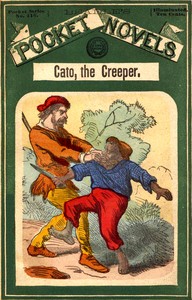
His name was Cato, the Creeper--from his aptness and stealthiness in pursuing a trail. He once had been a Mississippi slave, but had been freed many years since--in fact when he was quite young, and he was now thirty-five. He lived alone, and what he did for a living no one knew; but he always was to be found strolling about Dead-Man’s Forest, or else asleep in his cabin, which stood on the edge of the wood. He was suspected of being in league with a band of outlaws which haunted the woods, but, as nothing bad was ever proven against him, he was allowed to go unmolested.
Cato emerged into a flowery glade, with a skip and a caper.
“Hi!” he laughed, cheerily. “Ho! wha’ for dat Dutchman say song war--hi!”
He stopped, and bending his head, mused for a moment. Then he capered on, with a grin.
“Hi! yah! yah! Golly, I hab it!
“‘Sugar Bob, Sugar Bob, Sugar Bob-ee; I eat a glass of lager and I run away to sea-- Sugar Bob, Sugar Bob, Sugar Bob-eree, Zwei glass o’ lager am what suits me.’”
He grinned with delight at his song, and then burst out again:
“Way down on de ole Gum’s island, Knife and a fork a-stickin’ in de bacon-- Bacon, bacon, bacon plenty.”
He had hardly finished when a huge man burst from a thicket and collared him, with a series of horrible oaths, almost knocking him down in his violence.
“Blast ye!” the new-comer yelled, with another shake, “haint ye b’en told ter keep yer big mouth shet while ye’re in these woods? Do yer want ter bring the Regulators down on us? Be quiet, I say, yer dog!”
“Golly, Mars’r Fink, am dat yo’ fo’ shore? Golly, Mars’r Fink, I’s right glad ter see yer--I be, fo’ a fac’.”
“Shet up! It’s nuthin’ but ‘golly, Mars’r Fink’ all the hull time. Now it’s got ter be stopped--d’ye understand?”
“Sho’, Mars’r Fink; enty you know I’s allus willin’ to ’bey orders? I tell you, Katy, I’s be’n allus a fust-class creeper, ain’t I?”
“Yes, tolerable,” surlily assented the person called Fink. Then he mused for a moment, still wearing a surly air.
He was a rough backwoodsman, dressed in the rough backwoods style, in coarse jeans, coon-skin cap and heavy boots. He wore a belt, in which were a pair of wicked-looking revolvers, a small coil of stout cord, and an ugly knife. His countenance was sinister in the extreme, and denoted he was a slave to his passions, which were very violent. The cord was for the purpose of binding prisoners.
Prisoners? Yes; the man Fink was a desperado. At the time of this story (during the early settling of Arkansas), in addition to the hostile Indians, were a race more feared, more subtle and dangerous--robbers and cut-throats, united in bands for purposes of plunder. He was the second officer of one of these bands.
“Cato, I’ve got a job fur yer,” he said, looking up.
“Hi, Mars’r Fink; show ’em up; I’s allus ready,” replied the negro.
“It is to-- Hello! what hev we hyar?”
He started back suddenly, as a rustle was heard in the thicket, and drew a revolver. The negro, from some hidden place, drew a keen razor with remarkable agility, and stood on his guard, lowering at the copse.
A man burst out of the bushes boldly, as if fearing no danger, and knowing with whom he was meeting. He was dressed in green throughout, with a peaked hat, and high, shining boots. He wore a belt, stuck full of weapons. He was a handsome, genial-looking fellow, in the prime of life, very agile and strong, as could be seen by his sinewy limbs.
His eyes were a deep brown, shining pleasantly, and from under his hat peeped a few short, chestnut curls. His hands were small and shapely, and were very white. His face was intelligent, and his head that of a man born to command. Yet this man, whom, in point of looks, any woman would welcome as a lover, was a fiend within--a demon of extraordinary cruelty and daring. His name was Charles Downing--Captain Downing--and he was the chief of a notorious and feared robber band--the same of which Fink was lieutenant.
“How are you, Cato?” he said, with a smile, which disclosed a set of handsome, even teeth. “So you are on the defensive.”
The negro’s arm dropped, and he slipped the razor into his bosom. Fink belted his revolver.
“Golly, Mars’r Cap’n, Cato t’ink ole fool Injun war prowlin’ ’bout. Berry glad it ain’t, fur ye see thar mout be bloodshed,” and he grinned from ear to ear.
“Nonsense, Cato, there are no Indians within twenty miles. They are nearly all off on the prairie, buffalo-hunting. We will meet them, however, soon, and it will be no harm to be wary and cautious. I was just trying to find you--I’ve work for you to do this afternoon.”
“Dat’s wha’ Mars’r Fink done se’d; golly, I’se fearful dry to-day--ef thar’s whisky in the camp I’se work my fingers off--hi, hi, hi!”
“You shall have all you wish, Cato, after the job is finished. I want to warn you about singing and laughing so shrilly; it may bring the Vigilantes down upon us. You know you are suspected.”
“Hi, yi! ole Creeper Cato done stove ’em off sebenteen times a’ready,” grinned Cato. “Tek’s Cato Creeper ter fool ’em, yi, yi!”
The lieutenant struck in harshly:
“Wal, thar’s an eend ter all things; so thar is ter ropes. Ye’ll find that out soon ef yer aint keerful; yer be too reckless by half.”
“Recollect, Cato, that old man Jeffries is casting a suspicious eye on you. He is very shrewd, and, if my suspicions are correct, he belongs to the Regulators. You can not be too careful; the oldest and slyest foxes are sometimes trapped.”
“And the trees have tongues,” added Fink.
“Whar’s de job, Mars’r Cap’n?” inquired Cato, impatiently.