"Their black hair, thick and lowering, Above their wild eyes hung, And about their frowning foreheads Like wreaths of night-shade clung. 'The bisons! ho, the bisons!' They cried and answered back. The frightened creatures stood aghast To see them on their track."
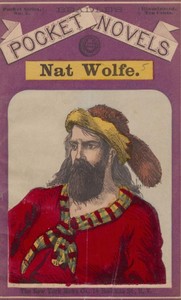
With rifle on shoulder and knife in belt, Nat Wolfe rode along carelessly, for it was midday, and the country was open. That caution which ten years of uncivilized life had taught him never entirely slumbered, and he gave a sharp glance ahead, when, upon turning a low bluff rising out of the plain just here, he descried travelers in advance of him. A moment assured him that they were a family of emigrants making their toilsome way to Pike's Peak. He had seen hundreds of such during the season; had sometimes aided them in cases of sickness and famine; and had cursed in his heart the folly of those men who had brought with them their women and children to share in the hardships of the journey.
The party he now observed was only one of multitudes presenting the same general features. There was a stout wagon, drawn by three pairs of lean oxen at a slow and lumbering pace--probably the last wagon of a train, as it was seldom that a family ventured upon crossing the plains alone. If so, the train was out of sight along the track, which here becomes less monotonous, winding among the bluffs and along the shallow bed of a river, in which, at present, no water was visible. The driver had attempted to lessen the difficult task of his team while ascending a long swell of ground, the heavy wheels of the wagon cutting deep in the sand, by dislodging the two women and three children from their seats in the conveyance. The sun was hot, the air languid, and there were no cool shadows of trees to break the heat and glare of the way. The two elder children, who were boys, ran on with spirit, but a four-year-old girl lagged behind and cried, while the women toiled on with listless, dragging steps. As Nat watched them, one of them stooped and took the poor little child on her back.
"It's too bad!" muttered he, spurring his horse forward.
The whole family looked back anxiously when they heard the clatter of horse's hoofs, the driver involuntarily reaching for his rifle, as the route was one of frequent danger and dread.
"Halloo, madam, let me carry your cub for you," called Nat riding up and lifting the child from the bent back to the neck of his strong animal.
There was a kindness in his voice which dispelled fear, even that of the shy little creature in his arm.
"Thank you, sir."
He looked down at the speaker curiously, for her tone and manner were unexpected. She was a girl, of not more than seventeen, slender, and with a face too quickly hidden again by the drooping and uncomely sun-bonnet, for him to realize fully its peculiar and melancholy beauty.
Nat Wolfe was a hater of Indians and hunter of bison, not a lady's man; so he rode in advance of the slouched sun-bonnet to the side of the wagon.
"Another fool!" was his curt, sarcastic greeting.
"I begin to think so myself," answered the emigrant, whose hollow cheeks and emaciated frame gave force to his disconsolate words. It was evident he had been sick on the way.
"Pike's Peak, I s'pose?"
"Yes."
"You're late in the season."
"Was down with the fever back to Pipe's Creek; kept us two weeks."
"Where's your company?"
"Just ahead. They're to stop at that little strip of cottonwoods we're coming to, for dinner. I hope they've found water for the cattle."
"Not a drop. You'll have to press on smartly if you reach water this evening. The nearest, on this trail, is fifteen miles beyond. I was over the route yesterday."
"Sho! the teams'll have a tough pull through this sand; they'd be glad of a drink now."
"What possessed you to bring this little thing along with you, stranger? It's bad enough for men, let alone wives and babies."
"That's so. But fact is, Meranda's got tol'able used to follering me about. When I fust went out to Indiana I left her to home in York, and she won't never be left behind sence. She's emigrated to Missouri with me, and two years ago to eastern Kansas, and now we're a-marching for the mines."
"Marching for the poor-house," growled Nat. "I'm a 'rolling stone' myself, but then I ain't a family man, and have a right to do as I please."
"Well, the fact is, things hain't prospered with us as they seem to with some people. We've had bad luck."
"And always will, I reckon," again muttered Nat, taking in at a shrewd glance the whole air of the man.
They had now reached the summit of the bluff, and at its foot, on the other side, along the edge of the stunted strip of wood which there freshened the eye, was drawn up the emigrant-train for a brief rest. The cattle were not unyoked, nor were there any fires kindled. The men were eating their cold bacon and hard bread, some lounging on the ground and some in their wagons. Only one woman was visible among the party of thirty or forty men, besides the two now trudging along by the last wagon. Nat did not resign the little girl until they came to the halting-place, when her father came and lifted her down.
"Won't you take a bite with us?" he asked, in return for Nat's civility.
"Obliged to you, stranger; but I've got a bit of dried buffalo in my pocket, and a biscuit."
Before dismounting and tying his horse to the low branches of a cottonwood, the hunter rode along the line of wagons to see if he knew any of the party. He had lived so long in that region that he was widely known, having a fame of his own which just suited his peculiar ambition, and which he would not have exchanged for that of General or Senator. So, although he was acquainted with none of the faces here, he was recognized by several, who greeted him heartily, and passed his name from lip to lip. The emigrants could not but feel braver and in better spirits when they heard that Nat Wolfe was among them.
As he lounged under a tree, against which he had carefully rested his rifle, cutting off bits of dried meat with the knife from his belt, he was surrounded by eager inquiries, asking after the route--with which they knew him to be familiar--about the water, the feed, the Indians, the streams, the storms, etc. While he talked, his eyes were constantly wandering to the little spot of shadow where the young girl was sitting, patiently feeding the little one, but seeming to eat nothing herself. She had thrown aside her bonnet to catch a breath of the light breeze springing up on the plains; her eyes were fixed afar off, on the heads of bison dotting the vast, monotonous desert, or the horizon, which ringed it in--except for the care of the child, she hardly took an interest in the scene more immediately about her. Whether it was the beauty of her face or its sad patience which touched him, Nat did not inquire of himself; he only wondered who she was and what she was doing in such a place. He could trace no resemblance between her and the thin, sun-burned, care-worn-looking woman by her side, the mother of the children, but evidently not of the young girl. They surely could not be sisters, for they were too unlike.
Neither the fierce sun, nor the fiercer wind of the prairies had spoiled the rich, dark hue of her skin, a clear olive on brow and temples, melting into a glow on either cheek. The melancholy eyes were large and dark, and floating in liquid fire--a fire that, however slumbering and repressed, seemed made to flash forth laughter and love. Her hair, instead of being neglected, as her present mode of life would have excused, or "done up," frontier-fashion, in a rude knot, was woven in glossy braids, wound tastefully about her head. The faded calico dress, awkwardly fitted as it was, could not conceal the rounded outlines of her form, any more than the coarse shoes and the wearisome journey could deprive her movements of their natural grace.
"See if he won't take a drink of this cold coffee, Elizabeth; it'll fresh him up more than whisky," spoke the older woman, pouring out a draught into a tin-cup, and giving it to the girl, who rose and approached Nat with the simple offering which testified their gratitude for the trifling kindness he had done them.
Too young and innocent to feel the full awkwardness of her position, in the midst of so many rough men, yet with a demeanor of shrinking modesty, she passed through the crowd surrounding the hunter, and gave him the cup.
"Thank you, child. It's just what I wanted to top off this salt meat," and drinking the beverage, Nat returned the cup to her hand with a smile which brought the flush to her cheeks.
"Pretty girl that," remarked one, as she retreated quickly.
"Yes," replied Nat, gravely, "and I wish she were where she ought to be, instead of in such company as this."
"So do we all," said another, warmly. "There's none of us would harm a hair of her head--and if we did, that uncle of hers would teach us better manners. He sets more store by her than by his own children, I do believe."
"Bosh! he hain't got spirit enough to take care of his own women-folks," added a third.
"So she's his niece?" queried Nat.
As he threw another admiring glance toward the maiden, he met one as admiring in return. Safe beside her aunt, she was regarding him shyly, and with something of interest lighting up the apathy of her expression.