Public-domain ebook
The Ring bonanza
by Otto Binder
English423 downloads on Project GutenbergDownload EPUB
Public-domain ebook sourced from Project Gutenberg #68700.
Public-domain ebook
by Otto Binder
English423 downloads on Project GutenbergDownload EPUB
Public-domain ebook sourced from Project Gutenberg #68700.
The opening · free to read
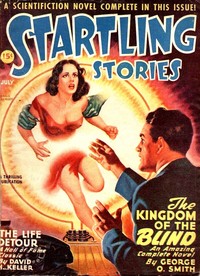
[Transcriber's Note: This etext was produced from Startling Stories, July 1947. Extensive research did not uncover any evidence that the U.S. copyright on this publication was renewed.]
The rings of Saturn stretched like a level sheet in all directions, though actually composed of millions of tiny bodies. Homer Timkin carefully braked with the nose rockets till he floated motionlessly with respect to the ring's own rotary motion around its primary. Then he eagerly donned his vac-suit.
Had he struck it rich this time? Through his binoculars, a moment ago, he had seen the glint of one small jagged lump among the ring debris--and it had glinted like gold or silver. There was vast treasure among the rings, if one could find it....
In his vac-suit he used his reaction pistol to propel him down toward the glinting mass. In his eagerness, he almost failed to see the other ring body which now hurtled up, pursuing its own independent orbit within the grander sweep of the rings.
Timkin braked with his reaction pistol only in time to let the marauder lumber past, scraping his foot. He let out his breath with a hiss. That had been close. Many a ring prospector never returned to the Titan docks, because of some such accident as this, creeping up on you unawares.
More than prospecting in earth's out-of-the-way spots had ever been it was a hazardous occupation among Saturn's rings. But it had its enticing rewards and lures. Some prospectors returned with a load of precious metals or uncut virgin diamonds that made them rich for life.
Timkin reached the glinting body he had previously spied. It was irregular in shape, some five feet in its greatest diameter. And it had a yellow tinge in the soft light shed by huge Saturn over his shoulder. Timkin permitted himself wild hope as he chipped off a piece with his belt pick. He held the chip up to his glassine visor, squinting at the grain.
His face fell slack.
"Fool's gold!" he muttered, flinging the piece away in a small fury.
It was just pyrites, worth a few cents a pound in the market and not worth the hauling. Timkin sat down on the miniature worldlet and cursed all the gods of luck and ill luck. He had been out a month now, and no bonanza. Of course, it had been so for the past ten years. Each year the old prospector hoped for his big find, and each year he only eked out a precarious living, picking up odd bits from the rings.
He looked with bleary eye over the plane of the rings, stretching vastly in all directions. Timkin was not young any more. His lean spare body could not stand the rigors of space much longer. His leathery, seamed face showed the strain of countless near-escapes from death. If he didn't strike it rich this trip he'd have to retire--poor. He'd be one of those derelicts, haunting the Titan docks and mooching meals.
He shuddered.
Hopelessly, he watched the endless parade of the rings. By far the most of their expanse was just worthless rock. Then he saw a jet black lump not far off. It was coal. Timkin grinned mirthlessly.
Coal had been used as an industrial fuel and chemical storehouse some 200 years ago. Today it was no more than a curiosity in museums. That was his luck--spotting things in the rings that would barely pay the expenses of his trip.
As he sat he also saw a whitish mass further along--fossil bones. And nearby, a dully shining angular object, probably a bit of machinery.
Sighing, Timkin got up. "Got to make expenses," he muttered. "Might as well collect those odds and ends."
His reaction pistol took him to the lump of coal. It was four feet in diameter but in weightless space it was no strain for Timkin to push it toward his ship and stow it through the back lock into the hold.
Then he went back for the space-bleached bones. Theory had it that there had once been a moon of Saturn within two-and-a-half diameters of the giant planet. Gravitational stresses had then exploded the moon into countless fragments, which took up the same orbit after spreading out and thus came to be the unique rings.
Seemingly, there had once been life, and civilization, on the destroyed moon. Fossil bones, once buried within the moon's crust, now floated within the ring debris--and bits of machinery of some vanished and unknown race. There was no oxygen or moisture in space to rust them and thus the metal remained perfectly preserved through eons of time.
Timkin looked musingly at the bones, as he shoved them to his ship. They made up part of the skeleton of an ancient creature that possibly resembled an earthly tiger. The Saturn Archeological Museum would pay five SS-dollars for this--Solar System Dollars, the standard currency. Not too bad.
Finally, Timkin got the bit of machinery. It consisted of a broken portion of a huge cogged wheel with dangling wires and bits of other enigmatic mechanical devices. Timkin wondered just how advanced the people had been who once inhabited the first moon. That was something even the experts didn't know with the few poor clues they had collected.
For a moment, Timkin's imagination wandered. He pictured life on the first moon, before the debacle. Towering cities--humming wheels--busy, industrious people. Then, abruptly, their world cracking apart, into a billion bits. And now only this remained ... the rings of Saturn.
As Timkin brought the broken wheel to his ship he took one last look around and saw another museum item. It had circled in slow gyrations and come into view from the back of his ship. Timkin got that too, perhaps the most intriguing find of the lot, for it was a stone with mysterious "writing" on it. The museum had quite a collection of such stones, evidently parts of temples or buildings.
Seemingly the people of the first moon had inscribed most of their stone walls with their writings. But these writings had never been translated. They were a riddle that baffled the best archeological minds of the System.
He also put this carved stone in the hold.
"Huh," he grunted. "I'm just a scavenger for the museum, that's what I am."
Timkin looked over the things crammed in his hold, gleaned from the rings for a month. Their total value would possibly pay for the trip with a few SS-dollars to spare. Yet one find of gold or precious stone and he would dump the whole mess out and be far the richer.
Growling to himself, Timkin took off his vac-suit and went to the controls. He debated. He still had food and fuel enough for three days before he had to return to the Titan docks. What should he do?
"I'm going to the Crêpe Ring," he finally told himself. "I had no luck in Rings A and B, so why not try C just to play it out to the finish?"
Timkin had started, a month ago, at the outer ring--Ring A. This portion of the rings had an outer diameter of 171,000 miles and extended inward toward Saturn for 11,100 miles.
Then there was a separation of 2,200 miles between rings A and B named Cassini's Division when first seen through earthly telescopes centuries ago.
Ring B was 145,000 miles, outer diameter, and some 18,000 miles wide. Another space of 1000 miles and then came Ring C or the Crêpe Ring, 11,000 miles wide. So had the rings of Saturn distributed themselves, under the laws of gravitation, when the first moon exploded ages before. The first moon had not been large, for the total mass of all the rings was estimated at no more than one-quarter of earth's moon.
Timkin urged his old rattletrap Jetabout up from the plane of the rings till he had a clear path before him and then jetted straight toward mighty Saturn, which hung in the sky like a bloated, vari-colored marble.
He crossed the narrow empty space between Rings B and C and finally cruised over the outer edges of the Crêpe Ring. Saturn was only 17,000 miles distant and Timkin could feel the faint tug of its powerful gravitation.
"Now," Timkin said between set teeth, "let's see if I have any luck. I've got three days to nose around through the Crêpe Ring, searching. I know there's gold or diamonds ahead ... if I can just stumble on them."
As he slowly cruised above the Crêpe Ring, with his binoculars to his eyes, Timkin munched a sandwich and now and then took a swig of coffee. In all their explorations of other worlds earthmen had never found any beverage better than time-honored coffee, though the Martians tried hard to sell a green-tinted product called tukka.
Timkin's hand gave a little jerk, and his binoculars wavered. Watching him one would have thought he had spied something exciting--like gold. But it was something else, almost equally as startling....
"Another Jetabout!" Timkin murmured. "Gave me a start, seeing it so suddenly."
It was a rare event when two wandering Jetabouts happened to cross paths in the vast area of the rings, almost like two explorers in the heart of Africa meeting each other. Timkin grinned humorlessly.
"Another chump!" he thought. "He wouldn't have a bonanza, or he'd be streaking back for Titan. He's cruising and looking for something like me."
The book keeps going
Reading is free forever. Sign up and watch scenes appear while you read.



Scenes Storieta drew for other classics.
New illustrated classics
Once or twice a month: the latest books to get full character casts, scene art, and free comic editions. No account needed.