Public-domain ebook
History of the Sabbath and first day of the week
Language: en4,381 downloads on Project Gutenberg
Subjects
In: History - Ancient·History - Religious·Religion/Spirituality
Public-domain ebook sourced from Project Gutenberg #68714.
Public-domain ebook
Language: en4,381 downloads on Project Gutenberg
Subjects
In: History - Ancient·History - Religious·Religion/Spirituality
Public-domain ebook sourced from Project Gutenberg #68714.
John Nevins Andrews’ work is a scholarly treatise that sets out to trace the Sabbath from its biblical origins through the sweep of secular history, culminating in an examination of how the first‑day observance supplanted it. The opening pages lay out a sweeping premise: the seventh day was instituted by the Creator at the very dawn of time, blessed, sanctified, and upheld by Adam, the patriarchs, the prophets, the apostles and even the Son of God himself. Andrews promises a three‑part structure, first a detailed biblical history, then a chronological survey of secular sources, and finally a comparative analysis of the rise of the Sunday “festival.” He signals a methodical approach, citing original authorities and promising faithful quotations, while also asserting that the Sunday movement rests on “frauds and iniquities.” The book therefore positions itself as a comprehensive defense of the Sabbath’s divine mandate.
Written in the earnest, polemical style of late‑nineteenth‑century Protestant scholarship, the text combines extensive scriptural exegesis with historical documentation, reflecting the author’s background as a Seventh‑Day Adventist theologian. Its language is formal and didactic, aiming to persuade readers of a theological conviction through meticulous argumentation. Readers who appreciate rigorous theological history, especially those interested in Adventist doctrine, Sabbath observance, or the development of Christian liturgical practice, will find Andrews’ exhaustive research and earnest advocacy compelling.
The opening · free to read
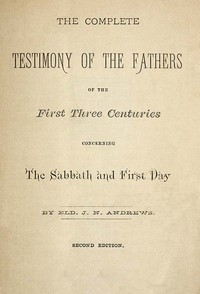
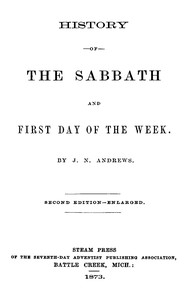
HISTORY OF THE SABBATH AND FIRST DAY OF THE WEEK.
BY J. N. ANDREWS.
SECOND EDITION—ENLARGED.
STEAM PRESS OF THE SEVENTH-DAY ADVENTIST PUBLISHING ASSOCIATION, BATTLE CREEK, MICH.:
1873.
PREFACE.
The history of the Sabbath embraces the period of 6000 years. The seventh day is the Sabbath of the Lord. The acts which constituted it such were, first, the example of the Creator; secondly, his placing his blessing upon the day; and thirdly, the sanctification or divine appointment of the day to a holy use. The Sabbath, therefore, dates from the beginning of our world’s history. The first who Sabbatized on the seventh day is God the Creator; and the first seventh day of time is the day which he thus honored. The highest of all possible honors does, therefore, pertain to the seventh day. Nor is this honor confined to the first seventh day of time; for so soon as God had rested upon that day, he appointed the seventh day to a holy use, that man might hallow it in memory of his Creator.
This divine appointment grows out of the nature and fitness of things, and must have been made directly to Adam, for himself and wife were then the only beings who had the days of the week to use. As it was addressed to Adam while yet in his uprightness, it must have been given to him as the head of the human family. The fourth commandment bases all its authority upon this original mandate of the Creator, and must, therefore, be in substance what God commanded to Adam and Eve as the representatives of mankind.
The patriarchs could not possibly have been ignorant of the facts and the obligation which the fourth commandment shows to have originated in the beginning, for Adam was present with them for a period equal to more than half the Christian dispensation. Those, therefore, who walked with God in the observance of his commandments did certainly hallow his Sabbath.
The observers of the seventh day must therefore include the ancient godly patriarchs, and none will deny that they include also the prophets and the apostles. Indeed, the entire church of God embraced within the records of inspiration were Sabbath-keepers. To this number must be added the Son of God.
What a history, therefore, has the Sabbath of the Lord! It was instituted in Paradise, honored by several miracles each week for the space of forty years, proclaimed by the great Law-giver from Sinai, observed by the Creator, the patriarchs, the prophets, the apostles, and the Son of God! It constitutes the very heart of the law of God, and so long as that law endures, so long shall the authority of this sacred institution stand fast.
Such being the record of the seventh day, it may well be asked, How came it to pass that this day has been abased to the dust, and another day elevated to its sacred honors? The Scriptures nowhere attribute this work to the Son of God. They do, however, predict the great apostasy in the Christian church, and that the little horn, or man of sin, the lawless one, should think to change times and laws.
It is the object of the present volume to show, 1. The Bible record of the Sabbath; 2. The record of the Sabbath in secular history; 3. The record of the Sunday festival, and of the several steps by which it has usurped the place of the ancient Sabbath.
The writer has attempted to ascertain the exact truth in the case by consulting the original authorities as far as it has been possible to gain access to them. The margin will show to whom he is mainly indebted for the facts presented in this work, though it indicates only a very small part of the works consulted. He has given the exact words of the historians, and has endeavored, conscientiously, to present them in such a light as to do justice to the authors quoted.
It is not the fault of the writer that the history of the Sunday festival presents such an array of frauds and of iniquities in its support. These are, in the nature of the case, essential to its very existence, for the claim of a usurper is necessarily based in fraud. The responsibility for these rests with those who dare commit or uphold such acts. The ancient Sabbath of the Lord has never needed help of this kind, and never has its record been stained by fraud or falsehood.
J. N. A.
Battle Creek, Mich., Nov. 14, 1873.
The book keeps going
Reading is free forever. Sign up and watch scenes appear while you read.



Scenes Storieta drew for other classics.
New illustrated classics
Once or twice a month: the latest books to get full character casts, scene art, and free comic editions. No account needed.