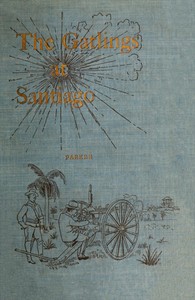
On the morning of July 1st, the dismounted cavalry, including my regiment, stormed Kettle Hill, driving the Spaniards from their trenches. After taking the crest, I made the men under me turn and begin volley-firing at the San Juan Blockhouse and intrenchments against which Hawkins’ and Kent’s Infantry were advancing. While thus firing, there suddenly smote on our ears a peculiar drumming sound. One or two of the men cried out, “The Spanish machine guns!” but, after listening a moment, I leaped to my feet and called, “It’s the Gatlings, men! It’s our Gatlings!” Immediately the troopers began to cheer lustily, for the sound was most inspiring. Whenever the drumming stopped, it was only to open again a little nearer the front. Our artillery, using black powder, had not been able to stand within range of the Spanish rifles, but it was perfectly evident that the Gatlings were troubled by no such consideration, for they were advancing all the while.
Soon the infantry took San Juan Hill, and, after one false start, we in turn rushed the next line of block-houses and intrenchments, and then swung to the left and took the chain of hills immediately fronting Santiago. Here I found myself on the extreme front, in command of the fragments of all six regiments of the cavalry division. I received orders to halt where I was, but to hold the hill at all hazards. The Spaniards were heavily reinforced and they opened a tremendous fire upon us from their batteries and trenches. We laid down just behind the gentle crest of the hill, firing as we got the chance, but, for the most part, taking the fire without responding. As the afternoon wore on, however, the Spaniards became bolder, and made an attack upon the position. They did not push it home, but they did advance, their firing being redoubled. We at once ran forward to the crest and opened on them, and, as we did so, the unmistakable drumming of the Gatlings opened abreast of us, to our right, and the men cheered again. As soon as the attack was definitely repulsed, I strolled over to find out about the Gatlings, and there I found Lieut. Parker with two of his guns right on our left, abreast of our men, who at that time were closer to the Spaniards than any others.
From thence on, Parker’s Gatlings were our inseparable companions throughout the siege. They were right up at the front. When we dug our trenches, he took off the wheels of his guns and put them in the trenches. His men and ours slept in the same bomb-proofs and shared with one another whenever either side got a supply of beans or coffee and sugar. At no hour of the day or night was Parker anywhere but where we wished him to be, in the event of an attack. If a troop of my regiment was sent off to guard some road or some break in the lines, we were almost certain to get Parker to send a Gatling along, and, whether the change was made by day or by night, the Gatling went. Sometimes we took the initiative and started to quell the fire of the Spanish trenches; sometimes they opened upon us; but, at whatever hour of the twenty-four the fighting began, the drumming of the Gatlings was soon heard through the cracking of our own carbines.
I have had too little experience to make my judgment final; but certainly, if I were to command either a regiment or a brigade, whether of cavalry or infantry, I would try to get a Gatling battery—under a good man—with me. I feel sure that the greatest possible assistance would be rendered, under almost all circumstances, by such a Gatling battery, if well handled; for I believe that it could be pushed fairly to the front of the firing-line. At any rate, this is the way that Lieut. Parker used his battery when he went into action at San Juan, and when he kept it in the trenches beside the Rough Riders before Santiago.
Theodore Roosevelt.
Map—Santiago and Surrounding Area.
The history of the Gatling Gun Detachment, Fifth Army Corps, is to a certain extent the history of the Santiago campaign. The detachment was organized on the spur of the moment, to utilize material which would otherwise have been useless, and was with the Fifth Corps in all the campaign. It participated in all the fighting of that campaign, except the fight at La Guasimas, and was disbanded upon the return of the Fifth Corps to Montauk. Whatever hardships were endured by the Fifth Corps were shared by this detachment; whatever dangers were faced by the Fifth Corps were faced by it also; where the hottest fighting occurred this detachment went in and stayed; and at the surrender it was paraded, to use the words of General Shafter, “Upon that portion of the line which it occupied so promptly and defended so well.”
But this memoir is not intended as a history of that campaign nor of the Fifth Corps. The author has not the data available to cover so large a field, nor the ability to do justice to the courage, fortitude, and endurance so heroically displayed by that gallant army. That story will be written by abler pens, and will be the wonder of the world when it is told.
This story is that of an experiment. It is told to lay before the general public, as well as the military critic, the work of a little detachment of thirty-seven men, armed with an untried weapon, organized in the short space of four days preceding July 1, 1898, and which without proper equipment, adequate instruction, or previous training, in the face of discouragements and sneers, and in spite of obstacles enough to make the mere retrospect sickening, still achieved for itself a warm place in the hearts of all true soldiers, and covered itself with glory upon the hardest fought battle-field of the Hispano-American War.
This story is to commemorate the gallantry of the enlisted men who helped to make history and revolutionize tactics at Santiago. It will tell of the heroism of the plain American Regular, who, without hope of preferment or possibility of reward, boldly undertook to confute the erroneous theories of military compilers, who, without originality or reason, have unblushingly cribbed the labored efforts of foreign officers, and foisted these compilations of second-hand opinions upon the American Army as military text-books of authority and weight. These literary soldiers declared, following the lead of their foreign guides, that “The value of machine guns on the battle-field is doubtful,” and that “Their offensive value is probably very small.” They also agreed, with most touching unanimity, that “A direct assault upon a fortified position, occupied by good, unshaken infantry, armed with the modern rifle and plentifully supplied with ammunition is sure to fail, unless made by overwhelming numbers and prepared by strong and accurate fire by artillery.”
These servile imitators of foreign pen soldiers were destined to see all their pet theories exploded by the grim old mountain puma from California and his brave Fifth Corps. They were to learn, so far as they are capable of learning, that the American Regular makes tactics as he needs them; that the rules of war established by pen soldiers do not form the basis of actual operations in the field; that theories must go to the wall before the stern logic of irrefutable facts; and that deductions based on the drill-made automatons of European armies are not applicable to an army composed of American Volunteer Regulars, led by our trained officers.
We shall see that an army destitute of cavalry, and hence without “eyes”; not supported by artillery; in the most difficult country over which soldiers ever operated, and without maps or reconnaissance—in twenty days shut up and captured an army of twice its own effective strength, in a strongly fortified city, with better served and more numerous artillery.
We shall find that when the “sledge” was not at hand, American ingenuity was able to use the “mallet” instead, making light machine guns perform all the function of artillery, and dispensing altogether, so far as any practical results were concerned, with that expensive and much overrated arm; that the Regular private is capable of meeting all demands upon his intelligence, and that the American non. com. is the superior of foreign officers.
It is also hoped to place before the intelligent American public some correct ideas of the new arm which was tried thoroughly at Santiago for the first time in the history of the world. The machine gun is the latest practical product of American inventive genius applied to war. The first form of this weapon tried, the mitrailleuse, was not very successful. It failed, not on account of faults of construction, or imperfect mechanism, but because its proper tactical employment had not been thought out by the French army. Since that time machine guns have been greatly improved, but no one has succeeded in making their great value appreciated by military authorities. The failures of the French brought the gun into disfavor, and created a prejudice against its employment.
The Artillery of the world, which poses in every country as an élite body of scientific fighters, and is often found on the battle-field to be an aggregation of abstruse theorists, were jealous and contemptuous. They said, “See how easily the artillery knocked out machine guns at Gravelotte.” The Cavalry of the world, famous everywhere for an esprit-du-corps which looks haughtily down on all other arms of the service, were too deeply absorbed in the merits of saber vs. revolver, and in the proper length of their spectacular plumes, to give a second thought to this new, untried, and therefore worthless weapon. The world’s Infantry, resting upon the assumption that it is the backbone of all armies, and the only real, reliable fighting body under all conditions, left the consideration of these vague dreams of mechanical destructiveness to lunatics, cranks, and philanthropists.
In our own country the Ordnance Department, which is the trial court before which all military inventions must appear, scouted the idea of usefulness of machine guns even after war was declared, and adhered to the view that machine guns, in the very nature of things, could never be useful except in the defense of fortified positions; that they never could be brought up on the battlefield, nor used if they were brought up. This view was that of a prominent young officer of that department who wrote a report on the subject, and it seemed to express the views of the department.
This view must have been that of our War Department, for it did not even acknowledge the receipt of drawings and specifications for a machine gun carriage, offered freely to the Government as a gift by the inventor six months before the war, together with the first correct tactical outline of the proper use of machine guns ever filed in any War Office in the world. This invention was designed to facilitate the use of the machine gun by making its advance with the skirmish line possible on the offensive, and was recommended by the whole staff of the Infantry and Cavalry School as a meritorious device, worthy of trial. The discussion filed with the invention pointed out, for the first time, the correct tactical employment of the weapon, and staked the military reputation and ability of the author and inventor on the correctness of his views.